“The good or ill accidents of life are very little at our disposal; but we are pretty much masters what books we shall read, what diversions we shall partake of, and what company we shall keep.” —David Hume, “Of the Delicacy of Taste and Passion”
“He moves like he’s being yelled at by invisible people whom he hates but whom he basically agrees with.” —Mary Gaitskill, Veronica
Social media for thee but not for me.
“I wanted to hide so that I could get busy at my real work, which was a sort of wooing of distant parts of myself.” —Alice Munro, “Miles City, Montana”
“It is said that Balzac on his deathbed inquired anxiously after the health and prosperity of characters he had created.” —John Le Carré, The Spy Who Came in from the Cold
“I believe one reason why Americans look so careworn is because they all feel so intensely the responsibility of governing the country.” —Barbara Leigh Smith Bodichon, journal, 27 December 1857
“A sort of alter-egotism in the book was unavoidable.” —F. L. Olmsted, A Journey through Texas
“It is pleasant to embark on a voyage, if only for a short river excursion, the boat to be your home for the day, especially if it is neat and dry. A sort of moving studio it becomes, you can carry so many things with you. It is almost as if you put oars out at your windows and moved your house along.” —Henry D. Thoreau, journal, 31 August 1852
“What person, for example, could possibly be so comforting as one’s bed?” —Barbara Pym, Crampton Hodnet
“And you know how it is with charm—the more you distrust it the more it excites you.” —Thom Gunn to Douglas Chambers, 18 May 2001
“History was mysterious, the remembrance of things unknown, in a way burdensome, in a way a sensuous experience. It uplifted and depressed, why he did not know, except that it excited his thoughts more than he thought good for him. This kind of excitement was all right up to a point, perfect maybe for a creative artist, but less so for a critic. A critic, he thought, should live on beans.” —Bernard Malamud, “The Last Mohican”
One of the very few advantages of having a brain like mine is that when you’re listening to the Allegro of the Divertimento #3 in F major, you notice that Mozart is borrowing a melody from Cheap Trick.
“One never knows, Craft, whether what happens to one is, in the final analysis, good or bad.”
“Usually it’s bad,” replied the other coldly as he went up to the looking-glass and adjusted the knot of his white tie.
—Eça de Queiroz, The Maias
“The body grows weaker, but gazing at the mountains remains the same.” —Eliot Weinberger, The Life of Tu Fu
“In film, tricks win over truth. They provide the variations, the dimension and depth.” —Jean Cocteau, Diary of a Film
“After talking with Uncle Charles the other night about the worthies of the country, Webster and the rest, as usual, considering who were geniuses and who not, I showed him up to bed, and when I had got into bed myself, I heard his chamber door opened, after eleven o’clock, and he called out, in an earnest, stentorian voice, loud enough to wake the whole house, ‘Henry! was John Quincy Adams a genius?’ ‘No, I think not,’ was my reply. ‘Well, I didn’t think he was,’ answered he.” —Thoreau, journal, 1 January 1853 (N.B.: Uncle Charles had found the vein of graphite that became the basis for the family’s pencil-making business)
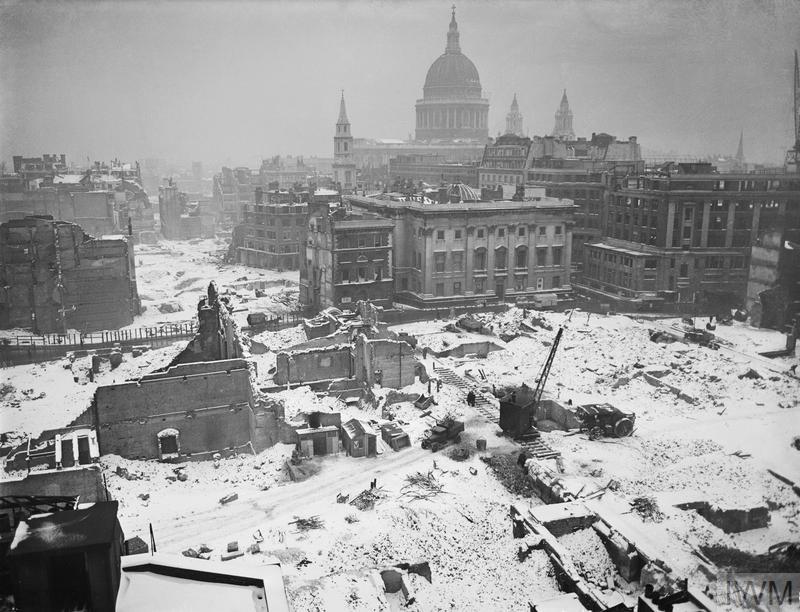
“Bomb Damage in London, January 1942,” Imperial War Museums (D 6412)
Every poem has a purpose, William Wordsworth says in the preface to Lyrical Ballads, the poetry collection he collaborated on with Samuel Taylor Coleridge. This probably isn’t what most people remember him saying. More memorable are his claims that poetry should be written in “the real language of men” (i.e., not in self-consciously poetic diction), that poetry consists of “the spontaneous overflow of powerful feelings,” and that poems are made out of “emotion recollected in tranquility.” His claim about purpose, which is abstract and slightly odd, is easy to forget.
According to Wordsworth, the purpose of a poem is “to illustrate the manner in which our feelings and ideas are associated in a state of excitement.” This is so bland that a reader’s eye impatiently skips over it. It’s less pithy and much less amenable to conceptual handling than, say, Horace’s idea that literature is supposed to delight and instruct. Don’t people always experience feelings and ideas in association with other feelings and ideas? Excitement, by the way, is notwhat makes poetry poetry, Wordsworth goes on to say. To the contrary! He’s against sensationalism (“this degrading thirst after outrageous stimulation”); he deprecates the idea that extreme subject matter—death, violence, lust—makes a work of literature valuable or interesting. In good poems—in his poems—“the feeling therein developed gives importance to the action and situation, and not the action and situation to the feeling.”
If a little girl dies in a snowstorm, in other words, Wordsworth writes a poem not for her sake but in order to find out what he thinks and feels about it. The narcissism of this is wonderfully Wildean, though maybe this is the case with all true literature. The specifics of what Wordsworth seems to mean are both subtle and impossibly grandiose. “I believe,” he writes, “that my habits of meditation have so formed my feelings, as that my descriptions of such objects as strongly excite those feelings, will be found to carry along with them a purpose.” Purpose here seems to be almost an aftereffect of sensibility. It isn’t a specific aim, but a sense of having an aim—a feeling of meaningfulness. The events that inspire a poem are more or less arbitrary. What matters is the nature of the mind excited by the events, a nature revealed through the choices the mind makes as it does its describing. “Nature,” by the way, is probably the wrong word. The mind in question has been formed, given shape and edge by a kind of study—by long-continued effort to enhance and structure its receptivity. One implication of this theory is that at the moment of a poem’s creation, the poet may not have much control. His conscious labor, to the extent that volition comes into play at all, has to happen earlier: in the years leading up to that moment, years the poet spent cultivating an openness to feelings and to the beauty of the world.
Though Wordsworth never quite out and says it, the purpose of a poem is to show the mind of the poet, to show the resonances that his way of life has given to his sensibility. A great poet, Wordsworth writes (his grandiosity flushed out into the open by the imperative to explain what he’s trying to do), has “a more comprehensive soul.” He is distinguished by his “greater readiness and power in expressing what he thinks and feels, and especially those thoughts and feelings which, by his own choice, or from the structure of his own mind, arise in him without immediate external excitement.” Notice that by this point in Wordsworth’s explanation, excitement is by the way, and any real events that cause excitement are almost regrettable, maybe even a little vulgar. In several passages in the preface, in fact, Wordsworth stresses that the poet probably can’t and maybe shouldn’t make poetry directly out of his feelings about real events, not even when the events have happened to him personally. Instead the poet is to use doubles or mirrors or imagined representations of original feelings. Even when the poem is about his own emotions, he is to work from “an emotion, kindred to that which was before the subject of contemplation.” The doubling distances the poet from reality, and in Wordsworth’s opinion, this distance is to the good. Meter further de-realizes a poem. No one in real life consistently speaks in meter, after all. “The co-presence of something regular,” Wordsworth writes (a lovely phrase!), soothes and reassures in cases where too sharp an apprehension of reality would be distressing.
Not long ago I read the poet Thom Gunn’s letters, and because Gunn was an enthusiast, who raved to friends about his favorite music, movies, novels, and gay bars (including a bar in New York’s East Village that was a favorite of mine, too, at the time he was writing about it, the mid-1990s—though I never ran into him; I biked past it yesterday; it’s a bodega now), I found myself taking notes. To read, on Gunn’s recommendation: Basil Bunting’s Briggflatts. Robert Duncan’s Opening of the Field. Marianne Moore’s Observations. And a Wordsworth poem that Gunn wrote to Robert Pinsky about, in June 1989:
I did find a wonderful poem by Wordsworth I’d never read before, “St Paul’s,” written 1808, not published till 1947. . . . I have never really been able to figure W out. . . . the Lucy poems leave me feeling that it’s possible to be too artless . . . I know how Keats’s worst poetry is connected to his best (it would be possible to make a kind of spectrum), but I don’t know how W goes from his worst (or even his average) to his best. It’s as if, once in an age, he is suddenly able to find a tune which matches his complete intentness of feeling. As in this poem. [Gunn, Letters 467]
Wordsworth’s unevenness is one of the mysteries about him. For pages and pages he writes about clouds floating through his mind that he happens to find morally significant, the verse as flocculent as the subject—and then a gust lifts his kite into the sun, and he makes you want to cry. (Or makes me want to, anyway. A friend of mine who’s a beautiful poet is so immune to his intermittent charm that she can’t understand how I can bear him.)
“St. Paul’s” was written in Grasmere, the village in the Lake District where Wordsworth and his sister, Dorothy, lived, in the spring of 1808. It describes the end of a trip to London. Wordsworth had traveled there to find a publisher for The White Doe of Rylstone, a long historical poem of his that he and Dorothy were hoping would bring in money. Unfortunately for Wordsworth’s bargaining position, a two-volume collection of his poems, published the year before, had sold poorly. Byron had trashed it as “namby-pamby,” and was not the only reviewer to have been unkind. Wordsworth made his bargaining position even weaker by refusing to let his editor read the manuscript before bidding on it. “Without money what can we do?” Dorothy wrote to him, in exasperation, when she heard he was being difficult.
New House! new furniture! such a large family! two servants and little Sally! we cannot go on so another half-year. . . . Do, dearest William! do pluck up your Courage—overcome your disgust to publishing . . . [quoted in Gill, William Wordsworth: A Life 1990: 265]
A second object of this London trip was to visit Coleridge, who was ailing. The Royal Institution had commissioned Coleridge to deliver twenty-five lectures on poetry, but Coleridge had had a breakdown—vomiting, diarrhea, paralyzing anxiety—and was dosing himself with hensbane, rhubarb, magnesia, and laudanum. He dodged Wordsworth’s first attempts to pay a visit, maybe because he sensed that Wordsworth felt he should be making more of an effort to wean himself off the opiates. Over the years, a fair amount of tension had developed between the two—the one an industrious if underpaid tribune of sanity, and the other a chaotic and irresolute prophet of imagination. They had started to get on each other’s nerves. During this visit to London, Wordsworth, ever the philosophical egotist, declared that he did “not see much difficulty in writing like Shakespeare,” and the essayist Charles Lamb reported in a letter, with amusement, that Coleridge was “a little checked by this hardihood of assertion.”
While Wordsworth was in town, Coleridge’s health improved enough for him to throw a tea party, which he presided over from bed, swaddled in sheets and blankets, and to resume his lectures. In the third lecture, which Wordsworth attended, Coleridge quoted a poem of Wordsworth’s about daffodils (“I wandered lonely as a cloud”) as an example of the power of imagination. In his fourth, on April 2, he praised poetry’s “power of so carrying the eye of the Reader as to make him almost lose the consciousness of words—to make him see everything” [quoted in Holmes, Darker Reflections 115–27].
The peroration must have been echoing in Wordsworth’s ears when he left London the next day, April 3. He left Coleridge’s apartment “at 7 o’clock on Sunday morning . . . in a very thoughtful and melancholy state of mind,” he was to write to his friend Sir George Beaumont on April 8, in a letter that shares so much of the phrasing of “St Paul’s” that it could be considered a dry run in prose. [Joseph F. Kishel, ed., The Tuft of Primrose 1986: 3] (Maybe this is the secret of Wordsworth’s breakthroughs—that they are poems he first worked out in prose? Call it the Edward Thomas method.) He hadn’t found a buyer for the White Doe. He was leaving the manuscript behind with Coleridge, who was under the impression that Wordsworth wanted him to try to sell it. (When Coleridge did negotiate a sale, about a month later, Wordsworth was to declare that he hadn’t wanted him to and to hurt Coleridge’s feelings by canceling the deal.) In Grasmere, Wordsworth knew, a family friend had been coughing up blood, and when he arrived home, he was to find his son John gravely ill with meningitis. Failure and loss, vocational and personal, threatened on all sides. Here is how the poem begins:
Pressed with conflicting thoughts of love and fear
I parted from thee, Friend,
Wordsworth addresses the poem to Coleridge, without naming him. Also unnamed are the specific thoughts of love and fear in his mind. Had he already been thinking of Coleridge, consciously or unconsciously, in the prose version he sent to Beaumont? Had he been thinking of him but reluctant, because of the rivalry between them and the growing difference in their ways of life, to write to him? It’s also possible, of course, that in both versions, Wordsworth is speaking mostly to himself. A public letter is usually meant for its addressee only in a sort of ostensible, fictional way. It is not an accident that the poem starts with parting.
and took my way
Through the great City, pacing with an eye
Downcast, ear sleeping, and feet masterless
That were sufficient guide unto themselves,
And step by step went pensively.
Eye, ear, feet. This is a poem of detachment—of things taken apart and seen, at least for a moment, only for themselves. The poet’s body is here disassembled, and from each component, the corresponding faculty is taken away. Vision declines, hearing goes dormant. Feet are left to find their own way. The poet is dropping into a state that is the opposite of poetic intensity. His senses are lessened; his mind is growing inattentive, less present. In dejection and exhaustion, he is shutting the world out. Reducing himself, absenting himself. According to Wordsworth’s preface, a poet is supposed to have a sensibility across which the events of the world play, like a breeze across a wind chime. Wordsworth has sunk here to sensibility at degree zero, if not below zero. He is closed, empty. Even in this hollowed, slumbrous state, however, there’s a shut-down, depressive, lumbering majesty to the rhythm.
Now, mark!
Not how my trouble was entirely hushed,
(That might not be) but how, by sudden gift,
Gift of Imagination’s holy power,
My Soul in her uneasiness received
An anchor of stability.
From inattention, pay attention! From this point on, the poem is built out of appositives, noun phrases placed one after the other so that the second modifies or clarifies the first, a grammatical structure that suggests addition and also unfolding. A word in one line bumps into, and opens up into, an idea in the next. Here, for example, the words “sudden gift” hit up against, and give way to, the phrase “gift of Imagination’s holy power.”
The idea here about beauty—that perceiving it can restore, at least for a moment, a person’s balance—seems like it must be an old one. Plato wrote in the Phaedrus about beauty as the inspiration for art, but for Wordsworth, the apprehension of beauty is much less erotic than what Plato describes, and the benefit is more sharply limited: a temporary finding of one’s center, and no more. Of this hedged, disillusioned version of the idea, Wordsworth’s might the earliest formulation. The poet Charles Reznikoff, in his novel By the Waters of Manhattan(1930), gives it to his hero, Ezekiel: “To see a painting or a statue, he thought, and then to look out of the window, is to see how fresh and richer life itself is.” Ezekiel remembers coming across the idea in the work of a “German philosopher” (who may have been Schopenhauer, but I haven’t read Schopenhauer). The idea recurs again in the novelist Iris Murdoch’s philosophical treatise The Sovereignty of Good (1970): “I am looking out of my window in an anxious and resentful state of mind, oblivious of my surroundings, brooding perhaps on some damage done to my prestige. Then suddenly I observe a hovering kestrel. In a moment everything is altered. The brooding self with its hurt vanity has disappeared. There is nothing now but kestrel. And when I return to thinking of the other matter it seems less important.”
— It chanced
That while I thus was pacing, I raised up
My heavy eyes and instantly beheld,
Saw at a glance in that familiar spot
A visionary scene—a length of street
Laid open in its morning quietness,
Deep, hollow, unobstructed, vacant, smooth,
Another appositive, but with verb phrases instead of noun phrases: “instantly beheld” bumps into and opens up into “Saw at a glance in that familiar spot / A visionary scene.” Then comes an incantatory line of five adjectives in a row, suspended from the normal rules of poetic meter. Somehow we accept the four syllables of the word “unobstructed” as a single beat. The adjectives refer backwards to the noun “street” two lines above, as if they descend from it or radiate from it, the way snowflakes descend and radiate from the sky, each becoming, as it does, a potential independent focus of attention.
And white with winter’s purest white, as fair
As fresh and spotless as he ever sheds
On field or mountain.
I’m ruining the poem a little bit, of course, by glossing it like this—by saying explicitly that what we’re seeing here is snow, when Wordsworth chooses to withhold the word “snow” until the poem’s last moment, when it arrives like a ratification. Note that at this point Wordsworth has only revealed one element of the “visionary scene,” the (snow-covered) street.
Moving Form was none
Save here and there a shadowy Passenger
Slow, shadowy, silent, dusky,
A second incantation. Again the words break meter; the word “shadowy” is made to last as long as the word “slow.” Wordsworth isn’t shy about repeating the word “shadowy,” just as he isn’t about repeating the words “gift,” “pacing,” and “white” earlier in the poem, or the words “street,” “silent,” and “veil” later. One senses that the moving form, who is and isn’t here, is a double of Wordsworth. A self that has become diminished, a self somewhat disavowed.
and beyond
And high above this winding length of street,
This moveless and unpeopled avenue,
Pure, silent, solemn, beautiful,
A third incantation. The eye has taken in, as it rises, first the street, second the walker, and now, third, . . . Without yet knowing what the third element is, we are told about its silence and purity, qualities it shares, we sense, with the snow.
was seen
The huge majestic Temple of St Paul
In awful sequestration, through a veil,
Through its own sacred veil of falling snow.
Maybe the street represents a journey, and the passenger, the self who is taking the journey. One thinks of Keats’s speculation that this world is a “vale of soul-making.” London, for the moment, was that vale, for Wordsworth. Is that the meaning of the scene’s third element—is St. Paul’s the soul that Wordsworth is journeying toward? T. E. Hulme’s famous objection to Romanticism, which he dismissed as “spilt religion,” was that the Romantic aesthetic deliberately makes it impossible to answer such a question; the referent of such a signifier is kept vague in order to suggest that “man, the individual, is an infinite reservoir of possibilities,” as Hulme put it, which Hulme, a political conservative, didn’t think man was. Literally, of course, St. Paul’s is a cathedral, a “temple” as the poem says. To use the seat of religious authority in one’s country as a symbol of the infinite in oneself—a conservative wouldn’t have liked that one bit. Does the cathedral here represent the vocation of poetry? Is it a version of Wordsworth’s self that could survive not being paid, that could rise above not being understood? Superimposed on the cathedral are traces of another image: a person behind a veil, probably a woman, kept apart for reasons of ritual. In awful sequestration. A person initiated in the mysteries. Kept pure. Alone. Apart from Coleridge, apart from Dorothy, apart from wife and child. Maybe Wordsworth was having a vision of the sensibility he believed it was his calling to develop in himself, of the vital texture of associations that he thought gave him his purpose in the world. He couldn’t ever rely on seeing it, and he couldn’t consistently summon it, but at moments, unexpectedly, it was revealed.
“I will have free speech at my meetings,” the statuesque teenage heiress Eugenia Malmains insists, in Nancy Mitford’s 1935 novel Wigs on the Green. Eugenia, a fascist, has been interrupted mid-harangue by her nanny, who thinks Eugenia is disgracing herself. Eugenia proceeds to threaten her nanny with violence: “Now will you go of your own accord or must I tell the Comrades to fling you out?”
From time immemorial, the rage of fascists has styled itself as more-grown-up-than-thou, but in feeling-tone it in fact more closely resembles that of teenagers—grandiose, spirally, counterdependent. If only we lived in a world where it was safe to believe that it was just as harmless! And if only the right little old lady could be found to tug every fascist down from her washtub. Further deflating fascism’s pretensions in this particular case: In Mitford’s novel, Eugenia is seen largely through the eyes of two gold-digging cads, Jasper Aspect and Noel Foster, who don’t take her politics very seriously (“batty” is the word one of them uses) because they regard her not as a person but as an opportunity to marry into the moneyed aristocracy.
“Oh! I think that’s all a joke,” a middle-class woman in the novel protests, when her left-wing bohemian-artist friends upbraid her for being swept up in the fascist excitement. But what kind of a joke is it, exactly? Some of the novel’s humor takes advantage of fascism’s abrupt rhetorical extremes. On several occasions, Eugenia calls for “jackshirt justice,” i.e., beatings or worse, but when a flapper heiress wants to ditch a husband who has grown tiresome, Eugenia insists on the sanctity of marriage. “Well, well, what a governessy little thing it is,” Jasper observes. Even from the distance of nearly a century, Mitford makes clear how hackneyed and familiar fascist language was, much as it has become to us in the past few years. “Let me see, where had I got to—oh! yes,” Eugenia resumes, once she has surmounted her nanny’s interruption:
Patriotism is one of the primitive virtues of mankind. Allow it to atrophy and much that is valuable in human nature must perish. This is being proved today, alas, in our unhappy island as well as in those other countries, which, like ourselves, still languish ‘neath the deadening sway of a putrescent democracy. Respect for parents, love of the home, veneration of the marriage tie, are all at a discount in England today, society is rotten with vice, selfishness, and indolence.
Viktor Orban could do no better. An idealized past? Check. A hearkening back to patriarchal morals? Check. A jeremiad against sexual sophistication? Check. Scorn for democracy? Check. Fetishization of patriotism and strength? Check. Not to mention indignant cries of “free speech” at even the mildest interruption.
Even the great replacement theory, as it is now called (aka racial purity, as it was known then), puts in an appearance, a few scenes later. When Jasper makes a casual reference to beautiful women and their lovers, Eugenia reproves him: “Under our régime, women will not have lovers. They will have husbands and great quantities of healthy Aryan children.” Also familiar is Eugenia’s persistent dunning of her audience. Fundraising may be done to MAGA followers by text message today but in the early 20th century, it had to be inflicted in person. “You are asked to pay ninepence a month, the Union Jack shirt costs five shillings and the little emblem sixpence,” Eugenia says, to almost everyone she meets, in almost every scene in which she appears.
Is it okay to laugh at all this? Humor has become suspect lately, because of rightwingers’ strategy of using it to normalize racist and misogynist ideas—dodging them past the moral censors under cover of unseriousness. It is true that Mitford plays Eugenia’s calls for violence, for example, for laughs only. Eugenia is always talked out of her momentary enthusiasms—her nanny is not actually ever beaten up—so her talk never has consequences, and the danger remains hazy.
Confusingly, if one turns to Mitford’s letters, one finds her claiming that her mockery of fascism was meant, of all things, fondly. The inspiration for the book, it turns out, was the avid fascism of two of her sisters, Unity and Diana. Unity signed letters, “Heil Hitler,” and wrote home swoonily from Munich about conversations with the Fuhrer, and Diana was to marry Oswald Mosley, the leader (or “Leader,” as he was styled by his followers) of the British Union of Fascists—a political party that Nancy, too, for a while joined, as Charlotte Mosley explains in her introduction to the 2010 (pre-Brexit, pre-Trump) Vintage paperback edition. Having written a novel satirizing her sisters’ fervor, Nancy faced some tricky family diplomacy. She boldly told Unity that the novel was “about you” and assured her that the portrait was so attractive that “everyone who has read my book longs to meet you.” At the end of another letter to Unity, however, she took the opposite tack and drew a caricature in which Unity’s head is labeled “bone” and her heart “stone,” while one of Unity’s hand holds an object labeled “rubber truncheon,” and a foot is shod in what is described as a “hobnail boot for trampling on jews.” Yikes. There’s nothing so openly anti-Semitic in Wigs on the Green, but the ugliness of the caricature reveals that in 1935, at least, Nancy either didn’t understand that the brutality in fascist rhetoric was eventually going to be realized, or didn’t much care so long as it looked as though the violence was going to be inflicted on people outside her family’s social circle.
By means of flattery and kidding, Nancy seem to have succeeded in jollying Unity out of being offended by the novel’s satirical portrait. Diana, however, was not so easy to placate. In an effort to appease her, Nancy removed nearly three chapters about “Captain Jack,” a character modeled on Oswald Mosley. (In the novel as published, the character appears only off-stage.) Far from arguing that her humor cuts fascism down to size, as a modern antifascist reader might hope, Nancy tried to convince Diana, in a letter written on 18 June 1935, that humor like hers couldn’t possibly do fascism any harm:
Honestly, if I thought it could set the Leader back by so much as half an hour I would have scrapped it, or indeed never written it in the first place. The 2 or 3 thousand people who read my books, are, to begin with, just the kind of people the Leader admittedly doesn’t want in his movement. . . . I still maintain that it is far more in favour of Fascism than otherwise. Far the nicest character in the book is a Fascist, the others all become much nicer as soon as they have joined up. But I also know your point of view, that Fascism is something too serious to be dealt with in a funny book at all. Surely that is a little unreasonable?
Appeasement seems not to have worked. After the novel’s publication, Diana kept Nancy at a distance for years.
The awkward truth seems to be that Nancy was to some extent complicit with fascism when she wrote Wigs on the Green, thanks to family ties, personal history, and, to put it politely, thoughtlessness. But she went on appreciate fascism’s threat more keenly. In 1940 she wrote to the Foreign Office that Diana, though a British citizen, should be imprisoned as a Nazi sympathizer, and Diana was in fact imprisoned. In 1943, Nancy wrote again, to urge the government not to release her sister yet—she was still too dangerous. Half a dozen years after the war, she told Evelyn Waugh she was ruling out a reprint of Wigs because humor about Nazis, including her own, couldn’t at that point be in “anything but the worst of taste.”
Is it tacky that I enjoyed her disowned novel anyway, even though (because?) we’re currently living through a resurgence of fascism? Much of the book’s humor is Waughian: comely young heroes and heroines, some of them sickeningly rich, have spines too weak to resist louche and alcoholic pleasures; practically the only devoir they can manage with rigor or regularity is the application of face cream. The fascism in the novel could almost be incidental, if the contrast between the Jazz Age demoralized irony and fascism’s grotesque earnestness weren’t so perfect. As Nancy suggested in her 1935 letter to Diana, her crowd is what fascism defined itself against: dissipated, cosmopolitan, promiscuous. Despite Nancy’s attempts to butter up her sisters in private, it’s clear who she sides with in the novel: the hopeless sophisticates are us, and the fascists, them.
Maybe what I enjoyed was that the novel allowed me to visit a time before fascism was world-historical—before it had murdered so many people that it had to be taken seriously. In the world of Wigs, it still seems as if, were you to point out with sufficient perspicuity how laughable fascism is, its devotees might blink a few times and walk away, wondering what they had been thinking.
The worst possibility is that humor about fascism is a sort of sundial of history. A big question weighing on me lately is where we are in the cycle—toward the end or still only at the beginning? What if I’m able to laugh at Mitford’s novel now because we’re only at the dawn of the current outbreak, and some day, when its shadow has lengthened, I, like the author, won’t be able to find it funny any more?
Readings
“. . . to live like a soldier but not as a soldier, figuratively but not literally, to be allowed in short to live symbolically, spells true freedom.” —Thomas Mann, Confessions of Felix Krull, Confidence-Man
“The art of life, of a poet’s life, is, not having anything to do, to do something.” —Henry D. Thoreau, Journal, 29 April 1852
“I think she regarded my career as akin to a religion she didn’t understand but would of course respect.” —Siobhan Phillips, Benefit, describing how a scholar of English literature feels she is perceived by a former classmate who has gone into consulting
A kiss is but a kiss now! and no wave Of a great flood that whirls me to the sea. —George Meredith, Modern Love
“She neither embroidered nor wrote—only read and talked.” —Henry James, “A London Life”
“And so for me the act of writing is an exploration, a reaching out, an act of trusting search for the correct incantation that will return me certain feelings whenever I want them. And of course I have never completely succeeded in finding the correct incantations.” —Thom Gunn, “Writing a Poem,” Occasions of Poetry
“. . . so I went on leisurely, as a trifling man does, sometimes writing a sentence—then taking a turn or two—and then looking how the world went, out of the window . . .” —Laurence Sterne, A Sentimental Journey
“You talk like a Rosicrucian, who will love nothing but a sylph, who does not believe in the existence of a sylph, and who yet quarrels with the whole universe for not containing a sylph.” —Thomas Love Peacock, Nightmare Abbey
“. . . for beauty with sorrow / Is a burden hard to be borne . . .” —Walter de la Mare, “The Old Summerhouse,” in Reading Walter de la Mare, ed. William Wootten
“All do not all things well,” sang Thomas Campion, and one thing that I don’t do well is the last few weeks before publication. My husband and I were trading anecdotes a few nights ago of how, in the month or so before my first novel was published, six years ago, I was a little sputtering butter warmer of rage and self-regard. I don’t want anyone to look at me! Why aren’t more people looking at me? was then the refrain of my days.
Frank Norris once said that he didn’t like to write but did like having written. It’s the sort of thing people like to hear from a writer, because it suggests that the writer is aware that there is something antisocial about the retreat from the world that is inextricable from writing, and that he is happy to reunite with the world at the end. It suggests, in other words, that the writer likes you.
What a lie. A writer is someone who likes other people much less than he likes to be able to say whatever he wants, in as rococo a way as he wants, at whatever length he wants, making jokes that only he may think are funny. For five years, while writing a novel, I have a life I never thought I’d be lucky enough to live: I sit alone for hours at a time, imagining people and a world, and growing fonder of them than of what is called the real world. And then, just when I think, Wow, I’ve finished a novel, what a good boy am I, I am told: You’re fired, sucker. Worse luck, my new job is salesman. Are my social media accounts tonally appropriate? What kind of pencil do I use? Are any of my characters based on people I knew in real life?
Overthrow is that cursed thing, a second novel. By “second novel,” I mean the book where one reaches—perhaps beyond one’s grasp. Herman Melville’s “second novel” was his third one, Mardi. (His actual second novel, Omoo, was just a sequel—more of the same of what was in his debut novel, Typee.) In Mardi, Melville attempted a novel that was also philosophy—allegorical, essayistic, stuffed full with oakum he had unpicked from his reading. It didn’t go over well. No, Herman, we liked it when you did boy’s-own adventure with ambiguous sexual frisson and anthropological tourism. Not watered-down Gulliver’s Travels but even more pedantic. For his next two books Melville went back to writing boy’s-own adventure with ambiguous sexual frisson and anthropological tourism, though he now appropriated the cultures of England and the American navy instead of those of islands in the South Pacific. In time the thwacked ambition of his “second novel” resurfaced, however. Moby-Dick is Mardi redux—a novel that is, once again, also a work of philosophy. But also with ambiguous sexual frisson and anthropological tourism, now of the culture of whaling. Melville couldn’t have written Moby-Dick if he hadn’t first written his failure Mardi. The challenge thus is not to mind failing. The proper stance to the reception of one’s work isn’t stovetop sputter but what I think of in my internal mental shortand as cool 1970s artist, wearing sunglasses and bellbottoms to her vernissage, cadging cigarettes from her friends in the back of the gallery, downing the yellowy white wine, not giving a shit because what’s important is to keep making the art, you know? Which of course is as much a lie as Frank Norris’s.
Quotes: “Les seuls vrais paradis, said Proust, sont les paradis qu’on a perdus: and conversely, the only genuine Infernos, perhaps, are those which are yet to come.” —Jocelyn Brooke, The Military Orchid
“A delightful feeling of rage seethed and bubbled over me as I read the letter. I was trembling a little and my palms felt sticky. Righteous indignation must be the cheapest emotion in the world.” —Denton Welch, Maiden Voyage
“If England is my parent and San Francisco is my lover, then New York is my own dear old whore, all flash and vitality and history.” —Thom Gunn, “My Life up to Now”
“The whole secret of a living style and the difference between it and a dead style, lies in not having too much style—being, in fact, a little careless, or rather seeming to be, here and there.” —Thomas Hardy, 1875 notebook, qtd. in Early Life
News: There’s an excerpt from Overthrow, the novel whose impending publication is causing me so much agita, in the August issue of Harper’s. In late June (gosh it’s been a while since I sent out a newsletter), the New Yorker website published my review of James Polchin’s Indecent Advances, a history of murders of gays in the 20th century and the so-called gay panic defense.
Below, in Technicolor, is the info on my bookstore events. Please don your bellbottoms and lengthen your sideburns and feather your hair and come: