Gleanings

A couple of birds and a few commonplace entries . . .

bald-eagle-0193

carolina-wren-0266

“My Aunt Maria asked me to read the life of Dr. Chalmers, which however I did not promise to do. Yesterday, Sunday, she was heard through the partition shouting to my Aunt Jane, who is deaf, ‘Think of it! He stood half an hour to-day to hear the frogs croak, and he wouldn’t read the life of Chalmers.’ ” —Henry D. Thoreau, journal, 28 March 1853

“I simply could not have endured the touch of their stupid, kind, sympathetic fingers on my private soul.” —Gwen Raverat, Period Piece

“And there is a great difference whether the tortoise gathers himself within his shell hurt or unhurt.” —Francis Bacon to Essex, March 1599, quoted in R. Waldo Emerson, journal, May 1822

“Marriage is not only time; it is also, paradoxically, the denial of time.” —Joan Didion, The Year of Magical Thinking

“One hour of a scholar lying on his bed but meditating on his knowledge is more valuable than the worship of a devout person for seventy years.” —Ahmad Baba, quoted in Andrew Hui, The Study

“We have lived enough for others; let us live at least this remaining bit of life for ourselves.” —Montaigne, “Of Solitude”

“They [entities, possibly from outer space, conjured by a mushroom trip] told me to trust myself. ‘Observe and report,’ they kept repeating, and all would be good; it was my mission in life.” —Emily Witt, Health and Safety

“History will continually grow less interesting as the world grows better.” —Emerson, journal, January–February 1823 (age 19, so don’t be too hard on him)

“Brougham’s review is not in good taste; he should have put on an air of serious concern, not raillery and ridicule; things are too serious for that. But it is very able. It is long yet vigorous like the penis of a jackass.” —Sydney Smith to Francis Jeffrey, 26 December 1809, quoted in James Schuyler to Harry Mathews, 28 February 1971

“—in reading it I felt [ms. torn] the [ms. torn] of that Species, not inclin’d to part [ms. torn]” —Sydney Smith to Henry Brougham, December 1809, commenting on the same review and extending the metaphor

Real and unreal

Further entries in an online commonplace book

“The good or ill accidents of life are very little at our disposal; but we are pretty much masters what books we shall read, what diversions we shall partake of, and what company we shall keep.” —David Hume, “Of the Delicacy of Taste and Passion”

“He moves like he’s being yelled at by invisible people whom he hates but whom he basically agrees with.” —Mary Gaitskill, Veronica

Social media for thee but not for me.

“I wanted to hide so that I could get busy at my real work, which was a sort of wooing of distant parts of myself.” —Alice Munro, “Miles City, Montana”

“It is said that Balzac on his deathbed inquired anxiously after the health and prosperity of characters he had created.” —John Le Carré, The Spy Who Came in from the Cold

“I believe one reason why Americans look so careworn is because they all feel so intensely the responsibility of governing the country.” —Barbara Leigh Smith Bodichon, journal, 27 December 1857

“A sort of alter-egotism in the book was unavoidable.” —F. L. Olmsted, A Journey through Texas

“It is pleasant to embark on a voyage, if only for a short river excursion, the boat to be your home for the day, especially if it is neat and dry. A sort of moving studio it becomes, you can carry so many things with you. It is almost as if you put oars out at your windows and moved your house along.” —Henry D. Thoreau, journal, 31 August 1852

“What person, for example, could possibly be so comforting as one’s bed?” —Barbara Pym, Crampton Hodnet

“And you know how it is with charm—the more you distrust it the more it excites you.” —Thom Gunn to Douglas Chambers, 18 May 2001

“History was mysterious, the remembrance of things unknown, in a way burdensome, in a way a sensuous experience. It uplifted and depressed, why he did not know, except that it excited his thoughts more than he thought good for him. This kind of excitement was all right up to a point, perfect maybe for a creative artist, but less so for a critic. A critic, he thought, should live on beans.” —Bernard Malamud, “The Last Mohican”

One of the very few advantages of having a brain like mine is that when you’re listening to the Allegro of the Divertimento #3 in F major, you notice that Mozart is borrowing a melody from Cheap Trick.

“One never knows, Craft, whether what happens to one is, in the final analysis, good or bad.”
“Usually it’s bad,” replied the other coldly as he went up to the looking-glass and adjusted the knot of his white tie.

—Eça de Queiroz, The Maias

“The body grows weaker, but gazing at the mountains remains the same.” —Eliot Weinberger, The Life of Tu Fu

“In film, tricks win over truth. They provide the variations, the dimension and depth.” —Jean Cocteau, Diary of a Film

“After talking with Uncle Charles the other night about the worthies of the country, Webster and the rest, as usual, considering who were geniuses and who not, I showed him up to bed, and when I had got into bed myself, I heard his chamber door opened, after eleven o’clock, and he called out, in an earnest, stentorian voice, loud enough to wake the whole house, ‘Henry! was John Quincy Adams a genius?’ ‘No, I think not,’ was my reply. ‘Well, I didn’t think he was,’ answered he.” —Thoreau, journal, 1 January 1853 (N.B.: Uncle Charles had found the vein of graphite that became the basis for the family’s pencil-making business)

Laughing at fascists

“I will have free speech at my meetings,” the statuesque teenage heiress Eugenia Malmains insists, in Nancy Mitford’s 1935 novel Wigs on the Green. Eugenia, a fascist, has been interrupted mid-harangue by her nanny, who thinks Eugenia is disgracing herself. Eugenia proceeds to threaten her nanny with violence: “Now will you go of your own accord or must I tell the Comrades to fling you out?”

From time immemorial, the rage of fascists has styled itself as more-grown-up-than-thou, but in feeling-tone it in fact more closely resembles that of teenagers—grandiose, spirally, counterdependent. If only we lived in a world where it was safe to believe that it was just as harmless! And if only the right little old lady could be found to tug every fascist down from her washtub. Further deflating fascism’s pretensions in this particular case: In Mitford’s novel, Eugenia is seen largely through the eyes of two gold-digging cads, Jasper Aspect and Noel Foster, who don’t take her politics very seriously (“batty” is the word one of them uses) because they regard her not as a person but as an opportunity to marry into the moneyed aristocracy.

“Oh! I think that’s all a joke,” a middle-class woman in the novel protests, when her left-wing bohemian-artist friends upbraid her for being swept up in the fascist excitement. But what kind of a joke is it, exactly? Some of the novel’s humor takes advantage of fascism’s abrupt rhetorical extremes. On several occasions, Eugenia calls for “jackshirt justice,” i.e., beatings or worse, but when a flapper heiress wants to ditch a husband who has grown tiresome, Eugenia insists on the sanctity of marriage. “Well, well, what a governessy little thing it is,” Jasper observes. Even from the distance of nearly a century, Mitford makes clear how hackneyed and familiar fascist language was, much as it has become to us in the past few years. “Let me see, where had I got to—oh! yes,” Eugenia resumes, once she has surmounted her nanny’s interruption:

Patriotism is one of the primitive virtues of mankind. Allow it to atrophy and much that is valuable in human nature must perish. This is being proved today, alas, in our unhappy island as well as in those other countries, which, like ourselves, still languish ‘neath the deadening sway of a putrescent democracy. Respect for parents, love of the home, veneration of the marriage tie, are all at a discount in England today, society is rotten with vice, selfishness, and indolence.

Viktor Orban could do no better. An idealized past? Check. A hearkening back to patriarchal morals? Check. A jeremiad against sexual sophistication? Check. Scorn for democracy? Check. Fetishization of patriotism and strength? Check. Not to mention indignant cries of “free speech” at even the mildest interruption.

Even the great replacement theory, as it is now called (aka racial purity, as it was known then), puts in an appearance, a few scenes later. When Jasper makes a casual reference to beautiful women and their lovers, Eugenia reproves him: “Under our régime, women will not have lovers. They will have husbands and great quantities of healthy Aryan children.” Also familiar is Eugenia’s persistent dunning of her audience. Fundraising may be done to MAGA followers by text message today but in the early 20th century, it had to be inflicted in person. “You are asked to pay ninepence a month, the Union Jack shirt costs five shillings and the little emblem sixpence,” Eugenia says, to almost everyone she meets, in almost every scene in which she appears.

Is it okay to laugh at all this? Humor has become suspect lately, because of rightwingers’ strategy of using it to normalize racist and misogynist ideas—dodging them past the moral censors under cover of unseriousness. It is true that Mitford plays Eugenia’s calls for violence, for example, for laughs only. Eugenia is always talked out of her momentary enthusiasms—her nanny is not actually ever beaten up—so her talk never has consequences, and the danger remains hazy.

Confusingly, if one turns to Mitford’s letters, one finds her claiming that her mockery of fascism was meant, of all things, fondly. The inspiration for the book, it turns out, was the avid fascism of two of her sisters, Unity and Diana. Unity signed letters, “Heil Hitler,” and wrote home swoonily from Munich about conversations with the Fuhrer, and Diana was to marry Oswald Mosley, the leader (or “Leader,” as he was styled by his followers) of the British Union of Fascists—a political party that Nancy, too, for a while joined, as Charlotte Mosley explains in her introduction to the 2010 (pre-Brexit, pre-Trump) Vintage paperback edition. Having written a novel satirizing her sisters’ fervor, Nancy faced some tricky family diplomacy. She boldly told Unity that the novel was “about you” and assured her that the portrait was so attractive that “everyone who has read my book longs to meet you.” At the end of another letter to Unity, however, she took the opposite tack and drew a caricature in which Unity’s head is labeled “bone” and her heart “stone,” while one of Unity’s hand holds an object labeled “rubber truncheon,” and a foot is shod in what is described as a “hobnail boot for trampling on jews.” Yikes. There’s nothing so openly anti-Semitic in Wigs on the Green, but the ugliness of the caricature reveals that in 1935, at least, Nancy either didn’t understand that the brutality in fascist rhetoric was eventually going to be realized, or didn’t much care so long as it looked as though the violence was going to be inflicted on people outside her family’s social circle.

By means of flattery and kidding, Nancy seem to have succeeded in jollying Unity out of being offended by the novel’s satirical portrait. Diana, however, was not so easy to placate. In an effort to appease her, Nancy removed nearly three chapters about “Captain Jack,” a character modeled on Oswald Mosley. (In the novel as published, the character appears only off-stage.) Far from arguing that her humor cuts fascism down to size, as a modern antifascist reader might hope, Nancy tried to convince Diana, in a letter written on 18 June 1935, that humor like hers couldn’t possibly do fascism any harm:

Honestly, if I thought it could set the Leader back by so much as half an hour I would have scrapped it, or indeed never written it in the first place. The 2 or 3 thousand people who read my books, are, to begin with, just the kind of people the Leader admittedly doesn’t want in his movement. . . . I still maintain that it is far more in favour of Fascism than otherwise. Far the nicest character in the book is a Fascist, the others all become much nicer as soon as they have joined up. But I also know your point of view, that Fascism is something too serious to be dealt with in a funny book at all. Surely that is a little unreasonable?

Appeasement seems not to have worked. After the novel’s publication, Diana kept Nancy at a distance for years.

The awkward truth seems to be that Nancy was to some extent complicit with fascism when she wrote Wigs on the Green, thanks to family ties, personal history, and, to put it politely, thoughtlessness. But she went on appreciate fascism’s threat more keenly. In 1940 she wrote to the Foreign Office that Diana, though a British citizen, should be imprisoned as a Nazi sympathizer, and Diana was in fact imprisoned. In 1943, Nancy wrote again, to urge the government not to release her sister yet—she was still too dangerous. Half a dozen years after the war, she told Evelyn Waugh she was ruling out a reprint of Wigs because humor about Nazis, including her own, couldn’t at that point be in “anything but the worst of taste.”

Is it tacky that I enjoyed her disowned novel anyway, even though (because?) we’re currently living through a resurgence of fascism? Much of the book’s humor is Waughian: comely young heroes and heroines, some of them sickeningly rich, have spines too weak to resist louche and alcoholic pleasures; practically the only devoir they can manage with rigor or regularity is the application of face cream. The fascism in the novel could almost be incidental, if the contrast between the Jazz Age demoralized irony and fascism’s grotesque earnestness weren’t so perfect. As Nancy suggested in her 1935 letter to Diana, her crowd is what fascism defined itself against: dissipated, cosmopolitan, promiscuous. Despite Nancy’s attempts to butter up her sisters in private, it’s clear who she sides with in the novel: the hopeless sophisticates are us, and the fascists, them.

Maybe what I enjoyed was that the novel allowed me to visit a time before fascism was world-historical—before it had murdered so many people that it had to be taken seriously. In the world of Wigs, it still seems as if, were you to point out with sufficient perspicuity how laughable fascism is, its devotees might blink a few times and walk away, wondering what they had been thinking.

The worst possibility is that humor about fascism is a sort of sundial of history. A big question weighing on me lately is where we are in the cycle—toward the end or still only at the beginning? What if I’m able to laugh at Mitford’s novel now because we’re only at the dawn of the current outbreak, and some day, when its shadow has lengthened, I, like the author, won’t be able to find it funny any more?


Readings

“. . . to live like a soldier but not as a soldier, figuratively but not literally, to be allowed in short to live symbolically, spells true freedom.” —Thomas Mann, Confessions of Felix Krull, Confidence-Man

“The art of life, of a poet’s life, is, not having anything to do, to do something.” —Henry D. Thoreau, Journal, 29 April 1852

“I think she regarded my career as akin to a religion she didn’t understand but would of course respect.” —Siobhan Phillips, Benefit, describing how a scholar of English literature feels she is perceived by a former classmate who has gone into consulting

A kiss is but a kiss now! and no wave
Of a great flood that whirls me to the sea.
—George Meredith, Modern Love

“She neither embroidered nor wrote—only read and talked.” —Henry James, “A London Life”

“And so for me the act of writing is an exploration, a reaching out, an act of trusting search for the correct incantation that will return me certain feelings whenever I want them. And of course I have never completely succeeded in finding the correct incantations.” —Thom Gunn, “Writing a Poem,” Occasions of Poetry

“. . . so I went on leisurely, as a trifling man does, sometimes writing a sentence—then taking a turn or two—and then looking how the world went, out of the window . . .” —Laurence Sterne, A Sentimental Journey

“You talk like a Rosicrucian, who will love nothing but a sylph, who does not believe in the existence of a sylph, and who yet quarrels with the whole universe for not containing a sylph.” —Thomas Love Peacock, Nightmare Abbey

“. . . for beauty with sorrow / Is a burden hard to be borne . . .” —Walter de la Mare, “The Old Summerhouse,” in Reading Walter de la Mare, ed. William Wootten

Marginalia

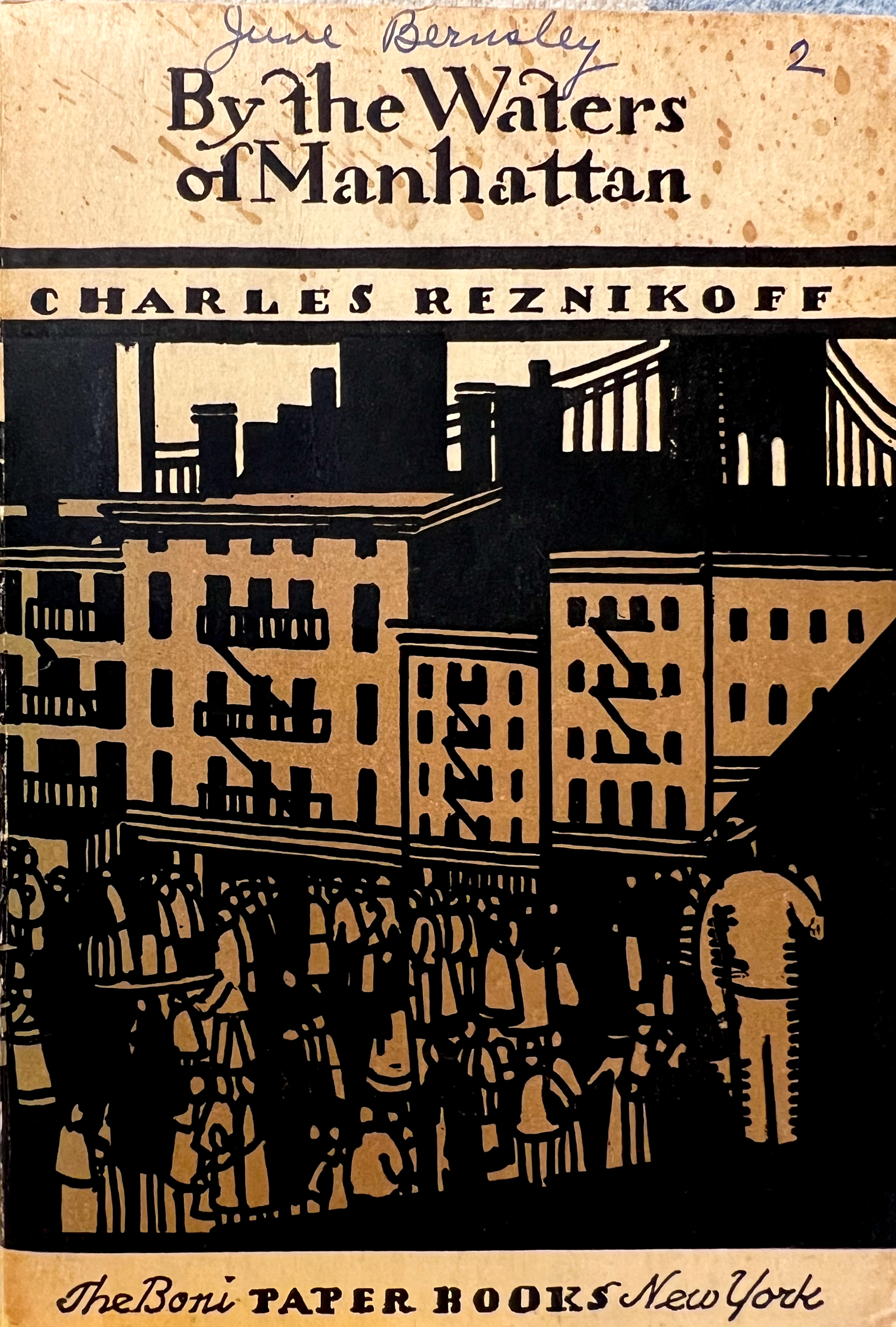
“To see a painting or a statue, he thought, and then to look out of the window, is to see how fresh and richer life itself is. He had read this a few weeks before in the volume of a German philosopher, and because Ezekiel had always felt so, the sentence had significance.” —Charles Reznikoff, By the Waters of Manhattan

Does anyone know which German philosopher Reznikoff’s hero was reading? I had the impression that the idea in question was originated by Muriel Spark, but Reznikoff’s novel was published in 1930, so this can’t be Spark in German drag. I bought (from Better Read than Dead) and read By the Waters of Manhattan because, shallow person that I am, I thought the cover of the paperback, by Amy Drevenstedt, was gorgeous, and as usual, my superficiality was rewarded. It’s a solid page-turner. The first two-thirds is about a Jewish woman growing up in eastern Europe in a family full of idealistic and often hapless men. The second is about her son starting a bookstore on the Lower East Side and venturing into a somewhat amoral romance with one of his customers.

A book cover, with the title and author's name hand-lettered, and an illustration of New York's Lower East Side with the Brooklyn Bridge as a backdrop


“Haven’t smoked for three days. Busy night and day not smoking. Already I can climb stairs better but that’s not much of a life. With smoking one has a life while dying. How did the Greeks ever run a whole culture without it? Maybe that’s why there was so much homosexuality.” —Russell Hoban, Turtle Diary


“Car horns serve the same purpose as birdsong—to warn away rivals, or to express annoyance.” —Sparrow, The Princeton Diary

This isn’t quite the case, of course, or anyway not exclusively—birds also use song for courtship, spooking prey, begging, and staying findable to mates and colleagues—but I lolled. I wrote a post about Sparrow’s previous novel, Abraham, a couple of years ago, and so far the new one is also very quotable (“Princeton is what New Jersey would be like without the mafia.”)


Years ago, soon after I landed my first real job, as a senior (sc. junior) editor at Lingua Franca, I bought a set of the old Houghton Mifflin / Riverside Press edition of Thoreau’s journals, which happened to have belonged to the late critic Alfred Kazin. I had read “in” Thoreau’s journals a fair amount in grad school, and I read “in” them some more when I did a Thoreau-related review soon after buying the set, but it was only last year that I sat down with the intention of reading them through. Having started birdwatching myself makes it more plausible, somehow. Sometimes I cross-check with the new Princeton edition, which I have many but not all volumes of, but I seem to prefer the old Riverside Press edition for actual reading, just as I seem to prefer the more-edited editions of John Clare. It turns out I’m not a purist and appreciate punctuation. Adding to the pleasure of the copy of Thoreau’s journal that I have are Kazin’s copious pencil annotations. I particularly liked this one, of Thoreau’s entry for October 14, 1851:

Alfred Kazin has written "Me" in pencil, beside this passage in Thoreau: "'Some men's lives are but an aspiration, a yearning toward a higher state, and they are wholly misapprehended, until they are referred to, or traced through, all their metamorphoses.'"
Me, too, by the way.


“She had no ambition to write a good book, but was painfully anxious to write a book that critics should say was good.” —Trollope, The Way We Live Now

Untimeliness

[Also available as an issue of my newsletter, Leaflet]

“Had I devoted myself to birds, I might have produced something myself worth doing.” —Ruskin, quoted by Katherine Rundell in an essay on hummingbirds (London Review of Books)

“Mourn the past, mend the present, beware of the future.” —Jan Hus, quoted in Claire Sterling’s The Masaryk Case (1969)

“Puss grew presently familiar, would leap into my lap, raise himself upon his hinder feet, and bite the hair from my temples. He would suffer me to take him up, and to carry him about in my arms, and has more than once fallen fast asleep upon my knee. He was ill three days, during which time I nursed him, kept him apart from his fellows, that they might not molest him (for, like many other wild animals, they persecute one of their own species that is sick), and by constant care, and trying him with a variety of herbs, restored him to perfect health. No creature could be more grateful than my patient after his recovery; a sentiment which he most significantly expressed by licking my hand, first the back of it, then the palm, then every finger separately, then between all the fingers, as if anxious to leave no part of it unsaluted; a ceremony which he never performed but once again upon a similar occasion.” —William Cowper, describing one of his three pet hares in a 1784 letter to The Gentleman’s Magazine

When you search for the name of a specific domestic duck breed, Google tells you that people also asked, “Are they friendly?” and “How do they taste?”

“There are no real hedgehogs in those woods, only foxes, who do well in the margins of our dominion. Perhaps there’s an alternative parable in there.” —the novelist Christopher Brown, on armadillos real and stuffed (Field Notes)

“For one brief moment—maybe, say, six weeks—nobody understood art. That’s why it all happened. Because for a short while, these people were left alone. Six weeks is all it takes to get started.” —the composer Morton Feldman, quoted by the musician Damon Krukowski in an essay on that we’re-all-just-figuring-it-out feeling

“There is an aftermath in early autumn, and some spring flowers bloom again, followed by an Indian summer of finer atmosphere and of a pensive beauty. May my life be not destitute of its Indian summer, a season of fine and clear, mild weather in which I may prolong my hunting before the winter comes, when I may once more lie on the ground with faith, as in spring, and even with more serene confidence. And then I will wrap the drapery of summer about me and lie down to pleasant dreams.” —Thoreau, journal, 8 Sept. 1851

I dreamed I got a postcard from a graduate student, who wanted to know, If you don’t have anything to do, how do you do it?

“Individual artists and writers, however deeply they influence their peers, seldom think of themselves (at least after the age of thirty) as part of a movement, though they are too polite to object when critics and historians praise them for their membership in it.” —Edward Mendelson on Hugh Eakin’s Picasso’s War (Book Post)

“I feel tender for you tonight, walking the wet streets of Portland in your tent of a black coat. Reading the taped-up neon flyers with everyone else’s happenings, readings, meetups, shows; halting on the sidewalk outside a corner bungalow because you hear OK Computer playing inside; offering your arm to the ghost of Elliott Smith every time you pass one of the streets, Alameda or Division, that he named in his songs; yourself haunting the door of the café where once, during rain, a girl shared your table, you exchanged two sentences about the novels you were reading and never met again; letting go your last dollars on someone’s new novel, a Sibelius LP, a cup of Stumptown because those transactions are the only connections you know how to make. I wish I could take you out for that cup of coffee. I know what a gift you’d find it just to be taken out for an hour, especially by a woman. By another woman, I ought to say, but you’re in no place to receive that.” —the novelist Pauline Kerschen, writing a letter to her younger self, on the eve of gender-affirming surgery

“But why—I asked myself at numerous points over the last five years—was this such a productive era for experimentation? Apart from the opportunities provided by the phenomenal pace of change in the era, it occurred to me that the German Empire was, as perverse as it sounds, just repressive enough. Which is to say it was a semi-autocratic state with a reactionary mainstream culture so there was definitely something to rebel against, but it wasn’t so repressive that it silenced radical voices entirely. Yes, some writers were censored, fined or even jailed for lèse-majesté, blasphemy, obscenity and other infractions, but it’s remarkable how many more weren’t when you consider the extremity of their positions. The countercultural vigour of the age, it appears to me, dwelt in this narrow gap between widespread antipathy and blanket repression.” —the publisher and translator James J. Conway, reflecting on the neglected classics of Wilhelmine Germany that he issued in new English-language translation during the five-year run of his small press, Rixdorf Editions

“I wonder when again that lovely old tune was whistled in that cottage, and when again that jig was danced under that roof, for those who danced are dead, and he who whistled the tune is dead, and I think that those who live in that cottage now have forgotten these old things, as soon all will have forgotten them. So we lay another night in the great bed, and slept in each other’s arms, slept the sound sleep that lovers sleep, so sound and yet so light that like a dream the consciousness of the other is always there—the only dream that enters the deep sleep of lovers.” —Helen Thomas, As It Was (1926)