Another cruise

A stereogram titled A Whaling Scene, by J. Freeman of Nantucket, showing two images of a diorama in which three whale boats have left their bark to pursue sperm whales, one of which is lolling upside-down with splinters of a whaleboat in its jaws

I was interviewed about Moby-Dick for a podcast the other day (keep an eye out for an episode of The World in Time, from Lapham’s Quarterly), which triggered a re-reading. I think this was my sixth time through? I am now the age of Ahab, who, in chapter 132, tells Starbuck that he started whaling as “a boy-harpooneer of eighteen” and has spent “forty years on the pitiless sea.” I, too, have reached my implacability-and-fixed-purpose era. (Or would like to have reached it. That third novel would be getting written faster, if I had.)

I think I was invited on the podcast because I’m a bit of an oddity, someone who managed in the end to turn himself into a general “writer” but started as a Melvillean. In an earlier life, I wrote for scholarly journals and university presses about such topics as Melville’s conflation of cannibalism and homosexuality, the trick sanctification of sacrificed gay desire in Billy Budd, and the Platonic erotics of mining for sperm at sea.

I happen to be re-reading Emerson’s journals, for no particular reason, and along the way I have been jotting down what amounts to a haphazard collection of entries that prefigure Melville. Some are pretty uncanny. For example, a dozen years before Melville’s debut novel Typee, which fictionalized his experience of jumping ship to live among islanders who might or might not have been thinking of dining on him, Emerson wrote in his journal: “In the Marquesas Islands on the way from Cape Horn to the Sandwich Islands, 9° S. of the Equator they eat men in 1833.”

A few days later, Emerson records a night in a hotel that foreshadows the meet-cute of Ishmael and Queequeg:

I fretted the other night at the Hotel at the stranger who broke into my chamber after midnight claiming to share it. But after his lamp had smoked the chamber full & I had turned round to the wall in despair, the man blew out his lamp, knelt down at his bedside & made in low whisper a long earnest prayer. Then was the relation entirely changed between us. I fretted no more but respected & liked him.

Prayer helps reconcile Ishmael and Queequeg, too; shortly after they get married, as you may recall, Ishmael joins Queequeg in worshipping his idol, Yojo.

Father Edward Taylor, the seamen’s minister, who was the real-life model for Melville’s character Father Mapple, was a friend and colleague of Emerson’s, and stayed over at his house at least once. In June 1835, while mulling over whether he should still call himself a Christian, Emerson declared, “But if I am the Devil’s child, I will live from the Devil,” a passage that reminds me of Ahab seizing a lit-up lightning rod in chapter 119 and avowing himself a child of the unholy electric fire.

Maybe the most remarkable prefiguration comes on 19 February 1834, when Emerson reports that

A seaman in the coach told the story of an old sperm whale which he called a white whale . . . who rushed upon the boats which attacked him.

Emerson was living in a Melvillean world.


What’s it like to read Moby-Dick when you’re Ahab’s age? There are probably a number of things I no longer see as acutely as when I had young eyes, but some elements are now in sharper focus. When young, I had only the vaguest sense, in any given chapter, where Ishmael was, geographically speaking. For me then, the important seas to be swimming through were of metaphor and feeling. Now I see that Melville is actually pretty careful to map the Pequod’s journey; in late middle age, my internal GPS module keeps better track of where I as a reader am supposed to be—so much better track that it’s a bit of a comedown to realize that the epic events of the novel happen in specific actual places, not just in elemental spheres.

At this point, I’ve read pretty much every word of Melville’s that has survived, so another thing I can’t help but notice is the way Melville prefigures himself in Moby-Dick. For example: In one of his prefatory chapters, Melville presents a series of quotes about whales and whaling. One of these is taken from an account of a mutiny aboard the whaleship Globe, and reads, “‘If you make the last damn bit of noise,’ replied Samuel, ‘I will send you to hell.'” Next to this extract, a younger me wrote in the margin, “& the relevance to whaling?” (in his defense, young me went on to speculate a not-implausible link to Hobbes’s Leviathan). I don’t have any trouble seeing the relevance today. It seems obvious to me now that mutiny is implicit everywhere in the novel, that Billy Budd is already present in Moby-Dick, as an undertext. (Mutiny and Billy Budd were also present in White-Jacket, the novel that came just before Moby-Dick.) In chapter 123, mutiny becomes explicit, when Starbuck raises a musket and then, weakly, lowers it. Starbuck is a good hero who can’t get angry enough to rebel, much as Billy Budd is the Handsome Sailor who can’t bring himself to say plumply no, until his fist flashes out. Starbuck’s fist never does. He’s the classic liberal, without quite enough thumós to take out the madman before it’s too late. Mutiny pretty much has to be an issue aboard the Pequod; the search for energy, after all, is classically the locus where force supervenes in politics and economics—where need and power override contracts and consent.

Other prefigurations: In their gams, the whaleships in Moby-Dick trade letters, sometimes addressed for sailors who have already perished, a foreshadowing of the Dead Letter Office that was Bartleby the scrivener’s previous place of employment. And in the contrasting plights of the sperm-filled whaleship Bachelor and the bone-dry Jungfrau, there seems to be a precursor to the “joke”/schema of Melville’s paired stories “The Paradise of Bachelors and the Tartarus of Maids”—a joke that now seems pretty ponderous to me, unfortunately, however laden it may be with homoerotic significance.

When you read Moby-Dick as an undergraduate, and you come across a reference to, say, a Bible verse you haven’t heard of—such as, in chapter 95, Melville’s reference to 1 Kings 15, which describes, Melville says, an idol “found in the secret groves of Queen Maachah in Judea; and for worshipping which, king Asa, her son, did depose her, and destroyed the idol, and burnt it for an abomination at the brook Kedron”—you think to yourself, Huh, well, we didn’t learn that verse in Sunday school, but I bet it’s the sort of thing a well-read person in the 19th century would have known about and recognized. Or, you read Melville’s comparison of the white whale to an anti-deity worshiped by “the ancient Ophites of the east,” or his comparison of the dark depths of Ahab’s soul to the undercellar of the Hotel de Cluny and to “the Roman halls of Thermes,” and you think, Everyone must have been so much more learnèd in Melville’s day! They must have had all these esoteric religious and archeological references at their fingertips. Well, maybe. But I’m as grown-up now as I’m likely to get, and have read an awful lot of 19th-century prose, and I think undergraduates can be forgiven for not getting all of Melville’s references. My sense is that some of Melville’s points of reference were pretty obscure, and would have been even to educated peers of his. Which isn’t that surprising. Melville was an autodidact. His picture of the cultural world is one he had to draw for himself, and what he came up with can be a little quirky, as is often the case with autodidacts. Especially quirky, with Melville, are the departments of theology and anthropology. Somewhat surprisingly, he actually seems pretty canonical where whaling is concerned; my sense is that most whaling nerds of his day would have agreed that the whaling books he mentions are the important ones.


The last thing that strikes me strongly on this re-reading: Moby-Dick is not built the way novels are supposed to be. It’s not surprising that most people who attempt the novel lose their oomph somewhere around page 100. Novels usually hold your attention with little loops and twists of plot. Clara and Guillaume have become engaged to marry, but after Soren returns from his apprenticeship in Rome, Clara remembers all that Soren used to mean to her, and for some reason becomes willing to believe Soren has reformed, as he claims, although Guillaume has by chance found out that Soren is not only still partial to gaming but also saddled with ignominious debt, and yet it would be ungentlemanly for Guillaume to betray Soren’s confidence to Clara; the only noble thing to do is wait out patiently the rekindling and eventual subsidence of her infatuation—there is nothing like any of this in Moby-Dick. Instead: sailors get on a doomed ship. They agree to hunt a white whale. Everyone knows it is going to end badly. Everyone knows this pretty much from the start. There is a romance plot, but no sooner is it sparked than it dives, far beneath narrative. Ishmael and Queequeg are married in chapter 10 (of 135), but once they board the Pequod, you pretty much never hear about their love, or any of its vicissitudes, ever again, unless you count the very late resurfacing (sorry, spoiler!) of Queequeg’s coffin, which becomes Ishmael’s life buoy. And there’s not really anything that takes the place of this submerged romance plot. There is no other novelistic “business.” Nothing ever seriously threatens to derail Ahab from his mission, for example; there’s not any back-and-forth of hope raised and then dashed. The novel’s plot is a straight line—interrupted, for a span of about 350 pages, by fairly allegorical episodes of whale-hunting, and fairly metaphysical essays about whales. I still think Moby-Dick is brilliant, don’t get me wrong, but it’s brilliant as a meditation on representation, and incarnation, and the problem of having a soul that’s inside a body, and necessarily dependent on, and sometimes antagonistic to, other bodies, which apparently have souls inside of them, too, and of living in a world that is said to have been created by a deity but doesn’t have all that much in it in the way of the grace and mercy that a benevolent deity could be counted on to supply. Moby-Dick is not brilliant in the way of, say, Middlemarch, which is the novel I’m re-reading now, where characters have different kinds of interiority and purpose, and project onto one another and frustrate one another and discover they have feelings for one another they weren’t at first aware of. Ishmael is almost too ironic about himself to have interiority, of the George Eliot sort. In Moby-Dick, only Ahab has rich interiority, and he’s insane. And the reader accesses his interiority through his soliloquies and through Melville’s complicated prose gestures towards him, not through the eavesdropping that free indirect discourse makes possible.

In Moby-Dick, a young, great, unruly, and untrained mind is wrestling. In chapter 42, for example, as Melville piles up associations and allusions that might help explain the meaning of the whiteness of the white whale, he notes that “the great principle of light . . . for ever remains white or colorless in itself, and if operating without medium upon matter, would touch all objects, even tulips and roses, with its own blank tinge.” Two chapters later, describing an episode that Ahab goes through of what sounds like depersonalization, maybe as a component of a panic attack, Melville tries to describe what it’s like to be conscious without a self, writing that “the tormented spirit that glared out of bodily eyes, when what seemed Ahab rushed from his room, was for the time but a vacated thing, a formless somnambulistic being, a ray of living light, to be sure, but without an object to color, and therefore a blankness in itself.” Did Melville realize he was echoing his earlier paragraph? The novel is full of what scholars call “unemendable discrepancies” and “unnecessary duplicates”—scribal errors that are impossible to yank out of the book’s semantic fabric. Maybe this echo, too, is an error, or maybe, to look at it more generously, Melville became aware, as he wrote, that he was repeating that idea that light, which bestows color, itself has no color—and doubled down. Maybe the “mistake” of repetition, as he made it, began to suggest a meaning he couldn’t bring himself to discard. I don’t think Melville is someone who ever killed his darlings. It’s hard to winkle out exactly what this particular “mistake” means, and it’s equally hard to imagine that Melville intended to make it before it, as it were, happened to him, in the heat of writing. Still, the suggestion made by the error is ingenious: that there is a parallel between the horror that the white whale inspires, through being the no-color of light itself, and the horror that not-Ahab experiences, when the self of Ahab is no longer coloring not-Ahab—that there is something terrifying about unqualified, unmediated existence, more real and more powerful than the appearances that we usually live as and among.
Through a veil: On “St. Paul’s,” by William Wordsworth

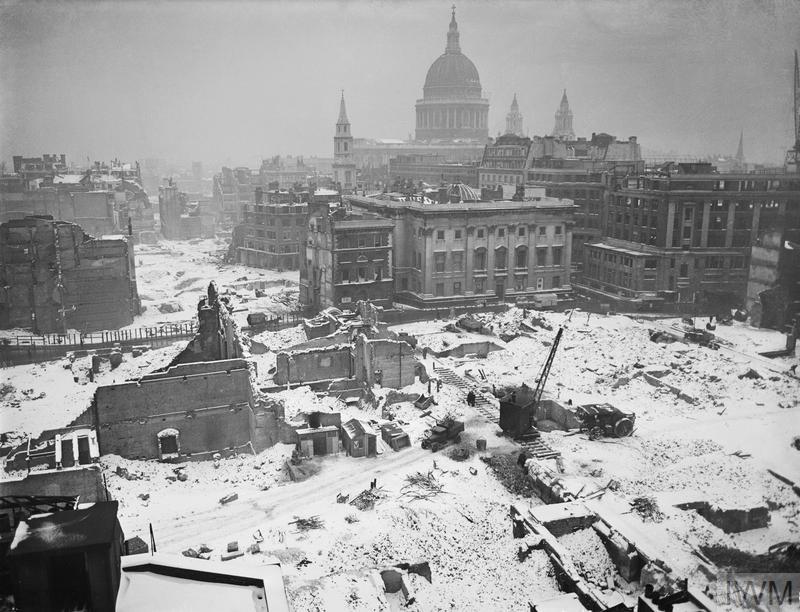
A black-and-white photograph of London after bomb damage, and under snow, with St. Paul's Cathedral in the distance
“Bomb Damage in London, January 1942,” Imperial War Museums (D 6412)

Every poem has a purpose, William Wordsworth says in the preface to Lyrical Ballads, the poetry collection he collaborated on with Samuel Taylor Coleridge. This probably isn’t what most people remember him saying. More memorable are his claims that poetry should be written in “the real language of men” (i.e., not in self-consciously poetic diction), that poetry consists of “the spontaneous overflow of powerful feelings,” and that poems are made out of “emotion recollected in tranquility.” His claim about purpose, which is abstract and slightly odd, is easy to forget.

According to Wordsworth, the purpose of a poem is “to illustrate the manner in which our feelings and ideas are associated in a state of excitement.” This is so bland that a reader’s eye impatiently skips over it. It’s less pithy and much less amenable to conceptual handling than, say, Horace’s idea that literature is supposed to delight and instruct. Don’t people always experience feelings and ideas in association with other feelings and ideas? Excitement, by the way, is notwhat makes poetry poetry, Wordsworth goes on to say. To the contrary! He’s against sensationalism (“this degrading thirst after outrageous stimulation”); he deprecates the idea that extreme subject matter—death, violence, lust—makes a work of literature valuable or interesting. In good poems—in his poems—“the feeling therein developed gives importance to the action and situation, and not the action and situation to the feeling.”

If a little girl dies in a snowstorm, in other words, Wordsworth writes a poem not for her sake but in order to find out what he thinks and feels about it. The narcissism of this is wonderfully Wildean, though maybe this is the case with all true literature. The specifics of what Wordsworth seems to mean are both subtle and impossibly grandiose. “I believe,” he writes, “that my habits of meditation have so formed my feelings, as that my descriptions of such objects as strongly excite those feelings, will be found to carry along with them a purpose.” Purpose here seems to be almost an aftereffect of sensibility. It isn’t a specific aim, but a sense of having an aim—a feeling of meaningfulness. The events that inspire a poem are more or less arbitrary. What matters is the nature of the mind excited by the events, a nature revealed through the choices the mind makes as it does its describing. “Nature,” by the way, is probably the wrong word. The mind in question has been formed, given shape and edge by a kind of study—by long-continued effort to enhance and structure its receptivity. One implication of this theory is that at the moment of a poem’s creation, the poet may not have much control. His conscious labor, to the extent that volition comes into play at all, has to happen earlier: in the years leading up to that moment, years the poet spent cultivating an openness to feelings and to the beauty of the world.

Though Wordsworth never quite out and says it, the purpose of a poem is to show the mind of the poet, to show the resonances that his way of life has given to his sensibility. A great poet, Wordsworth writes (his grandiosity flushed out into the open by the imperative to explain what he’s trying to do), has “a more comprehensive soul.” He is distinguished by his “greater readiness and power in expressing what he thinks and feels, and especially those thoughts and feelings which, by his own choice, or from the structure of his own mind, arise in him without immediate external excitement.” Notice that by this point in Wordsworth’s explanation, excitement is by the way, and any real events that cause excitement are almost regrettable, maybe even a little vulgar. In several passages in the preface, in fact, Wordsworth stresses that the poet probably can’t and maybe shouldn’t make poetry directly out of his feelings about real events, not even when the events have happened to him personally. Instead the poet is to use doubles or mirrors or imagined representations of original feelings. Even when the poem is about his own emotions, he is to work from “an emotion, kindred to that which was before the subject of contemplation.” The doubling distances the poet from reality, and in Wordsworth’s opinion, this distance is to the good. Meter further de-realizes a poem. No one in real life consistently speaks in meter, after all. “The co-presence of something regular,” Wordsworth writes (a lovely phrase!), soothes and reassures in cases where too sharp an apprehension of reality would be distressing.


Not long ago I read the poet Thom Gunn’s letters, and because Gunn was an enthusiast, who raved to friends about his favorite music, movies, novels, and gay bars (including a bar in New York’s East Village that was a favorite of mine, too, at the time he was writing about it, the mid-1990s—though I never ran into him; I biked past it yesterday; it’s a bodega now), I found myself taking notes. To read, on Gunn’s recommendation: Basil Bunting’s Briggflatts. Robert Duncan’s Opening of the Field. Marianne Moore’s Observations. And a Wordsworth poem that Gunn wrote to Robert Pinsky about, in June 1989:

I did find a wonderful poem by Wordsworth I’d never read before, “St Paul’s,” written 1808, not published till 1947. . . . I have never really been able to figure W out. . . . the Lucy poems leave me feeling that it’s possible to be too artless . . . I know how Keats’s worst poetry is connected to his best (it would be possible to make a kind of spectrum), but I don’t know how W goes from his worst (or even his average) to his best. It’s as if, once in an age, he is suddenly able to find a tune which matches his complete intentness of feeling. As in this poem. [Gunn, Letters 467]

Wordsworth’s unevenness is one of the mysteries about him. For pages and pages he writes about clouds floating through his mind that he happens to find morally significant, the verse as flocculent as the subject—and then a gust lifts his kite into the sun, and he makes you want to cry. (Or makes me want to, anyway. A friend of mine who’s a beautiful poet is so immune to his intermittent charm that she can’t understand how I can bear him.)

“St. Paul’s” was written in Grasmere, the village in the Lake District where Wordsworth and his sister, Dorothy, lived, in the spring of 1808. It describes the end of a trip to London. Wordsworth had traveled there to find a publisher for The White Doe of Rylstone, a long historical poem of his that he and Dorothy were hoping would bring in money. Unfortunately for Wordsworth’s bargaining position, a two-volume collection of his poems, published the year before, had sold poorly. Byron had trashed it as “namby-pamby,” and was not the only reviewer to have been unkind. Wordsworth made his bargaining position even weaker by refusing to let his editor read the manuscript before bidding on it. “Without money what can we do?” Dorothy wrote to him, in exasperation, when she heard he was being difficult.

New House! new furniture! such a large family! two servants and little Sally! we cannot go on so another half-year. . . . Do, dearest William! do pluck up your Courage—overcome your disgust to publishing . . . [quoted in Gill, William Wordsworth: A Life 1990: 265]

A second object of this London trip was to visit Coleridge, who was ailing. The Royal Institution had commissioned Coleridge to deliver twenty-five lectures on poetry, but Coleridge had had a breakdown—vomiting, diarrhea, paralyzing anxiety—and was dosing himself with hensbane, rhubarb, magnesia, and laudanum. He dodged Wordsworth’s first attempts to pay a visit, maybe because he sensed that Wordsworth felt he should be making more of an effort to wean himself off the opiates. Over the years, a fair amount of tension had developed between the two—the one an industrious if underpaid tribune of sanity, and the other a chaotic and irresolute prophet of imagination. They had started to get on each other’s nerves. During this visit to London, Wordsworth, ever the philosophical egotist, declared that he did “not see much difficulty in writing like Shakespeare,” and the essayist Charles Lamb reported in a letter, with amusement, that Coleridge was “a little checked by this hardihood of assertion.”

While Wordsworth was in town, Coleridge’s health improved enough for him to throw a tea party, which he presided over from bed, swaddled in sheets and blankets, and to resume his lectures. In the third lecture, which Wordsworth attended, Coleridge quoted a poem of Wordsworth’s about daffodils (“I wandered lonely as a cloud”) as an example of the power of  imagination. In his fourth, on April 2, he praised poetry’s “power of so carrying the eye of the Reader as to make him almost lose the consciousness of words—to make him see everything” [quoted in Holmes, Darker Reflections 115–27].

The peroration must have been echoing in Wordsworth’s ears when he left London the next day, April 3. He left Coleridge’s apartment “at 7 o’clock on Sunday morning . . . in a very thoughtful and melancholy state of mind,” he was to write to his friend Sir George Beaumont on April 8, in a letter that shares so much of the phrasing of “St Paul’s” that it could be considered a dry run in prose. [Joseph F. Kishel, ed., The Tuft of Primrose 1986: 3] (Maybe this is the secret of Wordsworth’s breakthroughs—that they are poems he first worked out in prose? Call it the Edward Thomas method.) He hadn’t found a buyer for the White Doe. He was leaving the manuscript behind with Coleridge, who was under the impression that Wordsworth wanted him to try to sell it. (When Coleridge did negotiate a sale, about a month later, Wordsworth was to declare that he hadn’t wanted him to and to hurt Coleridge’s feelings by canceling the deal.) In Grasmere, Wordsworth knew, a family friend had been coughing up blood, and when he arrived home, he was to find his son John gravely ill with meningitis. Failure and loss, vocational and personal, threatened on all sides. Here is how the poem begins:

Pressed with conflicting thoughts of love and fear
I parted from thee, Friend,

Wordsworth addresses the poem to Coleridge, without naming him. Also unnamed are the specific thoughts of love and fear in his mind. Had he already been thinking of Coleridge, consciously or unconsciously, in the prose version he sent to Beaumont? Had he been thinking of him but reluctant, because of the rivalry between them and the growing difference in their ways of life, to write to him? It’s also possible, of course, that in both versions, Wordsworth is speaking mostly to himself. A public letter is usually meant for its addressee only in a sort of ostensible, fictional way. It is not an accident that the poem starts with parting.

and took my way
Through the great City, pacing with an eye
Downcast, ear sleeping, and feet masterless
That were sufficient guide unto themselves,
And step by step went pensively.

Eye, ear, feet. This is a poem of detachment—of things taken apart and seen, at least for a moment, only for themselves. The poet’s body is here disassembled, and from each component, the corresponding faculty is taken away. Vision declines, hearing goes dormant. Feet are left to find their own way. The poet is dropping into a state that is the opposite of poetic intensity. His senses are lessened; his mind is growing inattentive, less present. In dejection and exhaustion, he is shutting the world out. Reducing himself, absenting himself. According to Wordsworth’s preface, a poet is supposed to have a sensibility across which the events of the world play, like a breeze across a wind chime. Wordsworth has sunk here to sensibility at degree zero, if not below zero. He is closed, empty. Even in this hollowed, slumbrous state, however, there’s a shut-down, depressive, lumbering majesty to the rhythm.

Now, mark!
Not how my trouble was entirely hushed,
(That might not be) but how, by sudden gift,
Gift of Imagination’s holy power,
My Soul in her uneasiness received
An anchor of stability.

From inattention, pay attention! From this point on, the poem is built out of appositives, noun phrases placed one after the other so that the second modifies or clarifies the first, a grammatical structure that suggests addition and also unfolding. A word in one line bumps into, and opens up into, an idea in the next. Here, for example, the words “sudden gift” hit up against, and give way to, the phrase “gift of Imagination’s holy power.”

The idea here about beauty—that perceiving it can restore, at least for a moment, a person’s balance—seems like it must be an old one. Plato wrote in the Phaedrus about beauty as the inspiration for art, but for Wordsworth, the apprehension of beauty is much less erotic than what Plato describes, and the benefit is more sharply limited: a temporary finding of one’s center, and no more. Of this hedged, disillusioned version of the idea, Wordsworth’s might the earliest formulation. The poet Charles Reznikoff, in his novel By the Waters of Manhattan(1930), gives it to his hero, Ezekiel: “To see a painting or a statue, he thought, and then to look out of the window, is to see how fresh and richer life itself is.” Ezekiel remembers coming across the idea in the work of a “German philosopher” (who may have been Schopenhauer, but I haven’t read Schopenhauer). The idea recurs again in the novelist Iris Murdoch’s philosophical treatise The Sovereignty of Good (1970): “I am looking out of my window in an anxious and resentful state of mind, oblivious of my surroundings, brooding perhaps on some damage done to my prestige. Then suddenly I observe a hovering kestrel. In a moment everything is altered. The brooding self with its hurt vanity has disappeared. There is nothing now but kestrel. And when I return to thinking of the other matter it seems less important.”

— It chanced
That while I thus was pacing, I raised up
My heavy eyes and instantly beheld,
Saw at a glance in that familiar spot
A visionary scene—a length of street
Laid open in its morning quietness,
Deep, hollow, unobstructed, vacant, smooth,

Another appositive, but with verb phrases instead of noun phrases: “instantly beheld” bumps into and opens up into “Saw at a glance in that familiar spot / A visionary scene.” Then comes an incantatory line of five adjectives in a row, suspended from the normal rules of poetic meter. Somehow we accept the four syllables of the word “unobstructed” as a single beat. The adjectives refer backwards to the noun “street” two lines above, as if they descend from it or radiate from it, the way snowflakes descend and radiate from the sky, each becoming, as it does, a potential independent focus of attention.

And white with winter’s purest white, as fair
As fresh and spotless as he ever sheds
On field or mountain.

I’m ruining the poem a little bit, of course, by glossing it like this—by saying explicitly that what we’re seeing here is snow, when Wordsworth chooses to withhold the word “snow” until the poem’s last moment, when it arrives like a ratification. Note that at this point Wordsworth has only revealed one element of the “visionary scene,” the (snow-covered) street.

Moving Form was none
Save here and there a shadowy Passenger
Slow, shadowy, silent, dusky,

A second incantation. Again the words break meter; the word “shadowy” is made to last as long as the word “slow.” Wordsworth isn’t shy about repeating the word “shadowy,” just as he isn’t about repeating the words “gift,” “pacing,” and “white” earlier in the poem, or the words “street,” “silent,” and “veil” later. One senses that the moving form, who is and isn’t here, is a double of Wordsworth. A self that has become diminished, a self somewhat disavowed.

and beyond
And high above this winding length of street,
This moveless and unpeopled avenue,
Pure, silent, solemn, beautiful,

A third incantation. The eye has taken in, as it rises, first the street, second the walker, and now, third, . . . Without yet knowing what the third element is, we are told about its silence and purity, qualities it shares, we sense, with the snow.

was seen
The huge majestic Temple of St Paul
In awful sequestration, through a veil,
Through its own sacred veil of falling snow.

Maybe the street represents a journey, and the passenger, the self who is taking the journey. One thinks of Keats’s speculation that this world is a “vale of soul-making.” London, for the moment, was that vale, for Wordsworth. Is that the meaning of the scene’s third element—is St. Paul’s the soul that Wordsworth is journeying toward? T. E. Hulme’s famous objection to Romanticism, which he dismissed as “spilt religion,” was that the Romantic aesthetic deliberately makes it impossible to answer such a question; the referent of such a signifier is kept vague in order to suggest that “man, the individual, is an infinite reservoir of possibilities,” as Hulme put it, which Hulme, a political conservative, didn’t think man was. Literally, of course, St. Paul’s is a cathedral, a “temple” as the poem says. To use the seat of religious authority in one’s country as a symbol of the infinite in oneself—a conservative wouldn’t have liked that one bit. Does the cathedral here represent the vocation of poetry? Is it a version of Wordsworth’s self that could survive not being paid, that could rise above not being understood? Superimposed on the cathedral are traces of another image: a person behind a veil, probably a woman, kept apart for reasons of ritual. In awful sequestration. A person initiated in the mysteries. Kept pure. Alone. Apart from Coleridge, apart from Dorothy, apart from wife and child. Maybe Wordsworth was having a vision of the sensibility he believed it was his calling to develop in himself, of the vital texture of associations that he thought gave him his purpose in the world. He couldn’t ever rely on seeing it, and he couldn’t consistently summon it, but at moments, unexpectedly, it was revealed.

Infinitely fine

In 1910, Henry James published an essay titled “Is There Life After Death?”

Probably not, is the answer he starts with. For one thing, a lot of people don’t even seem to care whether they have immortal souls. “How can there be a personal and a differentiated life ‘after,’ ” he sniffs, “for those for whom there has been so little of one before?” The consciousnesses of people who don’t care about their souls are almost certainly too boring to need to be preserved. In James’s opinion, in fact, it’s not clear why such people exist even once, unless they do so for the same purpose “slugs and jellyfish” do, to provide “amusement” and to represent “wealth and variety” for others in the universe who are more spiritually inclined.

This is divinely snobbish, but as a logical argument, hard to take very seriously. James goes on, however, to raise a more substantive objection to the afterlife: materialism. Science teaches that “we are abjectly and inveterately shut up in our material organs,” he writes, and most people’s experience confirms this. As we get older, we become more and more aware of the limits and compromises that our bodies inflict on our minds, and in the end, we are forced to acknowledge that “even at our highest flights of personality,” we are “the very stuff of the abject actual.” Our hopes and passions turn out to be “but flowers sprouting in that eminently and infinitely diggable soil.” Perhaps the most dismaying confirmation comes when we observe that people “die piecemeal.” After a certain age, most of us become aware of the encroachment of partial death even in ourselves. And if it’s possible for our personality to decline “by inches”—in my own case, the ability to recall people’s names is fast becoming a lost cause—it’s hard to sustain a belief that the mind is ineffable, and hard to resist the conclusion that mind is just an effect produced by “the poor palpable, ponderable, probeable, laboratory-brain.”

Then there’s the paucity of ghosts. This sounds pretty eccentric, as arguments against the afterlife go, but hey, we’re talking about Henry James. What he cares about is personality, and what is a ghost but the essence of the personal? In his nonfiction, it turns out, James doesn’t believe in ghosts, however persuasively he may have written about them in his fiction. (He admits he finds mediums and trances interesting, but only as evidence of the personalities of the mediums.) In James’s opinion, no one has ever come back from death for a visit. Which to James’s mind, more or less proves that no one continues to exist as an individual person after death. Because: No one came back? Really? No one? Could the afterlife be so overwhelmingly interesting that absolutely no one who gets there is willing to spare a moment to check in on the people they used to care so much about? If another world does exist, could the border between it and our world be so impenetrable that none of the greatest and bravest souls who ever lived can figure out a way to cross it, even briefly? And even if we the living are relatively speaking very boring, and even if the obstacles to returning are very high, isn’t a universal failure to come back just incredibly rude?

We think of the particular cases of those who could have been backed, as we call it, not to fail, on occasion, of somehow reaching us. We recall the forces of passion, of reason, of personality, that lived in them, and what such forces had made them, to our sight, capable of; and then we say, conclusively, “Talk of triumphant identity if they, wanting to triumph, haven’t done it!”

If you’re dead to the appeal of society to that extent, then, in Henry James’s opinion, you must really be dead.

In the second part of his essay, however, James changes his mind. He writes that the change began for him with a suspicion that he wasn’t quite sure about the afterlife, after all. He felt he needed to investigate by “trying to take the measure of my consciousness”—only to discover that it wasn’t at all clear that consciousness could be measured, that it had a beginning or an end. Mind seemed to him to be at least as large as the world that contained it, any angle of which it could observe and reflect, at will. “The more and the more one asked of it,” James writes, “the more and the more it appeared to give.” It seemed capable of giving more, in fact, than James thought he could come to the end of in the course of even the longest lifetime. His work as a novelist, in particular, brought this home to him:

. . . it is above all as an artist that I appreciate this beautiful and enjoyable independence of thought and more especially this assault of the boundlessly multiplied personal relation (my own), which carries me beyond even any “profoundest” observation of this world whatever, and any mortal adventure, and refers me to realizations I am condemned as yet but to dream of.

If consciousness is infinite, how can it come to an end? Once we’ve been given a taste of eternity, to yank it away would be, James writes, “a practical joke of the lowest description.” Fate couldn’t possibly be so “vulgar.”

I wish it were true that the universe couldn’t possibly be vulgar, but I’m not sure. I have to admit, however, that writing has sometimes brought me to a similar sense of consciousness as limitless. Writing about life is a strange activity. You take a portion of life that you have lived, and you spend a second portion remembering and re-experiencing the first, in order to create a representation and share it. Life goes on while you are doing the re-experiencing; life runs away, in fact. And the ratio of the second portion to the first, it soon becomes clear, may be any number. To write my first novel, I drew on a year of my life; the writing itself took more than five years. There are hours that it would be easy for me to spend months writing about. It has often happened that I’ve spent a day writing in my journal about the day before. Mathematically, this incommensurability is suggestive. Any set that can be put into one-to-one correspondence with one of its subsets can be shown to be infinite. As a corollary, therefore, since you can spend as much of your life as you want thinking about as brief a stretch of it as you’re interested in, life must be infinite. It can always be described more thoughtfully, more carefully. There is no limit to how much attention you can pay. Which doesn’t mean, mathematically speaking, alas, that it doesn’t or can’t have a beginning and an end. The moments in a life could be like the points in a line segment, which begins at A and ends at B but can be subdivided to any fineness.

It’s suggestive, too, though in a darker way, that the practice of writing, once capable of convincing James that the soul was eternal, looks likely to become an activity that very few humans will still do at any length, a decade or so from now, thanks to the advent of generative artificial intelligence.

Ambition

[A story. Also available as an issue of my newsletter, Leaflet]

I was walking through the library, naked as usual, and as always, of two minds, intention and sensibility. Plot and character. Dianoia and noos. But for some reason this time, as I was turning myself through the revolving door, and saw you coming toward me—coming in as I was going out—I wasn’t able to look away and pretend not to see that you saw me, and I knew that you saw me. And I thought, as I struggled to find my underwear, since that’s the piece of clothing to put on first—where had I put it?—I thought, Why do I do this? Why have I done this all my life, knowing, as I do, as a matter of intention and as a matter of sensibility, what I am doing, what will result from my intentions, what the impression on my sensibility will be. Knowing, that is, that I will shame myself, and apprehending, in anticipation, the flush and panic of shame. One is always both the person who decided to walk through the library unclothed (but when did I decide it?—it must have been so long ago) and also the person who is now naked, exposed.

If I find a book of mine in the library, on the open shelves, where the books are for general circulation, and I sign it, without telling anyone, how long will it take before my signature means something, means enough for someone to call it to the attention of a librarian, and enough for the librarian to remove the book from the open shelves to the archive—from general circulation to special collection? And do I want that? Isn’t it better for a book to have no value as a material object, and for my having written something in one copy of it, if I do decide to do that, to be an accident, a secret? A petty vandalism? An almost private defacement? More people might see the book, and the mark that I have made in the book, if I don’t tell, if I’m not caught, if the book isn’t removed. Even a book on the open shelves is so rarely opened by a reader nowadays. A book needs all the chances it can get.

The young people have a new magazine, and not long ago, I went and visited their office, which looks like a schoolroom. One of the young editors there was saying, in a pretending-to-be-annoyed way, that she had started receiving messages from a famous older editor who had been canceled, and I thought about telling her that I had kissed him once and that it hadn’t been so bad. But had I really kissed him, or did I just want to boast that I had? That’s the third kind of mind: pretending. An older writer arrived just then, to address the young editors of the new magazine, among whom I was camouflaging myself, and as we listened to her, I remembered how years ago, when I had been as young as the editors around me and she had been at the height of her powers, she had singled out one or two of my friends to sleep with but not me, and now she was a sage, with an editor at her right hand and a publicist at her left, and I was still in the audience, still hoping to be seen without being seen for what I am.