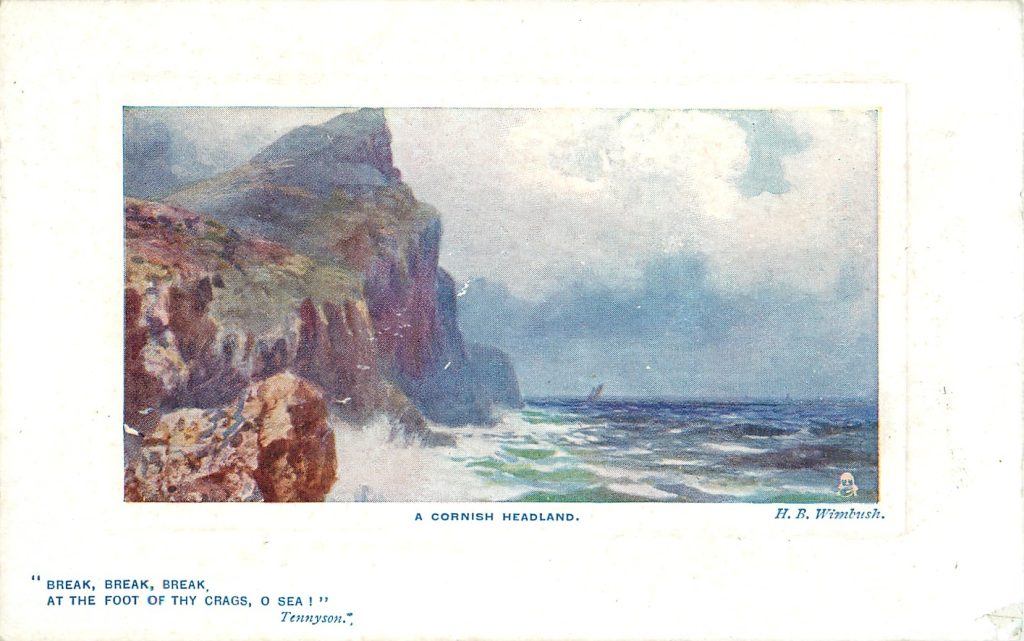
Peter and I are trying to revive an old practice, reading a poem together when we get up in the morning. The first one in the anthology we’ve chosen is “Beeny Cliff,” by Thomas Hardy, about a seaside rock face in Cornwall that Hardy visited with his first wife, Emma Lavinia Gifford, soon after they met. The poem starts by invoking the colors they saw in the ocean:
O the opal and the sapphire of that wandering western sea,
The poem’s subtitle is “March 1870—March 1913,” which are the month Hardy met Gifford and the month he revisited the site, forty-three years later, after her death. The first stanza has no tense, however; it merely apostrophizes the colors and then Gifford in a voice that belongs to neither the present nor the past, a voice that floats between.
And the woman riding high above with bright hair flapping free—
The woman whom I loved so, and who loyally loved me.
In a memoir that Gifford wrote not long before she died, and which Hardy didn’t discover until after, she recalls that when she rode her pony, which was named Fanny, “Fanny and I were one creature, and very happy,” and that she rode him in a brown dress whose color matched his coat, so long that she had to carry the end of it in order not to trip. She met Hardy because he was the architect hired to remodel the church where her brother-in-law was rector, a structure so dilapidated that “birds and bats had a good time” in the roof timbers. She remembered that when the architect visited, “I rode my pretty mare Fanny and he walked by my side, and I showed him some of the neighbourhood—the cliffs, along the roads, and through the scattered hamlets, sometimes gazing down at the solemn small shores below, where the seals lived, coming out of great deep caverns very occasionally.” In her biography of Hardy, Claire Tomalin reports that Gifford and Hardy sketchedeach other, the Victorian equivalent of taking joint selfies.
Unlike the poem’s first stanza, the second commits itself to the past, and describes one of the couple’s outings.
The pale mews plained below us, and the waves seemed far away
In a nether sky, engrossed in saying their ceaseless babbling say,
As we laughed light-heartedly aloft on that clear-sunned March day.
Peter and I both stumbled over “mews,” which are gulls, it turns out, not stables. I thought at first that “plained” had something to do with the flatness of the horizon, but Hardy means “cried” (as in the related words “complained” and “plaintive”). Gulls are crying below, in other words, but “mews plained” comes a little closer to the sound gulls make when they’re doing so. Hardy doesn’t mind using a word that’s a step removed from common diction if he can gain a poetic effect by it. His calling the sea below “a nether sky” is a nifty metaphor, because sea and sky are alike in both stretching away into the distance, where they meet and mirror each other along the horizon, and the metaphor accomplishes a neat trick of perspective: looking down somehow feels like looking up. There’s a suggestion, too, that the sea, or the reversed sky, covers an underworld, a suggestion at the moment easy to dismiss, given that the sea is distant and the murmuring of its waves sounds trivial, easily interrupted by the laughter he and Gifford are sharing.
A little cloud then cloaked us, and there flew an irised rain,
And the Atlantic dyed its levels with a dull misfeatured stain,
And then the sun burst out again, and purples prinked the main.
Colors are always subtle in Hardy. “Irised” means “iridescent,” the shimmer of rainbow that sometimes appears in rain, especially when seen from above. The Atlantic Ocean, lying behind this prismatic rain, appears to color it, to darken it, in horizontal strata. Hardy’s language here is as precise and general as an experiment in optics. At one moment he sounds like he’s talking to you in a conversational tone—“A little cloud then cloaked us”—and in the next line, he compresses his thought to the density of a mathematical formula. “Irised” isn’t a common word, but its meaning is clear, and its compactness keeps the poem in its trotting rhythm. There’s a kind of grammatical insistence, too, I think, in the accumulation of past participles—“engrossed,” “sunned,” “irised,” “misfeatured.” There’s even one at the core of “light-heartedly.” Act is being consolidated into completed action. In the “dull misfeatured stain” the malevolence of the “nether sky” is again visible, still in the background for now but beginning to leach through. Happily the sun returns—the action of this stanza is taking place in the past, when rebirths were still possible—and transfigures the staining ocean, whose tints now become decoration.
—Still in all its chasmal beauty bulks old Beeny to the sky,
And shall she and I not go there once again now March is nigh,
And the sweet things said in that March say anew there by and by?
With the em-dash, Hardy jump-cuts to the present. Beeny has become “old Beeny,” fond in memory, and Hardy asks, as if challenging a limit he knows he can’t pass, whether he and Gifford will ever visit it again together. The small love talk he exchanged with her on the cliff summit years ago now seems as distant as the babbling of the waves did when he stood next to her there.
What if still in chasmal beauty looms that wild weird western shore,
The woman now is—elsewhere—whom the ambling pony bore,
And nor knows nor cares for Beeny, and will laugh there nevermore.
The phrase “chasmal beauty” and the name “Beeny” are repeated, as if to stress that the cliff still exists, as the “woman” (a word repeated with a similar stress in the first stanza) does not. In any sublime geographic feature, there’s a hint of eternity, which is part of the attraction for human visitors, a hint that plays on the visitors a very slow joke, in that while rocks and sea may be lasting, any admirers, though they may feel like they have been placed above nature by virtue of their powers of perception, are not.
In his two-volume autobiography, written and then posthumously published under the not very convincing pretense that his second wife was the author of it, Hardy reprinted some of the notes he made in his journal when he first visited Beeny Cliff in March 1870 with Gifford.
March 10. Went with E. L. G. to Beeny Cliff. She on horseback. . . . On the cliff. . . . ‘The tender grace of a day,’ etc. The run down to the edge. The coming home.
The ellipses are Hardy’s. What a little shocked me, when an annotation to “Beeny Cliff” sent me to Hardy’s autobiography for a look at this journal entry, is the quoted fragment of poetry: “The tender grace of a day.” It comes from the conclusion of Tennyson’s poem “Break, break, break,” which is also about looking out over the sea while in mourning. The last two lines of that poem read as follows:
But the tender grace of a day that is dead
Will never come back to me.
Tennyson wrote the poem while grieving for his young friend Arthur Hallam, who had died while abroad, and whose death became the subject of his later masterpiece, In Memoriam, which imaginatively follows the homeward progress by sea of Hallam’s sealed coffin. What’s puzzling is that while it makes a great deal of sense for “Break, break, break” to have been in Hardy’s mind in 1913, when he was composing “Beeny Cliff” as an elegy for Gifford, the poem seems to have been in his mind already in 1870, back when he was courting her. The stenographic style of the journal entry implies that when he was writing about the day, he was confident he would always remember its texture. “The run down to the edge. The coming home.” These were lyrical moments that he knew a brief prompt would always return him to, the way a short quoted phrase can call to mind the poem it has dropped out of. Did he and Gifford kiss when they came to the edge of the cliff? Did the sight of the waves crashing below bring the same Tennyson poem into both of their minds (“Break, break, break / On thy cold gray stones, O Sea!”), and did one of them quote it to the other? Those details are not recoverable by us now, but the surprise is that the nether sky that Hardy saw in the sea that day, with Gifford by his side, was not a later invention, projected onto the past by a grieving husband. He saw it then, and so, probably, did she. “The tender grace of a day that is dead”: the young lovers wouldn’t have quoted that Tennyson line to each other unless they were already aware that they were living through a moment that was not going to return, aware that the beauty of their happiness together was not going to last as long as Beeny Cliff.
The two new poems are pretty different in style. “Sequence” is dense and muddy, at least for me. The origin-story is that I wrote it after I dropped a window sash on my right index finger, got four stitches, and took a picture of the wound every day for a month. It’s about the deep weirdness of watching one’s skin grow back together scarred.
The content of “Open Ticket” is a little dark, too, but in a light-verse way. There’s a simple what-if, the ramifications of which I then methodically pursue, in rhyming quatrains.
In other news, I’ll soon be leaving the derelict building where I’ve rented a writing studio for the past dozen years. The new owners plan to turn it into apartments. If you happen to have read Melville’s novel Pierre, you will have an idea what kind of building this was—an archaic structure that the lords of real estate for a time weren’t able to figure out what to do with, and where deserters from capitalism were therefore able, for a while, to find shelter for their arty, inefficient pursuits.
I’ve found a new place, which I hope will be even better, but I wrote one and a half novels here (counting only those that have seen the light of day), and more than a dozen short stories and poems, and I’ll miss it!
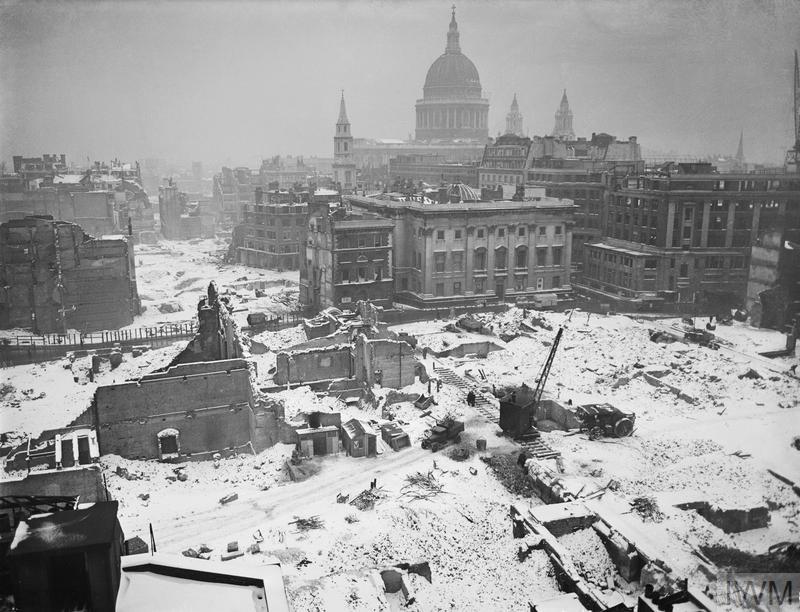
“Bomb Damage in London, January 1942,” Imperial War Museums (D 6412)
Every poem has a purpose, William Wordsworth says in the preface to Lyrical Ballads, the poetry collection he collaborated on with Samuel Taylor Coleridge. This probably isn’t what most people remember him saying. More memorable are his claims that poetry should be written in “the real language of men” (i.e., not in self-consciously poetic diction), that poetry consists of “the spontaneous overflow of powerful feelings,” and that poems are made out of “emotion recollected in tranquility.” His claim about purpose, which is abstract and slightly odd, is easy to forget.
According to Wordsworth, the purpose of a poem is “to illustrate the manner in which our feelings and ideas are associated in a state of excitement.” This is so bland that a reader’s eye impatiently skips over it. It’s less pithy and much less amenable to conceptual handling than, say, Horace’s idea that literature is supposed to delight and instruct. Don’t people always experience feelings and ideas in association with other feelings and ideas? Excitement, by the way, is notwhat makes poetry poetry, Wordsworth goes on to say. To the contrary! He’s against sensationalism (“this degrading thirst after outrageous stimulation”); he deprecates the idea that extreme subject matter—death, violence, lust—makes a work of literature valuable or interesting. In good poems—in his poems—“the feeling therein developed gives importance to the action and situation, and not the action and situation to the feeling.”
If a little girl dies in a snowstorm, in other words, Wordsworth writes a poem not for her sake but in order to find out what he thinks and feels about it. The narcissism of this is wonderfully Wildean, though maybe this is the case with all true literature. The specifics of what Wordsworth seems to mean are both subtle and impossibly grandiose. “I believe,” he writes, “that my habits of meditation have so formed my feelings, as that my descriptions of such objects as strongly excite those feelings, will be found to carry along with them a purpose.” Purpose here seems to be almost an aftereffect of sensibility. It isn’t a specific aim, but a sense of having an aim—a feeling of meaningfulness. The events that inspire a poem are more or less arbitrary. What matters is the nature of the mind excited by the events, a nature revealed through the choices the mind makes as it does its describing. “Nature,” by the way, is probably the wrong word. The mind in question has been formed, given shape and edge by a kind of study—by long-continued effort to enhance and structure its receptivity. One implication of this theory is that at the moment of a poem’s creation, the poet may not have much control. His conscious labor, to the extent that volition comes into play at all, has to happen earlier: in the years leading up to that moment, years the poet spent cultivating an openness to feelings and to the beauty of the world.
Though Wordsworth never quite out and says it, the purpose of a poem is to show the mind of the poet, to show the resonances that his way of life has given to his sensibility. A great poet, Wordsworth writes (his grandiosity flushed out into the open by the imperative to explain what he’s trying to do), has “a more comprehensive soul.” He is distinguished by his “greater readiness and power in expressing what he thinks and feels, and especially those thoughts and feelings which, by his own choice, or from the structure of his own mind, arise in him without immediate external excitement.” Notice that by this point in Wordsworth’s explanation, excitement is by the way, and any real events that cause excitement are almost regrettable, maybe even a little vulgar. In several passages in the preface, in fact, Wordsworth stresses that the poet probably can’t and maybe shouldn’t make poetry directly out of his feelings about real events, not even when the events have happened to him personally. Instead the poet is to use doubles or mirrors or imagined representations of original feelings. Even when the poem is about his own emotions, he is to work from “an emotion, kindred to that which was before the subject of contemplation.” The doubling distances the poet from reality, and in Wordsworth’s opinion, this distance is to the good. Meter further de-realizes a poem. No one in real life consistently speaks in meter, after all. “The co-presence of something regular,” Wordsworth writes (a lovely phrase!), soothes and reassures in cases where too sharp an apprehension of reality would be distressing.
Not long ago I read the poet Thom Gunn’s letters, and because Gunn was an enthusiast, who raved to friends about his favorite music, movies, novels, and gay bars (including a bar in New York’s East Village that was a favorite of mine, too, at the time he was writing about it, the mid-1990s—though I never ran into him; I biked past it yesterday; it’s a bodega now), I found myself taking notes. To read, on Gunn’s recommendation: Basil Bunting’s Briggflatts. Robert Duncan’s Opening of the Field. Marianne Moore’s Observations. And a Wordsworth poem that Gunn wrote to Robert Pinsky about, in June 1989:
I did find a wonderful poem by Wordsworth I’d never read before, “St Paul’s,” written 1808, not published till 1947. . . . I have never really been able to figure W out. . . . the Lucy poems leave me feeling that it’s possible to be too artless . . . I know how Keats’s worst poetry is connected to his best (it would be possible to make a kind of spectrum), but I don’t know how W goes from his worst (or even his average) to his best. It’s as if, once in an age, he is suddenly able to find a tune which matches his complete intentness of feeling. As in this poem. [Gunn, Letters 467]
Wordsworth’s unevenness is one of the mysteries about him. For pages and pages he writes about clouds floating through his mind that he happens to find morally significant, the verse as flocculent as the subject—and then a gust lifts his kite into the sun, and he makes you want to cry. (Or makes me want to, anyway. A friend of mine who’s a beautiful poet is so immune to his intermittent charm that she can’t understand how I can bear him.)
“St. Paul’s” was written in Grasmere, the village in the Lake District where Wordsworth and his sister, Dorothy, lived, in the spring of 1808. It describes the end of a trip to London. Wordsworth had traveled there to find a publisher for The White Doe of Rylstone, a long historical poem of his that he and Dorothy were hoping would bring in money. Unfortunately for Wordsworth’s bargaining position, a two-volume collection of his poems, published the year before, had sold poorly. Byron had trashed it as “namby-pamby,” and was not the only reviewer to have been unkind. Wordsworth made his bargaining position even weaker by refusing to let his editor read the manuscript before bidding on it. “Without money what can we do?” Dorothy wrote to him, in exasperation, when she heard he was being difficult.
New House! new furniture! such a large family! two servants and little Sally! we cannot go on so another half-year. . . . Do, dearest William! do pluck up your Courage—overcome your disgust to publishing . . . [quoted in Gill, William Wordsworth: A Life 1990: 265]
A second object of this London trip was to visit Coleridge, who was ailing. The Royal Institution had commissioned Coleridge to deliver twenty-five lectures on poetry, but Coleridge had had a breakdown—vomiting, diarrhea, paralyzing anxiety—and was dosing himself with hensbane, rhubarb, magnesia, and laudanum. He dodged Wordsworth’s first attempts to pay a visit, maybe because he sensed that Wordsworth felt he should be making more of an effort to wean himself off the opiates. Over the years, a fair amount of tension had developed between the two—the one an industrious if underpaid tribune of sanity, and the other a chaotic and irresolute prophet of imagination. They had started to get on each other’s nerves. During this visit to London, Wordsworth, ever the philosophical egotist, declared that he did “not see much difficulty in writing like Shakespeare,” and the essayist Charles Lamb reported in a letter, with amusement, that Coleridge was “a little checked by this hardihood of assertion.”
While Wordsworth was in town, Coleridge’s health improved enough for him to throw a tea party, which he presided over from bed, swaddled in sheets and blankets, and to resume his lectures. In the third lecture, which Wordsworth attended, Coleridge quoted a poem of Wordsworth’s about daffodils (“I wandered lonely as a cloud”) as an example of the power of imagination. In his fourth, on April 2, he praised poetry’s “power of so carrying the eye of the Reader as to make him almost lose the consciousness of words—to make him see everything” [quoted in Holmes, Darker Reflections 115–27].
The peroration must have been echoing in Wordsworth’s ears when he left London the next day, April 3. He left Coleridge’s apartment “at 7 o’clock on Sunday morning . . . in a very thoughtful and melancholy state of mind,” he was to write to his friend Sir George Beaumont on April 8, in a letter that shares so much of the phrasing of “St Paul’s” that it could be considered a dry run in prose. [Joseph F. Kishel, ed., The Tuft of Primrose 1986: 3] (Maybe this is the secret of Wordsworth’s breakthroughs—that they are poems he first worked out in prose? Call it the Edward Thomas method.) He hadn’t found a buyer for the White Doe. He was leaving the manuscript behind with Coleridge, who was under the impression that Wordsworth wanted him to try to sell it. (When Coleridge did negotiate a sale, about a month later, Wordsworth was to declare that he hadn’t wanted him to and to hurt Coleridge’s feelings by canceling the deal.) In Grasmere, Wordsworth knew, a family friend had been coughing up blood, and when he arrived home, he was to find his son John gravely ill with meningitis. Failure and loss, vocational and personal, threatened on all sides. Here is how the poem begins:
Pressed with conflicting thoughts of love and fear
I parted from thee, Friend,
Wordsworth addresses the poem to Coleridge, without naming him. Also unnamed are the specific thoughts of love and fear in his mind. Had he already been thinking of Coleridge, consciously or unconsciously, in the prose version he sent to Beaumont? Had he been thinking of him but reluctant, because of the rivalry between them and the growing difference in their ways of life, to write to him? It’s also possible, of course, that in both versions, Wordsworth is speaking mostly to himself. A public letter is usually meant for its addressee only in a sort of ostensible, fictional way. It is not an accident that the poem starts with parting.
and took my way
Through the great City, pacing with an eye
Downcast, ear sleeping, and feet masterless
That were sufficient guide unto themselves,
And step by step went pensively.
Eye, ear, feet. This is a poem of detachment—of things taken apart and seen, at least for a moment, only for themselves. The poet’s body is here disassembled, and from each component, the corresponding faculty is taken away. Vision declines, hearing goes dormant. Feet are left to find their own way. The poet is dropping into a state that is the opposite of poetic intensity. His senses are lessened; his mind is growing inattentive, less present. In dejection and exhaustion, he is shutting the world out. Reducing himself, absenting himself. According to Wordsworth’s preface, a poet is supposed to have a sensibility across which the events of the world play, like a breeze across a wind chime. Wordsworth has sunk here to sensibility at degree zero, if not below zero. He is closed, empty. Even in this hollowed, slumbrous state, however, there’s a shut-down, depressive, lumbering majesty to the rhythm.
Now, mark!
Not how my trouble was entirely hushed,
(That might not be) but how, by sudden gift,
Gift of Imagination’s holy power,
My Soul in her uneasiness received
An anchor of stability.
From inattention, pay attention! From this point on, the poem is built out of appositives, noun phrases placed one after the other so that the second modifies or clarifies the first, a grammatical structure that suggests addition and also unfolding. A word in one line bumps into, and opens up into, an idea in the next. Here, for example, the words “sudden gift” hit up against, and give way to, the phrase “gift of Imagination’s holy power.”
The idea here about beauty—that perceiving it can restore, at least for a moment, a person’s balance—seems like it must be an old one. Plato wrote in the Phaedrus about beauty as the inspiration for art, but for Wordsworth, the apprehension of beauty is much less erotic than what Plato describes, and the benefit is more sharply limited: a temporary finding of one’s center, and no more. Of this hedged, disillusioned version of the idea, Wordsworth’s might the earliest formulation. The poet Charles Reznikoff, in his novel By the Waters of Manhattan(1930), gives it to his hero, Ezekiel: “To see a painting or a statue, he thought, and then to look out of the window, is to see how fresh and richer life itself is.” Ezekiel remembers coming across the idea in the work of a “German philosopher” (who may have been Schopenhauer, but I haven’t read Schopenhauer). The idea recurs again in the novelist Iris Murdoch’s philosophical treatise The Sovereignty of Good (1970): “I am looking out of my window in an anxious and resentful state of mind, oblivious of my surroundings, brooding perhaps on some damage done to my prestige. Then suddenly I observe a hovering kestrel. In a moment everything is altered. The brooding self with its hurt vanity has disappeared. There is nothing now but kestrel. And when I return to thinking of the other matter it seems less important.”
— It chanced
That while I thus was pacing, I raised up
My heavy eyes and instantly beheld,
Saw at a glance in that familiar spot
A visionary scene—a length of street
Laid open in its morning quietness,
Deep, hollow, unobstructed, vacant, smooth,
Another appositive, but with verb phrases instead of noun phrases: “instantly beheld” bumps into and opens up into “Saw at a glance in that familiar spot / A visionary scene.” Then comes an incantatory line of five adjectives in a row, suspended from the normal rules of poetic meter. Somehow we accept the four syllables of the word “unobstructed” as a single beat. The adjectives refer backwards to the noun “street” two lines above, as if they descend from it or radiate from it, the way snowflakes descend and radiate from the sky, each becoming, as it does, a potential independent focus of attention.
And white with winter’s purest white, as fair
As fresh and spotless as he ever sheds
On field or mountain.
I’m ruining the poem a little bit, of course, by glossing it like this—by saying explicitly that what we’re seeing here is snow, when Wordsworth chooses to withhold the word “snow” until the poem’s last moment, when it arrives like a ratification. Note that at this point Wordsworth has only revealed one element of the “visionary scene,” the (snow-covered) street.
Moving Form was none
Save here and there a shadowy Passenger
Slow, shadowy, silent, dusky,
A second incantation. Again the words break meter; the word “shadowy” is made to last as long as the word “slow.” Wordsworth isn’t shy about repeating the word “shadowy,” just as he isn’t about repeating the words “gift,” “pacing,” and “white” earlier in the poem, or the words “street,” “silent,” and “veil” later. One senses that the moving form, who is and isn’t here, is a double of Wordsworth. A self that has become diminished, a self somewhat disavowed.
and beyond
And high above this winding length of street,
This moveless and unpeopled avenue,
Pure, silent, solemn, beautiful,
A third incantation. The eye has taken in, as it rises, first the street, second the walker, and now, third, . . . Without yet knowing what the third element is, we are told about its silence and purity, qualities it shares, we sense, with the snow.
was seen
The huge majestic Temple of St Paul
In awful sequestration, through a veil,
Through its own sacred veil of falling snow.
Maybe the street represents a journey, and the passenger, the self who is taking the journey. One thinks of Keats’s speculation that this world is a “vale of soul-making.” London, for the moment, was that vale, for Wordsworth. Is that the meaning of the scene’s third element—is St. Paul’s the soul that Wordsworth is journeying toward? T. E. Hulme’s famous objection to Romanticism, which he dismissed as “spilt religion,” was that the Romantic aesthetic deliberately makes it impossible to answer such a question; the referent of such a signifier is kept vague in order to suggest that “man, the individual, is an infinite reservoir of possibilities,” as Hulme put it, which Hulme, a political conservative, didn’t think man was. Literally, of course, St. Paul’s is a cathedral, a “temple” as the poem says. To use the seat of religious authority in one’s country as a symbol of the infinite in oneself—a conservative wouldn’t have liked that one bit. Does the cathedral here represent the vocation of poetry? Is it a version of Wordsworth’s self that could survive not being paid, that could rise above not being understood? Superimposed on the cathedral are traces of another image: a person behind a veil, probably a woman, kept apart for reasons of ritual. In awful sequestration. A person initiated in the mysteries. Kept pure. Alone. Apart from Coleridge, apart from Dorothy, apart from wife and child. Maybe Wordsworth was having a vision of the sensibility he believed it was his calling to develop in himself, of the vital texture of associations that he thought gave him his purpose in the world. He couldn’t ever rely on seeing it, and he couldn’t consistently summon it, but at moments, unexpectedly, it was revealed.
The Atlantic is publishing a new poem of mine on their website today. It’s called “Pemaquid lighthouse revisited,” and it’s about Peter and me revisiting a geologically striking promontory in Maine last year. It’s also about being married, and about being gay and being married, and about time. It’s sort of a knockoff of “Tintern Abbey” and sort of an answer to Auden’s “In Praise of Limestone,” a poem that also discusses homosexuality in rocks (which I wrote about for The Atlantic years ago, as it happens). At one point, Auden describes the young men in his poem as “at times / Arm in arm, but never, thank God, in step,” and as kind of a riposte to that anxiety of Auden’s (what would be so terrible about being in step, Wystan?), I wrote in alternating five-beat and six-beat lines, so that every pair of lines is, as I put it in the poem, “in step the way one always is in time / and differing the way one always does in time.”