
When my essay “Melville’s Secrets” was published last year by Leviathan: A Journal of Melville Studies, I wasn’t able to obtain permission to post a copy here on this blog. Since then, however, Leviathan has moved to a new publisher, Johns Hopkins University Press, which does allow scholars to archive their contributions on personal websites. With the editors’ permission, therefore, I’m posting the essay here today. (The essay is also available as a PDF at the journal’s website, if you work at an institution with a subscription to Project Muse).
Category: whaling
The Counterpane
This morning you can find me online reading “The Counterpane,” chapter 4 of Moby-Dick. Ishmael wakes up in Queequeg’s arms, is startled to find his bedmate’s hard tomahawk between them, and is reminded of the time his step-mother caught him trying to go up the chimney.
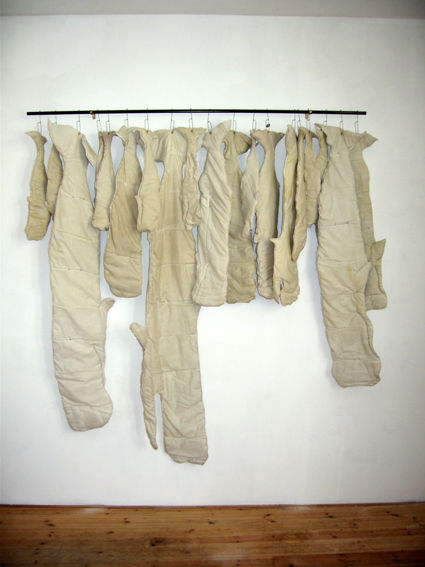
The reading is part of the Moby-Dick Big Read, which invites 135 different readers—including Tilda Swinton, prime minister David Cameron, Chad Harbach, and Andrew Delbanco—to tackle a chapter of Herman Melville’s novel. The project is being organized by the writer Philip Hoare and the artist Angela Cockayne. Hoare is the author of The Whale, which recounts his lifelong, Melville-induced pursuit of the leviathan, and Cockayne, too, takes much inspiration from Melville’s novel (the photo above is of her work Sleeping Sperm Whales).
I feel very honored to take part. The Guardian notes that other readers include Benedict Cumberbarch, Will Self, and David Attenborough; the New York Times reports that John Waters and Stephen Fry are involved; and the Provincetown Wicked Local adds the names Fiona Shaw, Cerys Matthews, and Nathaniel Philbrick.
“Melville’s Secrets”
 My essay “Melville’s Secrets” will be published in the September issue of Leviathan: A Journal of Melville Studies. A subscription to the journal is sent to all members of the Melville Society, so join now (you can use Paypal and do it all online), if you’d like a copy. The essay is a mild revision of the Walter Harding lecture that I gave at SUNY Geneseo in September 2010.
Melville’s Secrets: The Walter Harding Lecture, 2010
Yesterday afternoon I gave the 2010 Walter Harding lecture at SUNY Geneseo. The lecture series is named after Walter Harding, who taught for decades in Geneseo and was the preeminent twentieth-century scholar of Henry David Thoreau, and I felt it was a tremendous honor to have been asked. I talked about Melville’s secrets—in particular, about a distorted Platonic myth that I suspect may be present in Moby-Dick. “Ishmael,” I claimed, “might be considered a final, uninvited guest to Plato’s banquet, and his tale a postscript to Diotima’s.”
SUNY Geneseo has already uploaded a video of my talk (perhaps also embedded below, if I’ve coaxed the html sufficiently); a downloadable audio is forthcoming. I’m not going to post a transcript, because I’m hoping to revise the talk into a scholarly paper in the not-too-distant future. To that end, if any of you who heard the talk yesterday or who listen to it online have suggestions, corrections, or comments, please get in touch.
I had a great time at SUNY Geneseo. Many thanks to Marjorie Harding, for the gift that made the lecture series possible; it was an honor to meet the Harding family. I’m very grateful to Geneseo’s English department for their hospitality and great questions. I’m especially grateful to department chair Paul Schacht for his support and guidance, to associate professor Alice Rutkowski for a very kind introduction, and to the college president and English professor Christopher Dahl and his wife Ruth Rowse for a lovely dinner.
More evidence of sperm-squeezing
Looking again at “A Squeeze of the Hand,” Melville’s chapter about the practice of squeezing spermaceti, I noticed that Melville adds a telling bit of linguistic detail. Among the names that he gives for sperm whale detritus is slobgollion, “an appellation original with the whalemen.” He defines it as “an ineffably oozy, stringy affair, most frequently found in the tubs of sperm, after a prolonged squeezing, and subsequent decanting. I hold it to be the wondrously thin, ruptured membrances of the case, coalescing.”
It occurred to me that if sperm-squeezing was a real practice, then slobgollion must have been a real word, as well as an unusual one—and that with Google it’s now very easy to gather information about unusual words. A quick consultation with the OED proved inconclusive—though I did win a round of OED bingo—that is, when I looked up slobgollion, I found no more than the Melville passage I was trying to verify. Somewhat more helpfully, William Clark Russell’s 1883 Sailor’s Dictionary defines the word as a “whaleman’s term for an oozy, stringy substance found in sperm oil.” Clark Russell’s dictionary is so much later than Melville’s, though, that it’s possible he was just borrowing from Melville.
A more intriguing find was a report by Robert Clarke, “Open Boat Whaling in the Azores: The History and Present Methods of a Relic Industry,” Discovery Reports Issued by the National Institute of Oceanography, vol. 26 (1954): 283-356. Clarke visited the Azores in the summer of 1949 to study the natives’ continued practice of open-boat whaling. “The methods employed,” Clarke writes, “are a survival of that old-time whaling generally believed to have quite vanished from the seas, . . . learned from American whalers in the nineteenth century” and including not only the chase but also “the ‘cutting in’ of the whales and . . . the ‘trying out’ of their blubber in iron pots on the shore.”
Describing a heat purification system for oil and blubber at Negrito, on the isle of Terceira, Clarke writes:
The try-house stands nearby on somewhat higher ground, before a cemented space where two stone blubber tanks are excavated. Within the try-house there is a battery of four pots which are used for blubber only. The spermaceti from the case and junk is boiled out separately in an adjoining open-air try-works whose two pots are made not from cast iron but from riveted sheets of wrought iron. Spermaceti needs a lower temperature for trying out than blubber, and I have been told, rather obscurely, that this explains the use of sheet iron pots. At several Azores stations the case and junk are tried out indiscriminately with the blubber, so that the cooked spermaceti or ‘head oil’ is not kept separate. But where this separation is carried out, I understand that it is still customary, as in the whaleship days, to ‘squeeze sperm’ before putting the head matter into the pots. Squeezing sperm means plunging the hands into a tub of the semi-liquid spermaceti and there squeezing them together, so as to remove ‘slobgollion’, the fine strings and tatters of membrane which are suspended in the spermaceti and which would tend to char in the pots and somewhat affect the quality of the head oil.
So was sperm-squeezing real? I’m still not sure. The very word slobgollion, not being Portuguese, is probably one that Clarke brought with him to the Azores, borrowed from his reading of Melville. Also, the telltale phrase “I understand” seems to indicate that Clarke did not witness the practice himself. Still, he was told by someone he trusted that it did take place. Note that Clarke’s understanding of the purpose of sperm squeezing is not Melville’s but the one William M. Davis gave in Nimrod of the Sea (1874).