Ghastly Sights

Lynn Hunt’s Inventing Human Rights: A History is the subject of a lovely, insightful review by Gary J. Bass in the 7 May 2007 issue of The New Republic. Last month I wrote about Gordon Wood’s New York Times review of the book, because I was taken with Hunt’s suggestion, as relayed by Wood, that novels, by teaching empathy, fostered the development of human rights. Wood was skeptical of the link, but Bass thinks it reasonable:

The point that literature has been a cause of empathy is not a new one, but it is still a good one. . . . [T]his closing of the distance between people represented, in Hunt’s view, a huge leap of the moral imagination—the sort of leap without which the idea of human rights would not have been possible.

Bass has high praise for Hunt’s book, but he notes that she hurries through the history of human rights in the nineteenth century, and therefore provides his own capsule summary of the missing years. His survey ends with the observation that a liberal reader might look back “with a certain sense of satisfaction” at the progress made between the sixteenth century and now. “Human rights is not triumphant, to be sure; but the idea is holding its own.” But then he adds a note of concern:

Yet there is one element of this era of human rights that is in retreat: print capitalism, and thus foreign press coverage. Print and capitalism are not getting along. . . . Under heavy pressure from investors, some of the country’s best newspapers have decided to go local. . . . When the suits decide to shut those [foreign] bureaus, they fritter away a hard-won achievement of centuries. They are reversing the moral gains of modern empathy.

This adds a new wrinkle to the speculation that has been worrying me, namely, that as novel reading gives way to the enjoyment of streaming, visual media, we may no longer be able to take for granted that people will feel the kinds of empathy they used to. Newspaper executives shut their foreign bureaus, of course, for the same reason they shut down their papers’ book-review sections: they have to cut something, because profits are down, and they suspect their readers won’t mind their absence.

Bass’s review provoked another speculation in me. In passing, he jokes that public executions and public state-administered torture were the eighteenth-century equivalent of “the slasher movies of our time” in their capacity to draw an audience. He writes that Declaration of Independence-signer Benjamin Rush

denounced public punishment for its attempt to block the public from empathizing with the sufferer. For Rush, it was crucial to realize that even convicts “possess souls and bodies composed of the same materials as those of our friends and relations.”

It’s intriguing that an eighteenth-century human rights activist (to describe Rush loosely) was concerned that the spectacle of punishment would deter empathy. Rush, a doctor, thought and wrote about the human nervous system, so his interest in the problem is understandable. Rush’s comment reminds me of Charles Dickens’s famous description of the “wickedness and levity” of the London crowd that gathered to watch the 13 November 1849 hanging of the husband-and-wife murderer team Frederick and Maria Manning:

Fightings, faintings, whistlings, imitations of Punch, brutal jokes, tumultuous demonstrations of indecent delight when swooning women were dragged out of the crowd by the police, with their dresses disordered, gave a new zest to the general entertainment. When the sun rose brightly—as it did—it gilded thousands upon thousands of upturned faces, so inexpressibly odious in their brutal mirth or callousness, that a man had cause to feel ashamed of the shape he wore, and to shrink from himself, as fashioned in the image of the Devil. When the two miserable creatures who attracted all this ghastly sight about them were turned quivering into the air, there was no more emotion, no more pity, no more thought that two immortal souls had gone to judgement, no more restraint in any of the previous obscenities, than if the name of Christ had never been heard in this world.

The novelist, too, worried about the moral effects that such a spectacle had on its observers. (Herman Melville, as it happens, was also watching that day, and wrote in his journal, more laconically, that “The mob was brutish.”) I’m wondering, I suppose, whether, having been taught by novels to value empathy, reformers recognized such spectacles as enemies of empathy and therefore sought to quarantine them, and whether we risk something in allowing them to multiply.

While on the subject, I ought to correct a misstatement. I wrote, a couple of weeks ago, that David Griffith’s A Good War Is Hard to Find “starts by comparing the novel and movie versions of the torture scenes in Deliverance.” Not so; that was my misunderstanding of an email from its publisher, Richard Nash of Soft Skull Press, who was kind enough to send me a copy. Now that I’ve read it, I can say that Griffith does compare the novel and movie versions of Deliverance, but his comparison is in chapter 4, not chapter 1:

In the film, the scene lasts only a few minutes, whereas in the book, narrated in the first person, the whole episode lasts for nearly thirty pages. . . . Dickey’s book forces us to meditate on the ugliness of violence through images that are not neutral and objective but that call attention to the way violence, as Simone Weil argues in her revolutionary essay on The Iliad, can make a human being into an object. . . . Dickey captures the language of empathy that compels us to see the violence as despicable, not funny. . . . There is no way to flinch, to turn away, or close our eyes to it; there is no soundtrack to dull the senses.

Griffith doesn’t think the movie of Deliverance irresponsible in its handling of violence; his implied comparison here is actually between both versions of Deliverance and Tarantino’s Pulp Fiction, which he finds “ultimately destructive.”

The distinction between novelistic description and filmed depiction of torture is not, however, Griffith’s main concern. What he’s after is the distinction between representations of evil that are merely entertaining and those that allow the reader or viewer to understand his own complicity—his sin, actually, because Griffith is a Catholic, and his book is not only a meditation on the roots of the Abu Ghraib scandal in American culture but also an essay in theology. It’s an idiosyncratic, highly personal essay in theology, written with an appealingly broad yet lightly worn erudition, citing sources as disparate as Flannery O’Connor and Wayne Koestenbaum, but it is theology nonetheless. I was reminded, in reading it, of how rich the vocabulary of serious theology is, and how infrequently it is spoken in the public sphere on such topics, about which it has much to say. As a lapsed believer, I couldn’t follow Griffith in all of his arguments. I agree, for example, that American culture is evasive on the subject of its own potential for evil, but I’m not sure that an awareness of one’s potential for evil is necessarily salutary for the soul. I also don’t think that the best way to re-introduce moral questions into the legal sphere is by a turn to religion, and I’m not convinced that an improved understanding of what it means to be a Christian nation would bring about the outrage and energy for reform needed in America on the subject of torture—though of course I’d be very happy if it did. Griffith’s is nonetheless a tremendously likable book, and it was uncanny how often I agreed with his aesthetic judgments—thumbs up for Blue Velvet, and down for Andy Warhol. I found myself wanting to push Muriel Spark on him, if by some chance he hadn’t already read her.

A final, utterly miscellaneous, but not altogether unrelated note: While reading J. Gabriel Boylan’s brilliant and quirky essay on Vangelis’s soundtrack to Blade Runner in a new journal called The Crier—an essay that prompted me to wonder, “If you Googled for William Blake, Isaac Asimov, and Frank Lloyd Wright, would you land on the Wikipedia page for Blade Runner?” only to discover, no, you land on Boylan’s essay—I found myself recalling the machine in the movie that distinguishes humans from replicants through a series of questions about empathy—in one case, empathy for an animal in pain—as if it were the most distinctive trait in human nature.
Oregon, free state

Just a few days after posting, my chart is out of date. On May 2, the Oregon Senate approved a bill authorizing same-sex domestic partnerships (link via Towleroad). Since the Oregon House has already approved it, and the governor is expected to sign, I ought to add another line to my chart:

2007 Oregon 1844 Oregon

To be consistent, actually, I should add in the right column all the states and territories that outlawed slavery between “1818 Illinois” and “1844 Oregon.” In other words, no sooner did I wonder why the pattern I’d noticed hadn’t yet “been broken by the passage of gay-union laws in states like California, low in the right column not because they abolished slavery later but because they didn’t exist until later,” than Oregon broke it for exactly that reason.

How much it costs

In a fascinating post on Weekend Stubble yesterday, Paul Collins relays the news that Philip Morris “covertly fund[ed] a global-warming denial campaign,” as if encouraging young people to addict themselves to tobacco weren’t bad enough. Paul’s source was an NPR interview with George Monbiot, an Oxford University professor who reports in a new book, Heat, that the tobacco company hired a public relations firm in the early 1990s to gin up a purportedly grass-roots organization to attack science it didn’t like. The group went on to attack the evidence on global warming, as well as that on secondhand smoke.

The name of the fake grass-roots organization (the term of art is Astro-turf) was the Advancement of Sound Science Coalition. When the NPR interviewer asked for the evidence that Philip Morris was behind it, Monbiot explained that his proof was in the cigarette maker’s own strategy documents. “The great thing about one of the big lawsuits against the tobacco companies is that one of the outcomes was to force the companies to put their archives on public record,” he said, adding “There’s a document which says we should launch this away from the big media outlets because they’re quite likely to smell a rat, whereas elsewhere, where journalists seem to be more naive.”

Since one of my hobbies is wasting time trolling through historical archives digitized on the Internet, I thought I would see if I could find this particular document in the Legacy Tobacco Documents Library, an online, searchable archive of documents that Philip Morris, Lorillard, Brown & Williamson, R J Reynolds, and others were forced to release. It turns out that it’s pretty easy to find it, once you figure out to search by the Astro-turf group’s acronym, TASSC. I’m guessing that Monbiot was referring to the “Proposed Plan for the Public Launching of the TASSC [The Advancement of Sound Science Coalition],” dated 30 September 1993, which on page 2 deprecates a launching through “top media markets” and prefers an approach that “Avoids cynical reporters from major media” in order to arrange for “less reviewing/challenging of TASSC messages.”

The fee for a 20-city launch was $60,000, as you may read on page 8 of the memo, though Philip Morris was given the option of economizing: a 10-city launch would only cost $35,000. As the letterhead reveals, the PR firm that created TASSC for Philip Morris was APCO Associates. They seem to be in business still; according to their website, it is part of their “Culture and Values” to “Tell the truth.” No doubt. At any rate, if you narrow your search by adding the keyword “APCO” to the keyword “TASSC,” APCO’s role emerges rather clearly. Here’s a memo from the embryonic stage, when further gestation was costing Philip Morris $25,000 a month, plus $15,000 a month for media relations and $12,500 a month for assisting the tobacco company’s regional directors. By February 1994, APCO was asking Philip Morris for $632,500 for TASSC for the year, somewhat more than the $500,000 the tobacco company had budgeted. In fact, every time TASSC coughs, APCO bills Philip Morris, and so it’s particularly amusing when Philip Morris flirts with hiring a rival PR firm, Burson Marsteller, to handle TASSC’s expansion into Europe. Suddenly and testily, APCO informs Philip Morris that TASSC is an independent organization, full of headstrong, high-integrity scientific minds, and APCO cannot guarantee that TASSC will cooperate.

In the end, APCO and Burson Marsteller both worked on the European expansion. On 25 March 1994, APCO wrote to Philip Morris about the proposed European Astro-turfing and suggested that the new group would be “positioned in a credible manner” if it also took on other public debates on science. “Global warming” is at the top of the list.

It’s only because of the court cases that we know any of this. In July 1994, an internal memo at Philip Morris suggested that the proper answer to the question “Isn’t it true that Philip Morris created TASSC to act as a front group for it?” is “No, not at all.” Reporters who figure out that APCO is the tobacco company’s procurer are to be told, “You’ll have to ask TASSC why they are working with APCO.”

Kaboom

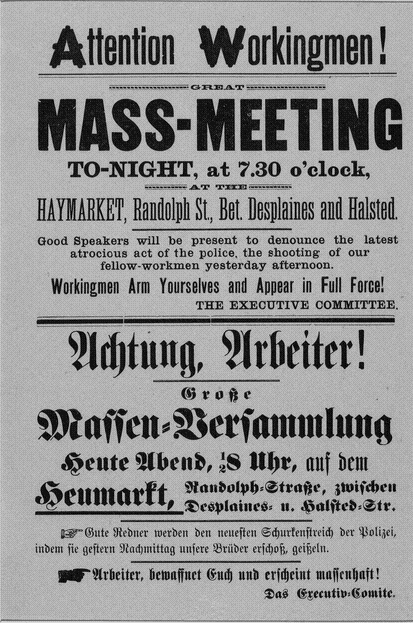
“The Terror Last Time,” my article about the 1886 trial of Chicago’s Haymarket anarchists, which is in part a review of James Green’s new book Death in the Haymarket, is published in the 13 March 2006 New Yorker. As it happens, there are many Haymarket resources on the web, so I thought I’d link to a few of them. What follows will seem a little scattered unless you read my article first (ahem), but if you’ve done that, then . . .

If you want to read the witnesses’ testimony yourself, the Chicago Historical Society has published the trial transcript in the Haymarket Affair Digital Collection. The collection has all sorts of neat tidbits. If you thought my description of Louis Lingg’s beauty was a bit too breathless, for example, you can judge for yourself here. If you want to see exactly how nut and bolt screwed together to make a bomb, look here, for a bomb allegedly Lingg’s. The historical society also collaborated with Northwestern University to create Dramas of the Haymarket, a sort of online guided tour of the archival holdings.

The 2003 re-analysis of the Haymarket bomb fragments and evidence was described in this article by Timothy Messer-Kruse, James O. Eckert Jr., Pannee Burckel, and Jeffrey Dunn in a 2005 issue of the journal Labor: Studies in Working-Class History of the Americas.

The night before Parsons, Spies, Engel, and Fischer were hanged, Parsons sang the Scotch ballad “Annie Laurie.” There’s no recording of Parsons himself singing it, but there’s a period recording of the song by the Edison Male Quartette in the UC Santa Barbara Cylinder Preservation and Digitization Project. As I mention in the article, the next morning, just a few hours before they were hanged, the men sang the “Workers’ Marseillaise” together. The three German speakers may well have sung in German, and I strongly suspect that that’s what’s being sung in this period recording. I’m not sure, though, because my German comprehension is extremely poor; it’s the right tune, certainly, and someone has catalogued it under the title Arbeiter, i.e., “workers.”

Against nicety in the popular cause

According to the front page of the New York Times, Republicans have said the word “Kerry” in the first three days of their convention more than twice as many times as Democrats said the word “Bush” in the first three days of theirs. In his speech accepting the nomination, Kerry called for restraint from ad hominem attack, but Cheney’s speech last night crescendoed into and spent itself in Kerry-bashing.

It’s asymmetric warfare, and it isn’t new. William Hazlitt explained the nature of it in his 1820 essay, “On the Spirit of Partisanship.”

Conservatives and liberals play the game of politics differently, Hazlitt wrote, because they have different motivations. Liberals are motivated by principles and tend to believe that personal honor can be spared in political combat. They may, in fact, become vain about their highmindedness. Hazlitt condemns the mildness as a mistake, both in moral reasoning and in political strategy. “They betray the cause by not defending it as it is attacked, tooth and nail, might and main, without exception and without remorse.”

The conservatives, on the other hand, start with a personal interest in the conflict. Not wishing to lose their hold on power, they are fiercer. “We”—i.e., the liberals, or the “popular cause,” in Hazlitt’s terminology—“stand in awe of their threats, because in the absence of passion we are tender of our persons.

They beat us in courage and in intellect, because we have nothing but the common good to sharpen our faculties or goad our will; they have no less an alternative in view than to be uncontrolled masters of mankind or to be hurled from high—

“To grinning scorn a sacrifice,
And endless infamy!”

They do not celebrate the triumphs of their enemies as their own: it is with them a more feeling disputation. They never give an inch of ground that they can keep; they keep all that they can get; they make no concessions that can redound to their own discredit; they assume all that makes for them; if they pause it is to gain time; if they offer terms it is to break them: they keep no faith with enemies: if you relax in your exertions, they persevere the more: if you make new efforts, they redouble theirs. While they give no quarter, you stand upon mere ceremony. While they are cutting your throat, or putting the gag in your mouth, you talk of nothing but liberality, freedom of inquiry, and douce humanité. Their object is to destroy you, your object is to spare them—to treat them according to your own fancied dignity. They have sense and spirit enough to take all advantages that will further their cause: you have pedantry and pusillanimity enough to undertake the defence of yours, in order to defeat it. It is the difference between the efficient and the inefficient; and this again resolves itself into the difference between a speculative proposition and a practical interest.

It is not fair play, and Hazlitt thinks that liberals who decline to fight fire with fire are fools. “It might as well be said that a man has a right to knock me on the head on the highway, and that I am only to use mildness and persuasion in return, as best suited to the justice of my cause; as that I am not to retaliate and make reprisal on the common enemies of mankind in their own style and mode of execution.”