The teal-and-mustard candidate

“I thought this might be a hoax,” an email now circulating on the internet begins. “Actually hoped it was, but snopes.com verifies the following info. . . . Obama The Patriot – Removes American Flag From His Plane.” And thousands of indignant Americans are now emailing this news widely, including to my relatives. “Please forward this if you’re not ashamed of our country and our flag,” the email suggests. And also: “If you do not forward this to everyone you know nothing will happen.”

To someone like me, the charge seems silly. Is it too silly to answer? Well, in the last election, people like me often thought themselves above responding to such charges, and it didn’t end well. And this particular accusation is awfully easy to answer, so . . .

Obama has indeed lowered the number of American flags on his campaign airplane, by trading in the flag-heavy corporate logos of North American Airlines for a design by his own campaign. But if you’re going to judge a candidate by his colors, it’s only fair to take a look at McCain’s plane for comparison. Have you seen it? Obama’s plane is red, white, and blue. What color is McCain’s? Teal and mustard.

There is an American flag on McCain’s plane, but it’s small, low to the ground, and hidden behind the jets. You can’t see it in most of the photos of the plane online. And if you take a second look at Obama’s campaign symbol, what do you really see? Red stripes, white stripes, blue. His symbol is the American flag, in a lot of ways. His symbol is saying that he’s so close to the flag that he’s at one with it.

For the record, of course I don’t seriously think that McCain’s choice of teal and mustard signals a lack of patriotism on his part. My point is that he’s just as vulnerable as Obama to such an attack—and maybe a little more so.

Their Name Is Legion

Pace the plausible deniers, there exists a blog devoted to exploring, in a spirit that is a ghastly echo of secular openmindedness, the idea that Obama is the Antichrist, and its readers take McCain’s recent web ad “The One” very much in earnest. In the comments section of this blog, a woman reports describing her enthusiasm over the news about the Antichrist to her psychiatrist, who then “gave me more meds.” Perhaps the McCain campaign would like to reimburse her health insurer? And then there’s the commenter “Assasinforfather” [sic], who is angry because the world is controlled by Satan and because, in what seems to have been a special revelation, he discovered that at the end of the world there will be no rapture, only universal tribulation. He writes that of “all the men in my lifetime who have been accused of being THE antichrist, Obama is the only one that the Spirit of Father has warned me of,” and warns that “I know who will give the beast the deadly wound.” Perhaps the McCain campaign would like to reimburse the Secret Service for the cost of paying this fellow a visit?

Under the cover of unacknowledged messages, a contribution can be made to the pool of irrationality in a culture. I’m not blaming the internet, by the way. Nixon was able to summon the silent majority from the vasty deep long before the internet existed. It is thanks to the internet, in fact, that one may see the process of summoning at work. One may watch an advertisement preying on superstition and fear one day, and then read the words of the mentally unstable, as they take courage from it, the next. The mentally unstable cannot be held to account, but the suits who stir them up may be.

PS: There’s a comprehensive round-up of Obama-as-Antichrist-alia here.

The Rove style

In his recent ads, John McCain has forfeited any claim he may once have had to a high-minded, statesman-like character. I am persuaded by Bob Herbert’s argument, in a New York Times op-ed published on August 2, that the McCain campaign was playing on the lowest racial stereotypes when it featured Paris Hilton and Britney Spears in its recent anti-Obama ad, “Celeb.”

McCain campaign, The One, 2008 (still from TV ad)

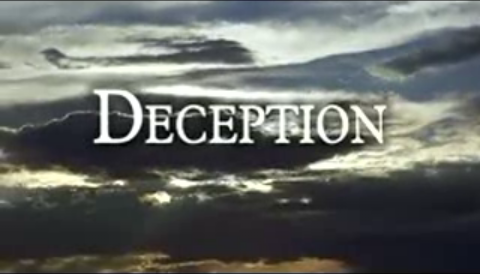
But evidently the gratuitous coupling of an ambitious black man with two highly sexed white women was not low enough for the McCain campaign. Now, as Scott McLemee, Maud Newton, and a number of others have been quick to perceive, the McCain campaign is toying with nothing less than armageddon. The new McCain ad, titled “The One,” suggests, in its imagery and language, that Obama is the Anti-Christ. The ploy is either blasphemy, an attempt to prey on religious fears, or both, depending on your convictions.

Left Behind, 2001 (still from movie trailer)

Some people will no doubt claim that those who see apocalypse-mongering in the ad are seeing things, and that it’s just a bit of humor. But humor and apocalypse-mongering aren’t irreconcilable; jokes often have unseemly subtexts. Just to call out one detail, I don’t think it’s an accident when, toward the end of the ad, the words “But Is He Ready” remain on the screen by themselves for a few moments. Eventually they are followed by “. . . To Lead?” but until then, they’re bound to raise a different possible ending in the minds of some viewers. I wish I could also claim that the style of the ad, as seen in the screen shot above—the stentorian mixture of caps and small caps, superimposed on an ominous cloud pattern—was unique, but alas, portentousness is widespread, and the resemblance to the screen shot to the left, from the trailer to Left Behind, may be no more than coincidental.

Obama examines the constitutionality of anti-gay legislation

This afternoon, the New York Times released an article by Jodi Kantor on Obama’s career as a law professor. In a sidebar, the Times posts a syllabus of his and quite a few of his exam questions, along with the corresponding answer memos.

Not that there was any doubt, but the new evidence suggests Obama has a formidably sharp mind. I didn’t expect, however, that the academic documents would cause me to tear up. In 2003, the first question on the final exam in Prof. Obama’s Constitutional law class asked for a brief on behalf of a monogamous gay couple in a relationship of ten years’ standing who want to challenge their state’s defense-of-marriage act and its legal restrictions on gay adoption. Of course the question, like most legal questions, could be answered merely as an intellectual exercise, but after the way that gays have been hung out to dry in recent elections, it moved me to discover that Obama, who supports the repeal of the Defense of Marriage Act, knows the legal terrain in such fine detail.

To wit: According to the answer memo for the exam (I at first thought that this answer memo had to have been written by Obama himself, but a commenter on the NYT‘s Caucus blog points out that law professors often distribute the best student answer in lieu of writing an answer memo themselves, so its authorship is uncertain), the equal protection clause of the 14th amendment will likely prove a stronger basis for the hypothetical couple’s case than the same amendment’s due protection clause. Because homosexuals are not considered a protected class under current interpretations of the amendment, the rationale for a law that singles them out need not be narrowly tailored to a legitimate state interest, but it does have to be “rationally related” to such an interest. “However, antagonism or a bare desire to harm a politically unpopular group cannot constitute a legitimate governmental interest (Romer).” The answer memo concludes that “if the [Supreme Court] finds that denying homosexuals marriage demeans their existence, it is likely that this statute, as written, will fail rational basis review.”

UPDATE, 11:50pm: The New York Times has deleted its link to the answer memo that I quoted above (though the link above still seems to be working) and has added a note reading, “In a previous version of this post, student answer memos were posted in addition to Mr. Obama’s memos.” So it seems that the answer memo was not written by Obama personally, though it remains true that he chose it as the best answer any of his students were able to provide.

Audacity of list-making

According to this morning’s New York Times, three Harvard child psychiatrists were paid more than $1 million each by pharmaceutical companies between 2000 and 2007, and failed to report most of the payments to the university, as they were obliged to. The omissions were uncovered by Charles E. Grassley, a Republican senator from Iowa, who has sponsored legislation that might help to solve the problem: He proposes a national registry of payments to doctors by pharmaceutical companies. This sounds like a wonderful idea to me, but my first thought as I read the article was, Of course it’ll never happen. Over the last eight years, I’ve learned to hope for no more than the occasional quashing of a really pernicious innovation (Cf. the privatization of Social Security). On second thought, however, I realized that my pessimism is a trained response, and that I am capable of unlearning it. In fact, I could start unlearning it now, because the Bush administration is about to be canned. I seem, after all, to have been carrying around in my head a list of regulatory and legislative changes that I’ve been hoping the next administration would put into effect. Herewith, in the spirit of very amateur punditry, in no particular order:

  1. A national registry of payments, in cash and in kind, to doctors by pharmaceutical companies and medical-device manufacturers, to be made publicly accessible in a searchable online database.
  2. Health care reform. My own personal horror story, with a creepy postscript: A couple of years ago, I woke up at 3am with excruciating pain. It was midwinter, and sleet was coming down outside. Seeing me curled up on the floor howling as I have never howled before, Peter called 9-1-1, and an ambulance soon arrived and took me to a nearby emergency room. It turned out that I was passing a kidney stone. Months later, our insurer, Blue Cross Blue Shield of Illinois, refused to pay for the ambulance ride, which cost slightly less than $500. They weren’t trying to claim that I hadn’t needed an ambulance. They were claiming that the ambulance I rode in was an out-of-network provider. I called them up and asked whether, as an Illinois-based company, they considered any ambulances in New York City to be in-network providers, because if they didn’t, they had no right to be offering insurance to companies located here. Oh yes, they said, they did have New York City ambulances in their network. Just not the one that took me. The name of the fly-by-night ambulance service I used? The Fire Department of New York. I tried arguing, in my appeal, that Peter wasn’t at 3am in any mental state to sort through which ambulance providers were in and out of network, that it probably wouldn’t have been medically appropriate to take the time to do that anyway, and that it wasn’t at all clear to me that New York City 9-1-1 operators let you specify which ambulance will come pick you up. They didn’t buy it; I had to pay out of pocket. Fast forward to 2008, when the city is considering a new program to send special ambulances to pick up people who’ve just died, so their organs will reach the hospital fresher (more on the concept here). A University of Pennsylvania bioethicist explained to the New York Times a potential objection:

    “There are a lot of Americans who have a hard time getting into a hospital because they don’t have insurance or they have poor insurance,” Dr. Caplan noted. “They will not necessarily find it a good thing when they find out that they can’t get into the hospital, but that a hospital will send a special ambulance to bring their body to the hospital when they’re dead.”

    My case is less dramatic, because I had no trouble getting into the emergency room and didn’t die. Still, if I had died, and such a program had been in operation, the ambulance would have been paid for. To make an unnecessarily long story short: The morality of not providing for health care for everyone will become more and more dodgy as medicine advances into such domains as high-speed organ recycling.

  3. A ban on the sale of sweetened drinks (including juices) and candy from all schools, and a ban on advertising food to children in print or on television.
  4. A national bully-pulpit campaign to urge energy conservation.
  5. The elimination of ethanol subsidies, because the math doesn’t add up on growing corn with natural-gas-produced artificial fertilizers in order to make a gasoline substitute. It’s an agribusiness boondoggle.
  6. The reform of U.S. farm policy generally. Drastic reform, if not elimination, of subsidies for corn, wheat, and soybeans. Failing that, support for the cultivation of fruits and vegetables at levels comparable to the support for commodity crops.
  7. A continued acceleration of fuel-efficiency standards for cars and trucks.
  8. A national commission to investigate all acts of torture perpetrated by U.S. agents or at their behest since 2001, to be modeled on the 9/11 Commission, with borrowings from South Africa’s Truth and Reconciliation Commission as necessary.
  9. The repeal of the Military Commissions Act, the shuttering of Guantánamo Bay and all secret U.S.-run prisons abroad, the end of the practice of rendition, and the closure of the military tribunal alternative justice system. The restoration of habeas corpus.
  10. The taxation of carbon.
  11. An end to obstruction by the Environmental Protection Agency, which should be enforcing laws that require coal-burning fuel plants to reduce their mercury emissions.
  12. More and safer bike lanes.
  13. The establishment of a national Financial Product Safety Commission, so that people may feel as confident when taking out a credit card or a mortgage as they do when buying a toaster.
  14. A Bill of Rights for non-citizens. Sixty-six immigrants died in detention between 2004 and 2007, according to the New York Times, which recently reported on one of them, Boubacar Bah, “a 52-year-old tailor from Guinea who had overstayed a tourist visa.” Bah suffered a head injury in detention, and when he came to, he yelled in his native language and threw up. His guards decided he was a “behavior problem,” put him in shackles, and took him to solitary confinement. His family didn’t hear of the accident until four days later, by which time he was in a coma, from which he never emerged.
  15. The repeal of the Defense of Marriage Act.
  16. Canadian-style packaging on cigarettes.
  17. An end to state-run lotteries, which are a tax on the poor. Yes, many of them give a portion of their income to state arts agencies, but that’s not a good thing: it’s a blatant and for some reason not transparent effort to buy the compliance of the intellectual class.