
In the tradition of They Might Be Giants' "James K. Polk," the band Two Man Gentlemen Band, who describe themselves in an email to me as a "vaudevillian-swing duo," have released the song "Franklin Pierce," in honor of the fourteenth U.S. president. They rhyme the president's last name with the word tears and beer, perhaps on account of his struggle with alcoholism. (It may not have been pronounced that way, though. His contemporary Lydia Maria Child, who loathed Pierce for opposing abolitionism, once said his name rhymed with curse.)
Category: American history
Lifestyles of the rich and famous, 1852 edition
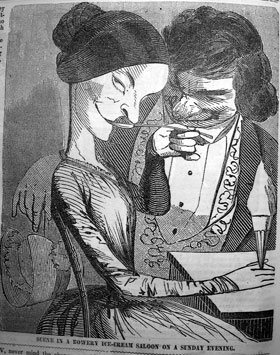
“They are evidently man and wife,” wrote the journalist George G. Foster, of two customers in one of 19th-century New York’s upscale ice cream parlors, “though not each other’s!”
I write about adulterous ice cream and other dark secrets in my chapter on old New York’s high life and low life in the forthcoming Cambridge Companion to the Literature of New York. I’ll be giving a short reading from my chapter at the launch party, free and open to the public, this Sunday night, May 2nd, at 8pm at the Bowery Poetry Club.
In my chapter, I take a quick tour of the literature of the down and out, but since the 19th-century down and out have been fairly well studied of late, I spend most of my page count describing a group of writers less well remembered: the chroniclers of the mid-19th-century rich, including such odd ducks as Charles Astor Bristed, Nathaniel Parker Willis, Régis de Trobriand, Ann S. Stephens, Donald G. Mitchell, George Templeton Strong, and George William Curtis. I discuss such vexing questions as how to mix a sherry cobbler properly, how to throw a party when your brownstone is only twenty-five feet wide, and what to do about the dangerous rash of flirtations between middle-aged women and much-younger men, as satirized in cartoons like this one, from 1852:

The caption, in case the scan is too grainy to read:
Young New York at a Party
Lady of the House.— Charlie, why don’t you ask Miss Brown to dance?
Charlie.— Cawn’t. Too demn’d young.
Reading for a living
Over at the Boston Globe‘s Brainiac blog, Christopher Shea relays the news that NPR has a new slideshow up about jobs that no longer exist, including copy boy, bowling pin setter, and lector, a person paid to read aloud to people rolling cigars by hand.
I knew I’d heard about this job before, though it took me a minute to remember that it was in James Weldon Johnson’s lovely 1912 novel Autobiography of an Ex-Colored Man:
After I had been in the factory a little over a year, I was repaid for all the effort I had put forth to learn Spanish by being selected as “reader.” The “reader” is quite an institution in all cigar factories which employ Spanish-speaking workmen. He sits in the center of the large room in which the cigar makers work and reads to them for a certain number of hours each day all the important news from the papers and whatever else he may consider would be interesting. He often selects an exciting novel, and reads it in daily installments. He must, of course, have a good voice, but he must also have a reputation among the men for intelligence, for being well posted and having in his head a stock of varied information. He is generally the final authority on all arguments which arise; and, in a cigar factory, these arguments are many and frequent, ranging from discussions on the respective and relative merits of rival baseball clubs to the duration of the sun’s light and energy—cigar making is a trade in which talk does not interfere with work. My position as “reader” not only released me from the rather monotonous work of rolling cigars, and gave me something more in accord with my tastes, but also added considerably to my income. I was now earning about twenty-five dollars a week . . .
The narrator is even able to afford to hire a piano.
Update (March 24): Jenny D. just relayed to me the news that on Thursday, March 25, at 7pm, here in New York, the Americas Society is hosting a reading by Araceli Tinajero from her new book El Lector: A History of the Cigar Factory Reader. (Alas, I won’t be able to make it, because I’m chained to my laptop impersonating El Escritor until further notice.)
Further update (later on March 24): The topic reminds my friend Gabe of Felipe Jesus Consalvos, a cigar roller in the early twentieth century who incorporated cigar boxes into his outsider-art collages.
And still more: Irin Carmon tells me via Twitter that there’s also a 2007 short documentary film about cigar lectors, With a Stroke of the Chaveta.
Into the horizon

I found this bookplate, unglued but still tucked into the front endpapers, in a history that I spent today reading. The book, which I bought used last week, was published in the 1930s; the Internet tells me that Edwin B. Coddington, its sometime owner, was the longtime chair of Lafayette College’s history department and wrote the definitive history of the Battle of Gettysburg, published in 1968, some time after his death. I like the way the bookplate evokes the idea of American history. I’ve been using it as a bookmark, and I must have looked at it half a dozen times before I had a Sesame Street moment and realized that the Indian and the airplane don’t belong in the same picture.
The Hard-knock life
"Beer Buddies," my review of Richard Stott's Jolly Fellows: Male Milieus in Nineteenth-Century America, appears in the February/March 2010 issue of Bookforum.