An unseemly rhyme

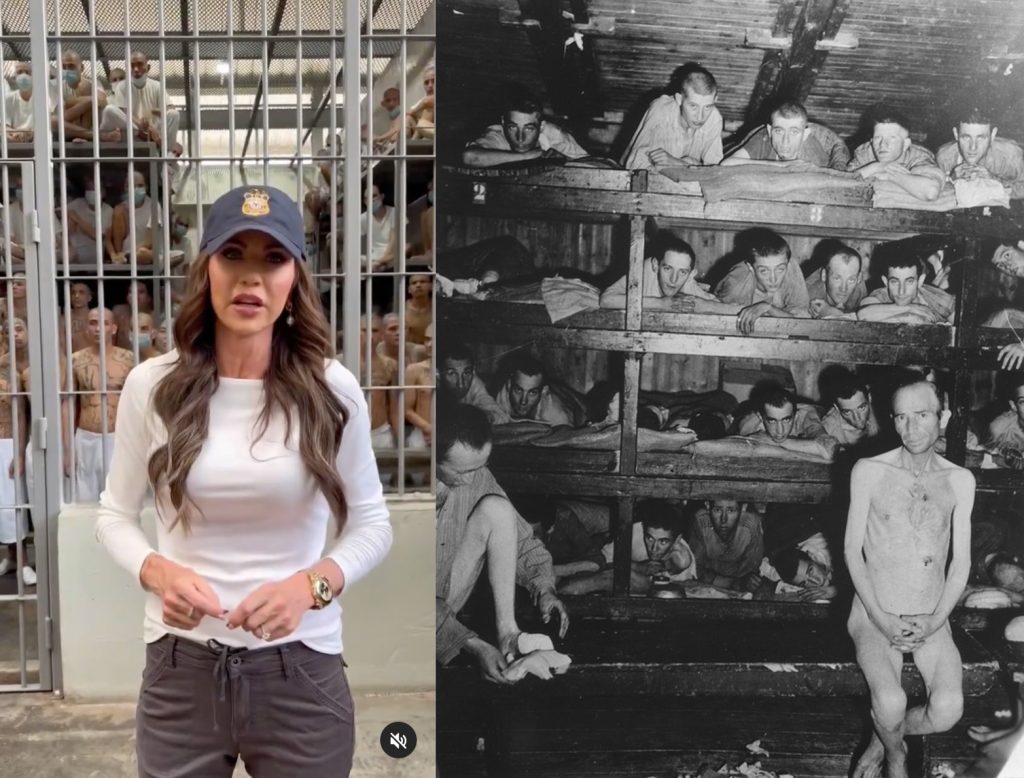
On the left, a color photograph of a woman in a blue baseball cap with long wavy hair, wearing a tight-fitting white jersey and drawstring gray cargo pants, in front of a cell inside of which can be seen prisoners standing and sitting on bunks. On the right, a black-and-white photograph of concentration camp survivors, sitting and lying in bunks inside a barracks at Buchenwald.

My mind has rebelled against the cascade of bad things the Trump regime has done lately by insisting that I pay attention for a little while to just one of them.

The week before last, the United States effected the spectacular rendition, fascist in manner and deed, of several hundred Venezuelan refugees to a forced-labor prison in El Salvador. U.S. immigration officials began laying the groundwork for the rendition well before Trump came to power for the second time.

As early as June 2024, American immigration officials began detaining Venezuelan refugees for their tattoos—a form of personal expression that, ironically, has been bound up with American national identity since the early republic, when sailors marked their bodies permanently as American in an effort to keep from being impressed into the British navy, which, long after America’s independence, was slow to distinguish American citizens from British subjects (see Nathan Perl-Rosenthal, Citizen Sailors: Becoming American in the Age of Revolution).

In June 2024, for example, an aspiring Venezuelan streetwear entrepreneur named Frizgeralth de Jesús Cornejo Pulgar, who had been targeted by paramilitary groups associated with Venezuela’s Maduro regime, met U.S. border patrol agents for an asylum interview that he had requested through the agency’s official app and was detained by them because of his tattoos. Not even a declaration from his tattoo artist, confirming that the designs were innocuous, could get him released. In November, Daniel Alberto Lozano Camargo, a Venezuelan asylum seeker working at a carwash in Houston, was detained because of his tattoos, which included the names of his father, his niece, and his partner’s daughter. In December, Jerce Reyes Barrios, a professional soccer player who had been arrested and tortured by the Maduro regime in Venezuela after taking part in peaceful political demonstrations, also made an appointment through U.S. immigration’s official app to apply for asylum, only for U.S. officials to argue that his tattoos—a soccer ball and a rosary—marked him as a member of the Venezuelan gang Tren de Aragua. He, too, was detained.

E.M., a young Venezuelan food vendor and delivery person who has so far only been identified in the press by his initials, fled to Colombia with his girlfriend in 2021, after paramilitaries in Venezuela targeted the two of them for their political activity. In 2023, E.M. and his girlfriend applied from Colombia for asylum in the United States. U.S. immigration agents in that country asked E.M. about his tattoos but, seemingly unconcerned, granted the couple official refugee status in late 2024. When the couple arrived in Houston on 8 January 2025, however, immigration officials designated E.M. a member of the same gang, also on the basis of his tattoos—a crown, a soccer ball, and a palm tree. He, too, was detained. All of these refugees denied gang affiliation, as did their families; none had criminal records.

The day of his inauguration, Trump issued an executive order declaring Tren de Aragua to be a terrorist organization. It seems likely to me, given the timing of the early detentions and of Trump’s first-day proclamation, that a plan was in place, and that officials inside Immigration and Customs Enforcement had been cooperating with it quietly even before Trump took office. After the inauguration, the collection of refugees accelerated. A Venezuelan barber named Franco José Caraballo Tiapa was detained because of his tattoos on 3 February 2025. When Frengel Reyes Mota, a house painter who fled Venezuela in 2023, checked in with U.S. immigration officials on 4 February 2025, he, too, was detained as a suspected gang member, even though he has no tattoos at all, as well as no criminal record, and even though, in the documents filed against him, “the government . . . uses someone else’s last name in several parts . . . , identifies him with female pronouns, and uses two different unique identification numbers that immigration authorities use to keep track of individuals.” A Venezuelan named Neri Alvarado Borges was also detained in early February; one of his tattoos was an autism awareness ribbon with his brother’s name. On February 8, an aspiring musician named Arturo Suárez Trejo was arrested by immigration officials at his home in Raleigh, North Carolina; his tattoos include a hummingbird, which his wife says symbolizes “harmony and good energy,” and a palm tree, a reference to a Venezuelan expression about God’s greatness that his mother likes to quote. The tattoos that got Andry Hernandez, a gay makeup artist, detained “are flowers and are dedicated to his parents,” one of his lawyers has told NBC News; Hernandez, too, was detained when he showed up for his appointment to request asylum.

In early March, these detained Venezuelan asylum seekers and others were moved to South Texas or Louisiana from detention centers elsewhere, vanishing from courtrooms around the country where their cases were still being heard. The government seems to have made tracking the location of the detained refugees difficult even for their lawyers, but Josh Kovensky, reporting for Talking Points Memo, has uncovered records of detainees being moved on March 5, between March 7 and March 9, and on either March 10 or 11.

On the night of Friday, March 14, the detainees were “told they would be deported the next day to an unknown destination,” and lawyers for the American Civil Liberties Union and Democracy Forward, representing five of these detainees, somehow “caught wind of these movements,” according to a narrative of the facts compiled by Judge James E. Boasberg. In the early hours of Saturday, March 15, the lawyers filed for a temporary restraining order, asking Boasberg’s court to prevent the U.S. government from sending the detainees out of the country before their cases could be heard. The lawyers suspected—correctly, it turns out—that the Trump regime was planning to deport the Venezuelans under the Alien Enemies Act of 1798, the only law to survive from the repressive Alien and Sedition Acts that schoolchildren are taught to deplore, a law that hadn’t been used in seventy-five years. Immigration officials were boarding detainees onto airplanes as early as 7am that Saturday morning. At 9:40am, Judge Boasberg gave a verbal order forbidding the government to send the five plaintiffs named in the case out of the United States. Immigration officials delayed the deportation of those five, but continued to deport the other Venezuelans in custody. At 4pm, the Trump regime revealed that Trump had indeed signed a proclamation targeting Tren de Aragua under the Alien Enemies Act, and at 5pm, Boasberg began hearing the civil rights lawyers’ request for a restraining order. The Trump regime’s representatives in court repeatedly refused to answer when Boasberg asked if detainees were at that very moment being deported, but in fact, the first plane left Harlingen, Texas, at 5:26pm. At 6:47pm, Boasberg enjoined the government from removing from the country anyone detained under the Alien Enemies Act—not just the five named in the lawsuit—and told the government that “any plane containing [members of the class] that is going to take off or is in the air needs to be returned to the United States. . . . This is something that you need to make sure is complied with immediately.” When he spoke those words, two planes were still in the air, and a third had yet to depart Texas. Boasberg’s order was entered into the court’s docket at 7:26pm Saturday evening.

The order was not complied with. The first of the U.S. government’s three planes landed in El Salvador at 12:10am Sunday morning—hours after both the oral and the written versions of Boasberg’s order. Boasberg wrote that “the most reasonable inference is that [the Government] hustled people onto those planes in the hopes of evading an injunction or perhaps preventing them from requesting the habeas hearing to which the Government now acknowledges they are entitled.” He was being almost polite. The Trump regime’s defiance of his court’s authority was flagrant.

The government’s planes landed at a “mega-prison” in El Salvador called the Centro de Confinamiento del Terrorismo (CECOT). Soon after they arrived, the president of that country, Nayib Bukele, who has ruled as a dictator since 2022, tweeted, “Oopsie… Too late,” a message that U.S. Secretary of State Marco Rubio retweeted. El Salvador, an authoritarian country, currently has “the highest incarceration rate in the world.” Its vice president has told the New York Times, “To these people who say democracy is being dismantled, my answer is yes—we are not dismantling it, we are eliminating it, we are replacing it with something new.” Bukele himself has boasted, “Let all the ‘human rights’ NGOs know that we are going to wipe out these damned murderers and their collaborators, we will put them in prison, and they will never get out. We don’t care about your pathetic reports, your paid journalists, your puppet politicians, or your famous ‘international community,’ which has never cared about our people.” The human rights NGOs that Bukele scorns have concluded that “torture has become a state policy” in El Salvador, and report that in its prisons, dead bodies have been left in cells until they stink, hungry prisoners have been made to lick food off the floor, and overcrowded cells are sometimes flooded and then an electric current passed through the water. Incarceration at CECOT, which is a forced-labor camp, seems to be permanent. “The Salvadoran government has described people held in CECOT as ‘terrorists,’ ” the director of the Americas division of Human Rights Watch notes, “and has said that they ‘will never leave.’ Human Rights Watch is not aware of any detainees who have been released from that prison.”

That the United States government had anything to do with Bukele’s regime at all is in itself a five-alarm fire. And sending refugees to a country with a human rights record like El Salvador’s is not only morally reprehensible—it is against U.S. law. As Boasberg notes in his decision, the Foreign Affairs Reform and Restructuring Act stipulates that the United States may not “expel . . . any person to a country in which there are substantial grounds for believing the person would be in danger of being subjected to torture.”

What brought the evil done by the Trump regime home to me, though, is the account that Philip Holsinger, a photographer for Time magazine, gave of the refugees’ arrival at CECOT:

The intake began with slaps. One young man sobbed when a guard pushed him to the floor. He said, “I’m not a gang member. I’m gay. I’m a barber.” I believed him. But maybe it’s only because he didn’t look like what I had expected—he wasn’t a tattooed monster.

On Bluesky, I saw speculation that this gay barber was Andry Hernandez, but there’s no way of knowing for sure. Hernandez is a makeup artist, and the two barbers among the deportees that I’m aware of seem to be straight. It hardly matters. The anguish of the prisoner, whoever he is, rings clear as a bell. And Holsinger’s photographs fill out the picture alarmingly. After arriving in the intake yard, in the middle of the night, the prisoners, shackled at their wrists and ankles, were slapped, kicked, and shoved. As the prisoners’ heads were shaved,

The guy who claimed to be a barber began to whimper, folding his hands in prayer as his hair fell. He was slapped. The man asked for his mother, then buried his face in his chained hands and cried as he was slapped again.

To recapitulate: Two weeks ago, my country, the one I was born in and that I’m a citizen of, sent hundreds of men, many with no criminal record, to a forced-labor camp in a totalitarian country that almost none of these men had probably ever been to. Upon their arrival, they were assaulted, their clothes were confiscated, and their heads were shaved. Those running the camp promise they will never leave. How is this not complicity in sending people to the modern equivalent of Auschwitz? How is this not the moral nightmare that every decent person alive today with any knowledge of history has been dreading his whole life? Whole news cycles of malfeasance by the Trump regime have coursed over us since these men were deported. But Andry Hernandez is still locked in CECOT, where, the Financial Times has written, if it ever reaches full capacity, each prisoner would have “less than half the minimum [space] required under EU law to transport midsized cattle by road.”

As if to prove the Trump regime’s immorality, Kristi Noem, the Secretary of Homeland Security, flew to El Salvador the other day to tour CECOT, and had herself filmed in front of a cell where the bunks are four tiers high. That’s how high the bunks were at Buchenwald, as it happens. To anyone who has ever read books about or watched documentaries about the Holocaust, Noem’s video selfie, which she posted to her Instagram account, makes an unseemly rhyme.
Notebook: The Golden Age of Piracy

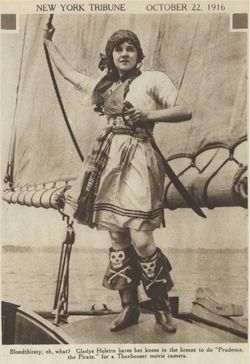
Gladys Hulette, New York Tribune, 22 October 1916

"Bootylicious," my review of Peter T. Leeson's The Invisible Hook, appears in the 7 September 2009 issue of the New Yorker.

As in the past, I'd like to offer on this blog some description of the sources that were useful to me in writing the article. The customary caveat: this post won't make much sense if you haven't yet read the article in question first. My first thanks, as usual, are for the book under review, Leeson's Invisible Hook, which is dapper and brisk besides being very well researched.

The best descriptions of pirates come from people taken captive by them. Captain William Snelgrave, whom I use to start my article, tells his story in A New Account of Some Parts of Guinea, and the Slave-Trade, which, though published in 1734, is mysteriously unavailable in Google Books. The only physical copy I can find for sale is a 1971 reprint—for $430. Talk about piracy! Within the scholarly world, Snelgrave's narrative is also famous for his observations of Africa and of slave-trading, which he defends. Another captive, Captain George Roberts, describes having been seized near the Cape Verde Islands in 1722 in The Four Years' Voyages of Capt. George Roberts. "You Dog! You Son of a Bitch! you Speckled-Shirt Dog!" one of his captors curses him. Asked who he thinks his captors are, Roberts submissively answers that "I believed they were Gentlemen of Fortune belonging to the Sea," only to be told off once more: "You lie by God, we are Pirates, by God." Roberts tells a good yarn, so good that some have wondered whether it might be fiction, but I think it's too good for that. When, for example, one of the pirates maroons Roberts on the high seas in a boat with no sail and no provisions, the pirate bestows on Roberts, in parting, a musket with a small amount of powder, calling it a special gift. The gift puzzles Roberts. In fact, though Roberts never figures it out, a loaded gun was traditionally given by one pirate to another when he marooned him—so the marooned man could shoot himself instead of starving to death slowly. It would take a subtle novelist to resist writing the scene where it dawns on Roberts what the musket is for; it seems more likely to me that Roberts's experience and ignorance were both genuine.

Two more captives tell their stories in the General History of the Pyrates, a book I'll describe in a moment. One of them, Captain Evans of the Greyhound, is quoted in my article saying he prefers to keep his hand and lose his gold. At the moment when another captive, Captain Macrae, is afraid that he's going to lose his life, "a Fellow with a terrible Pair of Whiskers, and a wooden leg, being stuck round with Pistols, like the Man in the Almanack with Darts, comes swearing and vapouring upon the Quarter-Deck." To Macrae's surprise, the blustering fellow acclaims him "an honest Fellow," and the testimony saves him. (After reading this story, I wasted a fair amount of time trying to figure out who "the Man in the Almanack with Darts" was, and here's the answer, courtesy of Notes and Queries, 13 June 1908: "The reference . . . is evidently an allusion to the woodcuts in the ephemerides of the seventeenth and eighteenth centuries illustrating the supposed effects of the planets, &c., on the diseases in various parts of man's body. . . . The arrows are merely lines pointing to the head, heart, breast, legs, feet, &c., of a small naked figure."

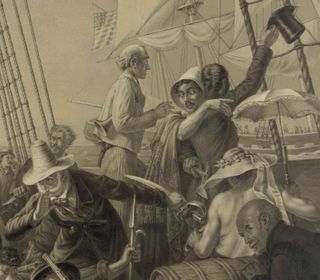
The Pirates' Ruse (detail), February 1896: Male pirates, dressed as ladies and gentlemen, lure a merchant ship closer, while their mates hide with their weapons below the bulwarks Several buccaneers left narratives. The most famous is The Buccaneers of America (first English edition, 1684) by A. O. Exquemelin, a Frenchman who served with Henry Morgan and later became a surgeon in Holland. Exquemelin has some nice observations of life in the New World—flamingo meat and crocodile eggs are very tasty, he reports, and one of the few drawbacks of Caribbean life are these insects known as mosquitoes ("most vexing of all is the noise they make in one's ears")—but there's so much torture in his story that it's quite grim and grisly. I read Alexis Brown's translation, but there's an older translation available for download on Google Books. The Library of Congress offers an online display of the illustrations to the 1678 Dutch edition. Another buccaneer, Basil Ringrose, wrote an account of further depredations that picks up where Exquemelin left off, and it has often been reprinted as the second half of Exquemelin's book.

Pirates (as opposed to buccaneers) left few first-hand documents. The General History reprints a few fragments from what it claims was Blackbeard's diary: "rum all out:—our Company somewhat sober:—A damn’d Confusion amongst us!" And there is the occasional threatening letter, such as the one from Henry Every that I quote, which is reprinted in J. Franklin Jameson, Privateering and Piracy in the Colonial Period (1923), a collection of letters, reports, and legal documents, glossed with very helpful footnotes. There is also the testimony that pirates gave in court, the amplest source of which may be the four volumes (well, two of the four volumes) of Joel H. Baer's British Piracy in the Golden Age.

And then there's Charles Johnson's A General History of the Pyrates (1724), which is droll and vivid. You want the version edited by Manuel Schonhorn, because it's the most meticulous, even though Schonhorn thought that "Charles Johnson" was a pseudonym for Daniel Defoe. In fact, Arne Bialuschewski has shown that it was almost certainly a pseudonym for the journalist Nathaniel Mist.

Between them, Exquemelin's Buccaneers and Johnson/Mist's General History are the source of almost all the great stories about pirates. Given the standards of historiography of their era, they're considered to be remarkably accurate. Still, they do contain instances of embroidery, including, in the case of Johnson/Mist, a long Voltairean (in style though maybe not spirit, depending on the level of irony you choose to read it at) fantasy about a pirate utopia in Madagascar called "Libertalia." Another problem: Johnson/Mist's book is a jumble, chronologically speaking. Only modern history will help you sort wheat from chaff. C. R. Pennell has written an excellent bibliographic essay about pirate scholarship, which appears at the start of his collection Bandits at Sea: A Pirates Reader, which itself contains a broad sample of historical essays, including several on pirates other than the English-speaking ones. To speak very generally, pirate history comes in two sorts: those that describe piracy as a system, and those that describe it as a series of events. (I'm speaking crudely, of course; all do both, to some extent.) Leeson's book falls into the first category, as do such works as Christopher Hill's essay "Radical Pirates?" (1984) and Marcus Rediker's wonderful Villains of All Nations: Atlantic Pirates in the Golden Age. (Rediker's pioneering effort on pirates was a chapter in his Between the Devil and the Deep Blue Sea: Merchant Seamen, Pirates and the Anglo-American Maritime World, 1700 – 1750.) Villains of All Nations is lively and astute, and in many ways Rediker's Marxian analysis of pirates anticipates Leeson's. Rediker also seems to have read every pirate-related document ever created. Somewhat lighter in spirit, but also very responsible, is David Cordingly's Under the Black Flag: The Romance and the Reality of Life Among the Pirates, which overlays pirate sociology with a tour of the literature and film created out of pirate lore in later centuries.

As for books that offer a more narrative history of pirates, English-speaking pirates did so much dastardy that it's hard to fit the whole story between two covers. One book that manages to tell the full tale is Patrick Pringle's Jolly Roger: The Story of the Great Age of Piracy (Norton, 1953), which covers it all—Elizabethan privateers, colonial-era buccaneers, and Enlightenment-age pirates. Pringle was a sedulous researcher, but new facts have come to light in the half-century since he wrote, so he can't always be relied on as a final authority. His felicitous style more than compensates, though; he's something of a wit. On the matter of pirate governance, he, too, anticipates Leeson's arguments:

Those seamen, mostly illiterate and uneducated, freed from moral and legal restraints, would to-day be regarded as unfit for self-government. . . . Where discipline is removed, self-discipline emerges in the most unlikely places. . . . It worked. Anarchism on a small scale usually does, if it is left in peace. Anarchism on a large scale has not yet been tried.

For in-depth and fully end-noted history, three relatively recent accounts are as riveting as adventure tales: Peter Earle's The Sack of Panamá: Captain Morgan and the Battle for the Caribbean (1981) describes the buccaneer Henry Morgan's opportunistic but (in English eyes) legal raids on Spanish territories in the 1660s and 1670s; Robert C. Ritchie's Captain Kidd and the War against the Pirates (1986) lucidly narrates Kidd's late-seventeenth-century plundering against a background of political intrigue between Whigs and Tories; and Colin Woodard's The Republic of Pirates: Being the True and Surprising Story of the Caribbean Pirates and the Man Who Brought Them Down (2007) tells the story of the last generation of Golden Age pirates, those of the early eighteenth century, including Blackbeard, Charles Vane, and Samuel Bellamy, and the role played in their demise by Bahamas governor Woodes Rogers.

A note on pirate sex: B. R. Burg argued in Sodomy and the Pirate Tradition (1983) that pirates practiced homosexuality more freely than their contemporaries. The circumstances do suggest that this might be likely, as do Bartholomew Roberts's pirate articles, which forbade the presence of any "boy or woman" on board. I'm reluctant to rule it out, knowing what one knows about the British Navy, the original employer of most pirates, and about the propensity of modern-day historians to sweep such matters under the rug. (In Under the Black Flag, for instance, Cordingly quotes Roberts's articles, including the diktat against "boy or woman," and then writes, "There is no mention in this code . . . of homosexuality." Argh, as the pirates say.) But there's not enough evidence to make any positive assertion. The ultimate source of a number of supposed accounts of pirate homosexuality is Louis Le Golif's Memoirs of a Buccaneer, widely suspected of being a twentieth-century fiction. When Le Golif's tales are excluded, very little evidence of pirate sodomy remains. Ringrose's narrative is the source of the anecdote in my article of the servant who claims to have been buggered by his buccaneer master. (Confusingly, the relevant passage does not appear in the reprint linked to above, but only in the original 1685 edition.) The servant confesses, however, just as his master is losing a power struggle with other buccaneers, so his confession might be true, might be part of a smear campaign, or might be both, but in any case it isn't a happy moment of love and liberation. Also intriguing is the testimony given in a court case involving a pirate named Powell, who told a sailor, "I wish you and I were both ashore here stark naked." Rediker reports the line as possibly containing an erotic charge, but when read in its original context (the line appears at vol. 3, page 186 of Baer's British Piracy in the Golden Age), it seems more likely that the statement was recalled in court as evidence of the extremity of Powell's wish to be off the pirate ship, not as evidence of sexual interest.

Pirates, you will not be surprised to hear, are all over the internet. In conclusion, as a representative sampling, here are American soldiers flying Jolly Roger in Afghanistan, a Victorian toy theater for rehearsing the adventures of Blackbeard in your pinafore at home, and an early episode of the exceedingly goofy "Auto-Tune the News" featuring both pirates and gay marriage.

How torture misled America into war on Iraq

There's another review of The Dark Side, Jane Mayer's exposé of America's involvement in torture, in Open Letters (thanks for calling my attention to it, Sam). Greg Waldmann explains lucidly and in depth a number of Mayer's revelations, including a disquieting link between torture and the case for war presented to American voters:

The most disturbing example of torture’s inefficacy was the "enhanced" interrogation of Ibn al-Shaykh al-Libi, who actually was a terrorist. Bush hailed al-Libi as a model of what "enhanced interrogation" could accomplish. But all the useful information he’d given was given to the FBI, who ran their interrogations normally. The CIA took control, however, and packed him away to Egypt, where he was pressed particularly hard on the subject of Iraqi/al-Qaeda connections. Al-Libi told the Egyptians that three al-Qaeda figures (he used real names) had gone to Iraq to learn about nuclear weapons. It was a fabrication. The Egyptians wanted more, so he made up some more stuff about Iraqi training in bomb-making and biological and chemical weapons. This "intelligence" made it into an October 2002 speech by President Bush, and later into Colin Powell’s famous February 2003 address to the United Nations.