“Wallenstein Garden,” by Jaroslav Seifert

I've been translating a few things from Czech lately, when I should have been doing something else. This poem is about a garden in Prague full of neoclassical statuary.

Wallenstein Garden
by Jaroslav Seifert

When violets rain down
into the strings of the old lyre,
held under one arm
as if it were a distorted discus

by the pretty young goddess
—there was a time when
a burbling fountain used to dress her
in his glittering silver—

when the wind beats
moldering leaves up against a staircase
and eats from an empty fountain
as from a bowl,

a nude crouches silently
under the cold ivy
and we tell each other
gentle foolishnesses again.

Next to the old musket,
there, in a corner gray with mildew,
I wiped the kisses off
the lips of your damp roses

much the way time, which has played quietly
here in the harps of the old trees,
long ago wiped the blood away
from the rusty weapons.

Licenses taken: I haven't tried to reproduce the rhyme or the rhythm of the original. In Czech, the goddess is a "little young goddess," not quite colloquial in English; I changed "little" to "pretty" in an attempt to capture the affection implied in Czech by the dimininutive. There's no second em dash in the original, but I think the conventions of English punctuation require one.

Venice in April

Turgenev, Diary of a Superfluous Man A few weeks ago, after a visit to friends in Garrison, New York, I spotted a sign for a bookstore and made Peter get off the highway. We ended up in a shop called Antipodean Books, where I stayed so long that our plans for that evening were ruined, but where the proprietor, in an act of generosity, offered me thirteen out of the seventeen volumes (what dealers poetically call a "broken set") of the Heinemann edition of Turgenev's complete works (Constance Garnett's translation) for just twenty-five dollars. They are still in their original dust jackets, a fetching, hazardous-materials shade of orange! Since I'd already read a few of Turgenev's better-known titles in other translations, the broken set suited me perfectly. Also, aesthetically speaking, I am weak-willed about duodecimo hardcovers, and each of these is just 4.5 by 6 inches—genuinely pocket-sized. And did I mention the highway-worker's-raincoat orange?

This is by way of bloggy-autobiographical prelude to my point, which is just to present a couple of quotes that I like. The two novels I've read in the set so far are about revolutionaries, but for some reason the passages that have most pleased me in them were about spring.

In Virgin Soil, when the hero Nezhdanov wanders in the garden of his employer one May afternoon, Turgenev writes:

Nezhdanov sat with his back to a thick hedge of young birches, in the dense, soft shade. He thought of nothing; he gave himself up utterly to that peculiar sensation of the spring in which, for young and old alike, there is always an element of pain . . . the restless pain of expectation in the young . . . the settled pain of regret in the old. . . .

I don't have anything to say about the quote, other than that I like the precision and the poignancy of it. (The ellipses are Turgenev's, by the way, not mine.)

The other passage that particularly struck me comes toward the end of On the Eve, a novella about a Bulgarian revolutionary and the Russian woman who falls in love with him, when the hero and heroine find themselves staying in Venice much longer than they intended to and somewhat against their wishes. The Venice chapters come as something as a surprise, a surge of sentiment in a book that has seemed up to that point to be concerned mostly with conflict, and if the book offered no more, they would make it worth the price of admission. The passage seems uncannily to prefigure Thomas Mann, but the bittersweetness is Turgenev's own. Reading it, I discover that my few visits to Italian cities have all taken place in the wrong months, but that's the least of the regrets evoked.

No one who has not seen Venice in April knows all the unutterable fascinations of that magic town. The softness and mildness of spring harmonise with Venice, just as the glaring sun of summer suits the magnificence of Genoa, and as the gold and purple of autumn suits the grand antiquity of Rome. The beauty of Venice, like the spring, touches the soul and moves it to desire; it frets and tortures the inexperienced heart like the promise of a coming bliss, mysterious but not elusive. Everything in it is bright, and everything is wrapt in a drowsy, tangible mist, as it were, of the hush of love; everything in it is so silent and everything in it is kindly; everything in it is feminine, from its name upwards. It has well been given the name of 'the fair city.' Its masses of palaces and churches stand out light and wonderful like the graceful dream of a young god; there is something magical, something strange and bewitching in the greenish-grey light and silken shimmer of the silent water of the canals, in the noiseless gliding of the gondolas, in the absence of the coarse din of a town, the coarse rattling, and crashing, and uproar. 'Venice is dead, Venice is deserted,' her citizens will tell you, but perhaps this last charm—the charm of decay—was not vouchsafed her in the very heyday of the flower and majesty of her beauty. He who has not seen her, knows her not; neither Canaletto nor Guardi (to say nothing of later painters) has been able to convey the silvery tenderness of the atmosphere, the horizon so close, yet so elusive, the divine harmony of exquisite lines and melting colours. One who has outlived his life, who has been crushed by it, should not visit Venice; she will be cruel to him as the memory of unfulfilled dreams of early days; but sweet to one whose strength is at its full, who is conscious of happiness; let him bring his bliss under her enchanted skies; and however bright it may be, Venice will make it more golden with her unfading splendour.

Meaulnes’s romance

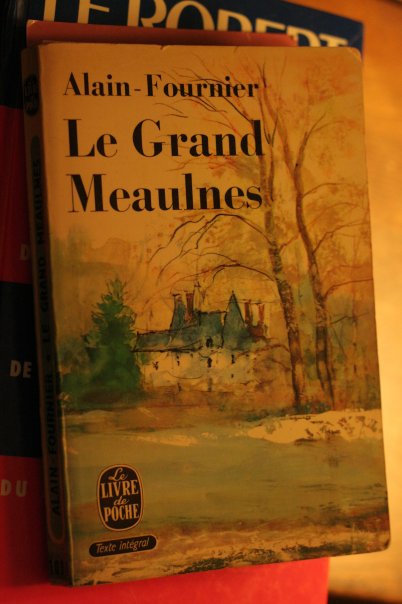
Le Grand Meaulnes, photo by Peter Terzian

In The Magician’s Book, her lovely, impassioned account of the Chronicles of Narnia, my friend Laura Miller suggests that the magic of C. S. Lewis’s books may owe more to medieval than to modern sensibilities. She points out that in his scholarship, Lewis defended medieval literature from the condescension of twentieth-century critics, who sometimes saw it as crudely allegorical. In fact, Lewis insisted, it was these critics’ understanding of medieval allegory that was crude. Writes Miller:

What made allegory powerful, and in Lewis’s eyes “realistic,” is that it was a sophisticated way of representing the inner lives of human beings at the time the great allegories like The Romance of the Rose were written. Though we now take for granted the notion of psychologically conflicted characters (who are “torn” or “divided” by forces contained within their own hearts and minds), the medievals didn’t have an artistic and conceptual toolbox quite like our own. Instead of imagining each person as possessing a complex interior mental space full of warring impulses, their picture of character was more external. So for them the natural way to portray what we would regard as a debate within a person’s psyche would be to write a passage in which a figure labeled (for example) Reason stands in a garden quarreling with a figure called Passion. . . . In a true allegory, where aspects of a woman’s personality are made to walk about and otherwise behave like independent people, the woman herself—the territory on which the conflict is being played out—becomes a physical space, a plot of land. The medieval self is, in this sense, geographical.

In later chapters, Miller suggests that Lewis’s Narnia books are romances, not novels, and belong to an alternative tradition that includes not only J. R. R. Tolkien and William Morris but also Dante, Thomas Malory, and Edmund Spenser. After crediting the critic Northrop Frye for the categories, Miller writes that “Most romance . . . belongs to youth and speaks to the desire to get out in the world and prove oneself, which may be why the form proliferates most luxuriantly and in some of its purest strains in children’s fiction.”

Recently, I read a book that turned out to be a romance, though I wasn’t expecting it to be one. When I began Alain-Fournier’s Le Grand Meaulnes, first published in 1913, I thought it was going to be about French schoolboys. The narrator, François Seurel, opens by looking back to a November day in the 1890s when he was fifteen years old and studying to earn his teaching certificate at a school where his father was headmaster. In describing the day that a new boy arrived at the school, Seurel’s tone is wistful, a little melancholy:

He arrived at our house one Sunday in November, 189…

I still say “our house,” even though the house no longer belongs to us. We left that part of the country almost fifteen years ago and we will surely never go back to it.

The new boy’s arrival coincides with Seurel’s recovery from a childhood hip disorder, which all but crippled him and left him shy and quiet. The new boy, Augustin Meaulnes, is in perfect health and is two years older than Seurel. Because of his height, the boy is soon to be nicknamed by his classmates “le Grand Meaulnes,” Tall Meaulnes (which sounds more cryptic in English than in French, and so in English the book either bears its French title or another one altogether). Meaulnes is also a little wild. Even before Mme. Meaulnes has settled with Seurel’s parents on the terms for boarding her son, Meaulnes finds in the Seurels’ attic two as-yet-unexploded fireworks and detonates them in the schoolyard as Seurel stands by. Seurel describes himself as “holding the tall new boy by the hand and not flinching.” Meaulnes, who reminds Seurel of a young Robinson Crusoe, is to be his guide into risk and adolescence.

Such a commencement doesn’t necessarily promise romance in C. S. Lewis’s sense of the word. The story of a mild boy looking up to a bolder one could be told novelistically, with a very modern psychology. But even in these opening chapters, it’s evident that Alain-Fournier isn’t a psychologist of that sort. Seurel describes his crush on Meaulnes without any embarrassment; he isn’t in any conflict about it. Nor is Meaulnes in any conflict about his wildness. He never apologizes when he breaks the rules set by Seurel’s father; he certainly never shows any signs of feeling guilty. For their part, Seurel’s parents are never petulant about Meaulnes’s behavior. Everyone treats everyone else with a kind of plainness and straightforwardness that is probably the first sign that this is a romance and not a novel. The second sign comes when Meaulnes runs off one day with a horse and carriage, becomes lost in the countryside, and, following a stone tower, stumbles into a ruined castle where he is invited to join a strange pageant, performed entirely by children . . .

To say much more would give too much away. The charm of the book is that it moves from realism to romance (and back again) without acknowledging any incommensurability between the genres. The people that Meaulnes finds in the castle are human; the bewitchment of the place is not by magic but by a kind of family history. But if, as Miller writes, “the medieval self is geographical,” then Meaulnes’s self is medieval, and so is Seurel’s, because the two boys will struggle with their geographic knowledge of the castle, or rather geographic ignorance of it, for the rest of the book. As in Lewis’s romances, all the characters find doubles, and in some cases triples. These doubles aren’t named Reason and Passion, or Childhood and History, or Wealth and Poverty, but they have the same internal simplicity and interactive complexity that Lewis, in Miller’s paraphrase, credits to allegory. By the end, there is nothing childish about the story at all, except insofar as the tragedy of adult love is one first perceived in childhood.

Vagaries of translations past

In The Year of Reading Proust (1999), Phyllis Rose related an anecdote that stuck in my head for a long time, because of its symmetry. It concerned the Englishing of the title of Proust’s multi-volume novel À la recherche du temps perdu.

Proust’s first English translator, C. K. Scott-Moncrieff, famously rendered the title as “Remembrance of Things Past,” drawing on a line from Shakespeare sonnet number 30, which begins:

When to the sessions of sweet silent thought,
I summon up remembrance of things past
I sigh the lack of many a thing I sought,
And with old woes new wail my dear time’s waste . . .

Recent translators, however, have preferred to be more literal and less allusive, and Proust’s title is today more often given as In Search of Lost Time. When, in Rose’s memoir, she mentions this change to a friend, he regrets it. It’s less sonorous, the friend complains, and furthermore, Scott-Moncrieff was not taking the liberty he seemed to be taking. As everyone knows, the phrase comes from a Shakespeare sonnet. But, continues the friend,

“. . . do you know that when Voltaire translated Shakespeare’s sonnets, he translated that phrase into French as ‘à la recherche du temps perdu’? That’s where Proust got it. So when Moncrieff wanted to translate Proust’s title, he went back to the Shakespeare sonnet Voltaire had been translating.”

It’s a perfectly formed anecdote. The pieces of the puzzle fit together exactly; the boldness of the first translator is justified by a knowledge of French literature that later translators lack. When I read Rose’s book, I went looking in Columbia’s library for Voltaire’s translations of Shakespeare’s sonnets, because the story made me want to see them with my own eyes. I couldn’t find them, but I figured I would run across them later, so I made a point of remembering to look for them again when I had a chance.

So I looked for them this afternoon, when I was in the New York Public Library. No luck. My guess is, Voltaire never translated Shakespeare’s sonnets. In the age of Google, if you spend an hour or two looking in scholarly databases for a piece of information about people of the stature of Voltaire and Shakespeare, and you can’t find it, it is not likely that it exists. There is no mention of such a translation among the volumes of the Oxford edition of the Complete Works of Voltaire. There’s also the circumstance that Voltaire was at times rather cranky on the subject of Shakespeare. He translated Hamlet’s “To be or not to be” soliloquy in his Lettres philosophiques of 1726, and he called Shakespeare “a genius” and “sublime” in 1770, but by 1776 he was calling him a “huckster” and discounting his earlier praise of Shakespeare as an attempt “to point out to Frenchmen the few pearls which were to be found in this enormous dunghill.”

In a 1963 issue of Shakespeare Quarterly, a scholar named Ralph Aiken suggested that the phrase “remembrance of things past” may itself have come from French. Aiken noticed that the phrase appears in a 1579 English translation by Thomas North of an introduction that Jacques Amyot wrote to his 1559 French translation of Plutarch’s Lives. Amyot was praising written history as an improvement over and fitting heir to the singing of memory that happens in oral cultures:

Now therefore I will overpasse the excellencie and worthines of the thing it selfe, forasmuch as it is not onely of more antiquitie then any other kind of writing that ever was in the worlde, but also was used among men, before there was any use of letters at all: bicause that men in those dayes delivered in their lifetimes the remembrance of things past to their successors, in songes, which they cause their children to learne by hart, from hand to hand, as is to be seene yet in our dayes, by thexample of the barbarous people that inhabite the new found landes in the West, who without any records of writings, have had the knowledge of thinges past, welneare eyght hundred yeares afore. [Aiken’s italics]

Aiken notes that “North has followed the French with his usual fidelity; Amyot’s phrase is ‘la memoire des choses passees [sic],’ and not, unfortunately, ‘la recherche du temps perdu.'” So Aiken, a formidably well-read Shakespeare scholar, was on the lookout for an instance of someone translating Proust’s title the way Scott-Moncrieff did, before Scott-Moncrieff did, and didn’t seem to know of one.

Maybe Rose’s friend misremembered the name of the translator? A number of French translations of Shakespeare were available to Proust and Scott-Moncrieff, and perhaps the anecdote will turn out to be true with someone else’s name in Voltaire’s place. I looked up Victor Hugo’s prose translation of the sonnets, just in case. I was for a while baffled by Hugo’s decision to give to sonnet 30 the number XLIV, but eventually I found the one I was looking for:

Quand aux assises de ma pensée doucement recueillie j’assigne le souvenir des choses passées, je soupire au défaut de plus d’un être aimé, et je pleure de nouveau, avec mes vieilles douleurs, ces doux moments disparus . . .

Hélas, no luck there, either. For now, this anecdote, like the one of quayside New Yorkers clamoring to hear the fate of Little Nell, should probably be athetized. I’ll leave you with Hugo’s rendering of the sonnet’s closing couplet, because it’s pretty and ends up almost rhyming:

Mais si pendant ce temps je pense à toi, cher ami,
toutes mes pertes sont réparées et tous mes chagrins finis.