A few early, expensive comments by the novel about the other talent in the room

I recently read a stack of Elizabeth Taylor’s novels, in preparation for writing an introduction to her novel A Game of Hide-and-Seek, to be reprinted as an NYRB Classic in February. In one of her later novels, In a Summer Season, published in 1961, there is a description of the advent of television into an upper-middle-class British household, which strikes me as an early attempt by the novel to reckon with its new rival. I wonder if anyone has made a collection of such scenes.

The book’s heroine is named Kate. Her adult son Tom lives with her, as does her second husband, Dermot, and an aunt named Ethel who tries to keep out of everyone’s way. The two men are to a certain extent allied against Kate in not-quite-reputable habits of leisure. Their unseemly alliance culminates in Tom’s purchase of a television set.

“Why can’t you read a book instead?” Kate asked [Tom]. She disdained such ways of passing time, not realising that she very seldom read herself these days and was just off for an evening in the pub with Dermot. Tom kept the television set in his bedroom and he and Dermot liked to sit there with curtains drawn against the sunshine, watching cowboy films. “Too good an evening to waste out of doors,” Dermot would say, taking a last glimpse out of the bedroom window while the set was warming up—Ethel’s dog lying on the hot gravel down there, a column of gnats dancing in the shaft of light under some trees and high above the trees some cirrus clouds paling and dissolving. “Right!” Tom would say, drawing up two uncomfortable bedroom chairs. On the screen, rods of light ran blindingly into one another, the picture steadied until they were able to see a packet of soap powder capering on tiny legs, singing a ditty. It then took a dive into a washing-machine, and a head of jostling bubbles, singing too, rose up.

The scene visible through the window is quiet enough to lend itself to a meditative description; the screen, by contrast, is too loud to meet with anything but sarcasm. But even more telling is the perfidy of Ethel, who means to resist but isn’t strong enough to.

Sometimes Ethel joined them, looking in with a trivial excuse, begging them not to stir and lingering to watch, but as if her attention was only momentarily caught. After hovering for a while, she gradually merged into the shadowy background and was forgotten, until at last, with sick-bed caution, she tiptoed away. Like hares before a serpent, Tom and Dermot sat rigid and in silence. From time to time, their hands groped on the floor for their glasses of light ale, their cigarettes burnt to their fingers.

A chapter or so later, after deprecating the television in a gossipy letter to a friend, Ethel is mesmerized by a broadcast of Swan Lake on ice.

Packing my library

A boxed library

Peter and I have moved! My Earthlink email address is kaput, though my Harvard forwarding email address (the one on my About page) remains intact. Here it is again, should anyone need it:

If anyone has a wish to snail-mail me something, please get in touch by email and I’ll let you know the new address.

Apologies for the blog silence. I have discovered that the reason that there are so many essays about unpacking one’s library and so few about packing it is that the latter process more or less does to you what Dave does to HAL at the end of 2001: A Space Odyssey, and it begins to seem prudent, with such a diminished capacity, to remain silent. Today, on day five of a flu of some kind, I seem to have lost my corporeal voice as well, so the silence apparently is to continue. We love our new apartment, thanks for asking, except for the bathtub drain that had to be unclogged by professional “snake,” the two successive leaks under the kitchen sink, the busted lock on the front door, and the fiendishly permanent child guards on the windows, which required five trips to the hardware store in order to collect all the equipment necessary for their uninstallation. (Babies apparently wish to hurl themselves out of apartment windows with all the ingenuity and resourcefulness of inmates at a Supermax prison, and must be correspondingly restrained.) Air conditioner brackets were my Waterloo.

The last count that I made of our book boxes before moving was 146, and we packed for another full day after that, so I think we ended up moving about 200 boxes of books. (We were able to stack them in an empty apartment on the floor below us, thus the weird orderly accumulation of volume in the photo above.) Furious and hasty has been the deaccessioning, but we still haven’t found enough bookshelf space in the new apartment to fit what remains. Some day soon I plan to return to being a writer, instead of just a subpar handyman and occasional haunter of Twitter, but that day is not yet, alas. There are no plans to acquire an e-reading device. Where would it go?

Unglued

Five years ago, I denounced deckle edges as an abomination. Before books melt away into ether once and for all, I feel compelled to express another strong opinion about the production of physical books: I hate glue bindings.

I have been gently counseled by book designers that my hatred may not be entirely justified. In fact, they say, there are glue bindings and there are glue bindings. “Hot melt” glues are indeed shoddy, I am told, but some “cold melt” glues are thought to be quite durable if they are applied via “double fan binding,” a process so named because it involves fanning the pages in first one direction, then the other. I hasten to say that all this may be true; I’m no expert. But it doesn’t matter. The trouble with glue bindings is that you never know until it’s too late. At the moment you buy a book bound with glue, it may indeed be more rugged than an identical book sewn together with thread. The question is the integrity of the glue ten years later. Thread lasts, if it’s kept dry and dark. In the Egyptian wing of the Metropolitan Museum of Art, you can see folded sheets of linen from pharaonic days. Glue, however, often doesn’t last. It’s no help to hear that some glue does. Nowhere in or on a book is there a list of the ingredients of its binding’s glue, and even if there were such a list, only astute chemists would be able to predict longevity from that information.

Let me break your heart with some examples. Here is a Northwestern-Newberry paperback of Herman Melville’s Pierre, purchased by your blogger in the mid 1990s, much re-read, and much annotated.
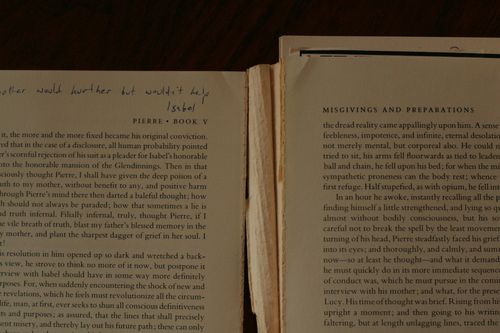
Melville, Pierre (broken spine)

A university press edition! People, they did this to scholars. Not all university presses are so heartless, though. To vindicate them, I include a photo of a University of California Press paperback of Moby-Dick, purchased by your blogger in the late 1980s, also much re-read—though not annotated, because the Barry Moser illustrations made it seem sacrosanct.

Melville, Moby-Dick (sewn binding)

I’ve opened the Moby-Dick to the center of a “gathering,” that is, to the center of a set of pages that were folded together, so if you look closely (after clicking on the picture to expand it), you can see a Morse code of thread running vertically along the fold. (Not all sewing is equal, by the way; the best kind is “sewing through the fold,” also known as “Smyth sewing,” after the brand name of one of the sewing machines capable of doing it.) Though the California paperback is at least five years older, it’s in good shape, and the Northwestern-Newberry is a shambles. For comparison, here’s the latter stacked on the former.
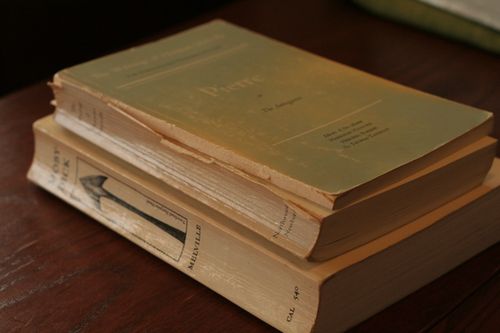
Glued 15-year-old Pierre vs. sewn 20-year-old Moby-Dick

You’re probably thinking, Well, I’m not going to trouble my little head with any of this. I buy hardcovers, after all. Surely they’re sewn not glued. Oh ho, and there you would be wrong. The poet Elizabeth Bishop has been so thoroughly and repeatedly canonized that if I am asked to read one more review solemnly scolding her editors for posthumously printing the fragments found in her desk, I will run screaming into the night. But is the latest of the scolded monumental editions, by her longtime publisher FSG, bound with thread? It is not. (As it happens, though, the mid-1980s FSG hardcovers of Bishop’s collected poetry and prose were glue-bound, too, and seem to be holding up, so maybe FSG uses nice glue, at least with Bishop.)
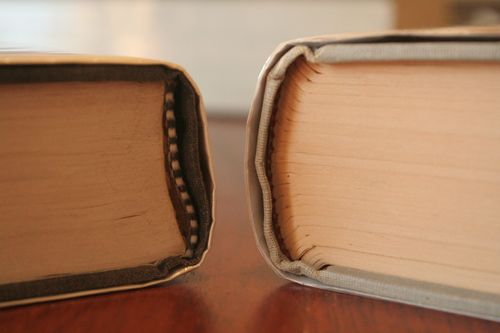
Glue-bound Philip Roth vs. Smyth-sewn Henry Roth

How, those of you whom I have succeeded in making anxious may want to know, can a glued binding be distinguished from a sewn one? On the left, in the photo above, is a glued Philip Roth (Zuckerman Bound, FSG, 1985), and on the right a sewn Henry Roth (Call It Sleep, Pageant, 1960). The little black-and-white skunk-tail-esque ribbon on the Philip Roth is spurious; it’s meant to hearken back to the days when an actual piece of fabric went all the way down the spine interior, and the gatherings were sewn into it, and its presence needn’t imply the existence or absence of any such thing now. What’s indicative is the way the pages meet the spine. In the glued Philip Roth on the left, the pages all run straight into the binding and stop dead. In the sewn Henry Roth on the right, the pages are folded together in gatherings, and they meet the spine in distinct bunches, which look a little like the illustrations of stomach villi from my high school biology textbook.
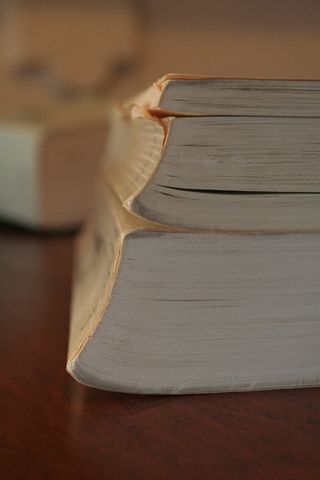
Spines of glued Pierre and sewn Moby-Dick

For further reference, here are the tragic Melville paperbacks again, glue on top, sewing beneath.
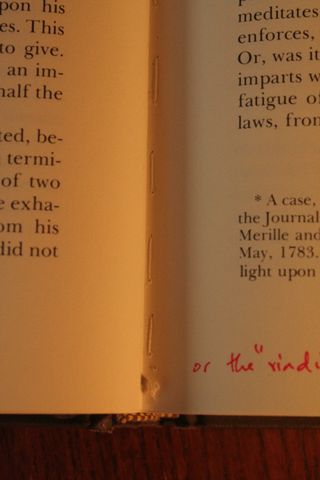
Wieland, repaired with needle and thread So nothing ever goes wrong with a sewn binding? Well, no, sometimes things do go wrong, but when they do, you can fix them yourself. To my dismay, I once discovered that the thread hadn’t passed through a signature or two of pages in my Kent State University Press hardcover of Charles Brockden Brown’s Wieland. I therefore sewed the pages to their neighbors.

More alarmingly, I was three-quarters of the way through marking up a Library of America edition of Howells when I found that a number of pages had been omitted altogether. I found them in a database, printed them out, and sewed them in, too—not as elegantly as I did with Brown, I’m afraid.
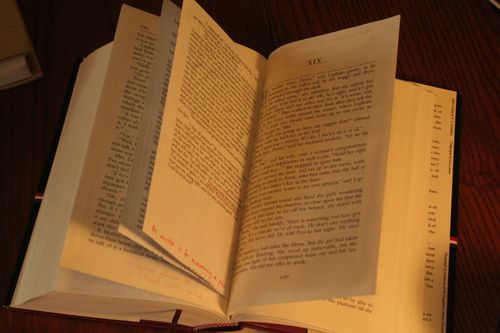
Howells, repaired with needle and thread

If pressed, I suppose I can bring myself to admit that these book repairs could have been done with glue, and that all I’m saying is that I’m more comfortable with needle and thread. In the interest of objectivity, in fact, I will will conclude with one more photo, of a 1922 translation of J. K. Huysmans’s Against the Grain whose previous owner “completed” it by pasting in slips of onionskin typing paper containing the passages omitted from the English translation. The glue he used has for the most part held up. (The book itself of course has a sewn binding.)
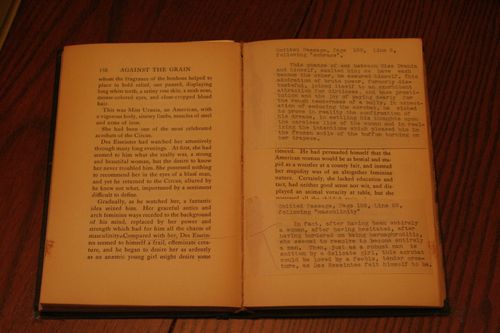
Huysmans, completed with glue

Other people’s flowers

Here are a few quotations that I copied into my notebooks, in some cases as long as four years ago but in one case as recently as last week:

It is as though an orange tree refused to flower for fear of committing a sin.

—Stendhal, On Love

The traditional British struggle with macaroni brought her down sharply from tragedy to farce.

—Elizabeth Bowen, The Hotel

And even though the tall giraffes were tough,
And even though the tough giraffes were tall . . .

—dream poem of John Chamberlain, cited by Edmund Wilson

"But it was nice while it lasted," Charlie said. "We were a sort of royalty, almost infallible, with a sort of magic around us. . . ."

—Fitzgerald, "Babylon Revisited"

If it's important to be sublime in anything, it's surely in evil.

—Diderot, Rameau's Nephew

"Mais quoi! Toujours le roman! Hélas!"

—La duchesse de Sanseverina, La Chartreuse de Parme

We made no more provision for growing older, than we did for growing younger.

—Charles Dickens, David Copperfield

In that same spirit of improvement, which was so busy everywhere, I could discern something like a shadow, that showed it was not altogether of that pure advantage, which avarice led all so eagerly to believe.

—John Galt, Annals of the Parish

He was not a particular person, but a sample or memento—reminding one of certain "goods" for which there is a steady popular demand.

—Henry James, The Reverberator

Historical-mindedness is so much a preconception of modern thought that we can identify a particular thing only by pointing to the various things it successively was before it became that particular thing which it will presently cease to be.

—Carl Becker, The Heavenly City of the Eighteenth-Century Philosophers

I remember when I was abroad, the trees, and grass, and wet leaves, rustling in the walks of the Thuilleries, seemed to be as much English, to be as much the same trees and grass, that I had always been used to, as the sun shining over my head was the same sun which I saw in England; the faces only were foreign to me.

—William Hazlitt, The Round Table

With bloudy mouth his mother earth did kiss,
Greeting his grave . . .

—Edmund Spenser, The Faerie Queene

Part of our existence lies in the feelings of those near to us. This is why the existence of someone who has lived for days during which man was merely a thing in the eyes of man is non-human.

—Primo Levi, If This Is a Man

You see Englishmen, here in Italy, to a particularly good advantage. In the midst of these false and beautiful Italians they glow with the light of the great fact, that after all they love a bath-tub and they hate a lie.

—Henry James, Letters

A pleasurable feeling of blind love,
The pleasure which there is in life itself.

—Wordsworth, "Michael"

I could observe, in little pieces, as it were; but as to making a net of a number of these pieces, and catching anybody in it, that was, as yet, beyond me.

—Charles Dickens, David Copperfield

Beauty, strength, youth, are flowers but fading seen.

—George Peele

I regard the march of history very much as a man placed astride of a locomotive, without knowledge or help, would regard the progress of that vehicle. To stick on, somehow, and even to enjoy the scenery as we pass, is the sum of my aspirations.

—Henry James, Letters

It is the ongoing—i.e., the "becoming"—of the world that produces its sadness. If the world stood still at a felicitous moment there would be no sadness in it.

—Thomas Hardy, Early Life, qtd. in Aaron Matz, Satire in an Age of Realism

I had already found that it was not good to be alone, and so made companionship with what there was around me, sometimes with the universe and sometimes with my own insignificant self; but my books were always my friends, let fail all else.

—Joshua Slocum, Sailing Alone Around the World