Polling can’t be fixed because only the very nice still answer the phone

I only did two sessions of phone-banking in this election cycle, but even in that very small sample, I came away impressed by how few people still answer their own phones and how elaborate the technology has become for avoiding calls from strangers. I was phone-banking with a group that had pretty sophisticated software, which did the dialing for us, in the background, but even so, mostly I was just leaving voicemail messages. Now and then I got through to an app called Google Assistant, which is basically just a way to hang up on people in realtime without the awkwardness of having let them hear your voice. Years of scam callers also seem to have disinhibited people from just hanging up the old-fashioned way.

I don’t blame people for not wanting to talk to strangers. I hate it myself, and only undertook to call strangers because I believed democracy was in peril. But if no one has to answer their phone any more, the people who do still answer their own phones must be different from you and me. They must not mind somehow. Maybe they enjoy human connection just for its own sake? (I’m reminded of the New York Times profile last year of a woman with a genetic mutation that has made her immune to any feelings of pain or anxiety.) Maybe the people who still answer their phones are . . . nicer? More open to experience? More available to human interaction? Is “sociotropic” the right word? Something like that.

Statisticians probably aren’t ever going to be able to correct for this difference by adjusting for race, gender, income, age, or any other trait. After the widespread pollster failure of 2016, many pollsters decided that their error in 2016 was failing to realize that the non-college-educated were different from the college-educated, and in 2020, almost every pollster did adjust for that. It didn’t help. One rough estimate I saw on Twitter is that in 2016, state polls were off by about 5 percent, and in 2020, they seem to have been off by about 7 percent.

If I’m right, polls from now on are always going to suggest a more humane outcome than will really happen. There will be no way to compensate, because you can’t add extra weight to the opinions of people who don’t answer their phone. They don’t answer their phones! Multiply zero by as large a factor as you want, it’s still zero. In the future, my advice is that whenever you read a poll result, figure out which candidate a mean person would be more likely to vote for, and silently add to that candidate’s numbers an extra 5 to 10 percent. Or more, if you think people are getting meaner.

UPDATE, 1pm: On Twitter, @15c3PO points out to me that David Shor, the political consultant famous for having been unjustly fired, has made a similar suggestion: because distrustful people didn’t answer their phones, the Hillary Clinton campaign failed to realize in 2016 that socially liberal messaging wouldn’t play well with non-college-educated voters. Says Shor:

The actual mechanical reason was that the Clinton campaign hired pollsters to test a bunch of different messages, and for boring mechanical reasons, working-class people with low levels of social trust were much less likely to answer those phone polls than college-educated professionals. And as a result, all of this cosmopolitan, socially liberal messaging did really well in their phone polls, even though it ultimately cost her a lot of votes.

And, @15c3PO adds, reporter Matthew Zeitlin also had the same idea as me, but sooner. The day before the election, Zeitlin wrote on Twitter: “Just putting this out there but isn’t it possible that the low social trust non-response problem has gotten worse and thus the swing toward Biden in the Trumpy demos and the states that swung big toward Trump is something of a mirage…(we’ll find out!).”

Phone-bank with me on Halloween!

Come phone-bank with me on Halloween!

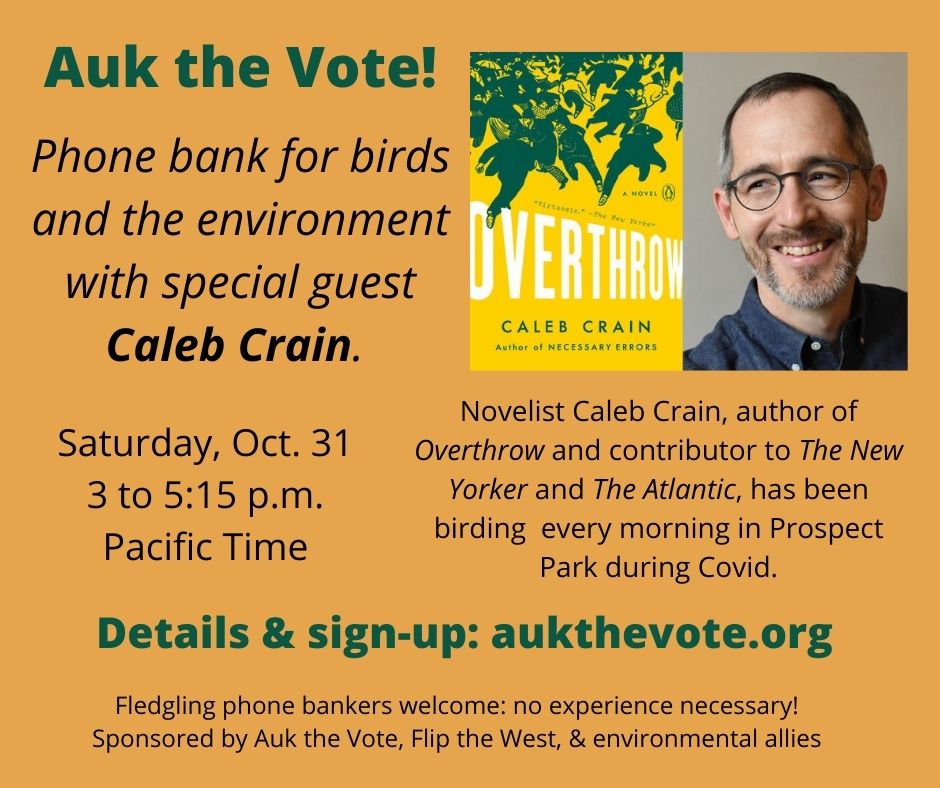
Come phone-bank with me and a bunch of birders this Saturday! You can sign up at Auk the Vote. The goal is to flip several Senate races blue.

If you’ve never phone-banked before, no worries! I hadn’t either until last Saturday, when I tried it out. (It isn’t necessary to know anything about birding, either, by the way.) Once you sign up with Auk the Vote, you’ll get an email with info about the campaign and about how to navigate the phone-banking software, which is pretty straightforward. And after you join the Zoom, which is at 6pm East Coast time / 3pm West Coast time on Saturday, there are trainers in the Zoom room who can show you how to phone-bank (or refresh your skills, if you’re already pro). Before we call voters, my friend David will interview me a little about my newbie birding, and afterwards, they’ll give away some copies of my latest novel.

Hope to see you there!

Swimming in the undertow

My first inkling that Trump was where something had gone badly wrong in the American psyche came in the fall of 2015, when Peter and I went to a bar in Williamsburg to hear a friend read a short story. The emcee took a turn at the microphone himself, as his reward for having organized the literary evening, but instead of reading a story or poem, he read aloud from one of Trump’s ghost-written books. The choice of text was meant to be a joke, I think. A few sentences would have conveyed the gist: the book was horrible, and obvious in its horribleness, and representative in its horribleness of the person whose name was on the cover. The emcee, however, read for what felt like an hour.

It was excruciating. If the point was that we Brooklyn literary hipsters were superior to someone like Trump, and knew better than to be taken in by him, why was the emcee reading so many of his words? And why were we listening? I couldn’t figure out what was going on or what the emcee was getting out of it. He seemed to be in the grip of something, and we were in his grip. It was all happening under the sign of irony, but irony wasn’t the right word exactly. In retrospect I should have taken warning; at the time, of course, I just wanted it to be over.

I’ve thought back to the night many times in the past four years. It came to mind most recently when I was reading The Oppermanns, a remarkably lucid novel by Lion Feuchtwanger set in, and written in, 1933. The book, recently reprinted by the British feminist press Persephone Books, describes the lives of four Jewish siblings in Berlin, owners and managers of a chain of furniture stores, as they try to adjust to the rise of Hitler, referred to in the text only as “the Leader” or as “the author of the book called Mein Kampf.”

About a third of the way in, one of the siblings, Gustav Oppermann, who’s a bachelor and a bit of a playboy, in a bibliophile kind of way, is visited by a friend, Alfred François, the rector of an elite high school where two of Gustav’s nephews are students. One nephew has recently had a run-in with a new teacher, who happens to be a Nazi, and the rector wants Gustav to persuade his nephew to apologize. It has become dangerous to make Nazi enemies, and François intuits that he won’t be able to continue protecting Gustav’s nephew indefinitely. Once Gustav hears the story, however, and realizes that his nephew was in the right, he refuses to intervene, as a matter of principle, and the rector amiably gives up. After all, he doesn’t really want Gustav’s nephew to knuckle under. Having tried their best, to no avail, he and Gustav retire with relief to Gustav’s library, to chat about books. They are the most erudite characters in the novel, and Feuchtwanger pokes gentle fun at their erudition: the rector is said to be writing a book about the influence of the ancient Greek hexameter on an 18th-century German poet, and Gustav, to be writing a biography of a philo-Semite playwright from the same period. As a slightly perverse hobby, Gustav collects editions of the infamous anti-Semitic tract The Protocols of the Elders of Zion, then back in the zeitgeist, thanks to the rise of Nazism. After showing off his newest copy of the Protocols, Gustav picks up Mein Kampf and starts to “read some particularly juicy passages to his friend.”

Rector François covered his ears. He did not want to listen to the incorrect, distorted German of the book. Gustav spoke to him soothingly. On account of his repugnance for the style, he had evidently missed the comic quality of the content. He refused to be dissuaded from quoting a few passages.

Gustav proceeds to read aloud a few samples of Hitler’s name-calling, allegations, and conspiracy theories. “Rector François, disgusted as he was, had to laugh over this accumulation of nonsense,” Oppermann writes.

I felt the edge of this passage’s irony rather keenly.

I’ve been trying to stay logged out of Twitter, so I don’t know whether this week we’re making fun of people who see analogies between Trumpism and Nazism, or making fun of people who resist such analogies. In either case, I admit that as I read The Oppermanns, the analogies seemed to draw themselves. A character insists to himself that he still loves his country, despite what it has become. A character discovers, to his chagrin, that even people dear to him would rather minimize the new outrages to decency than see them for what they are (“It was disgusting to read the papers and disgusting to hear the row the Nationalists made. But who took that seriously?”), and that even people who are hurt by the new regime quickly accept their injury as part of a new status quo (“It was an old story that the Nationalists were dirty dogs. There was no need for anyone to come and tell them that”). What little I know of Q-Anon sounds very silly, but you would probably laugh over the claims in the Protocols of Zion, too, if, like François, Gustav, and (in 1933) Feuchtwanger, you didn’t know what they led to.

After a while, exhausted by my pessimism, I started to check my analogical bent by telling myself that it makes a difference that Trump does not have a paramilitary force at his command, independent of government control, as Hitler did, and that the misguided anarchists of our day have broken shop windows and mau-maued outdoor diners but have not yet given white supremacists the pretext that they are looking for—that is, our anarchists have not yet burned down the American equivalent of the Reichstag. And then I learned this week that a teenage white supremacist Trump supporter, responding to a call for law and order on Facebook, gunned down three protesters in Kenosha, Wisconsin, killing two of them, and that the shootings were later characterized by several pro-Trump TV pundits as a natural response to the protests in Kenosha, which the pundits saw as civic breakdown. So now the threat of attacks from vigilantes is indeed part of our political reality, and so is disingenuous justification of such attacks, and I have to fall back on consoling myself with the thought that the white supremacist in this case was a volunteer, not part of an organized militia. At least so far as we currently know. (A more sturdy consolation is that the American communities of color dog-whistled about and gaslit by Trump and the Trumpists are much more numerous, and therefore much less vulnerable, than Germany’s Jewish citizens were in 1933, when they comprised less than one percent of that country’s population.)

There’s a minor character in The Oppermanns named Friedrich Wilhelm Gutwetter who might be a portrait of Martin Heidegger. (Of course it’s possible that Feuchtwanger didn’t mean the reference to be that specific; there were no doubt many quisling intellectuals at the time.) At the opening of the novel, Gutwetter is a harmless-seeming, starry-eyed writer who happens to be fashionably pessimistic about the prospects of Western civilization. Since he’s oblivious to mere worldly concerns, it’s convenient that he is supported financially by Gustav Oppermann, who believes in his genius. When Gustav goes into exile, Gutwetter regrets his patron’s decision to leave with a curiously intense indignation, telling a mutual friend,

This country is about to give birth to a great new type of humanity. We have the enormous luck to be present at the birth of this gigantic embryo and to hear the first babblings of the noble monster. And our friend Gustav goes and runs away because one of the outcries of this nation in travail is offensive to his ears?

Gutwetter’s obliviousness to worldly matters, the reader senses, is starting to acquire an edge of intentionality. Gutwetter brings himself to accept Gustav’s exile to the extent of asking if he may borrow books from the library that Gustav has had to leave behind. Of course Gustav says yes. Before long Gutwetter succeeds in working his ideas about the new era’s new man into print, and soon he is enjoying a popularity that he believes to be world-historical:

He was not surprised that history had now, at last, made his, the poet’s, vision come true. The Nationalists, however, were surprised to find such a voice as his raised on their behalf. Almost all scholars, almost all artists of any standing, had turned their backs on the Nationalists. What a bit of luck it was that a great writer should now suddenly come forward to espouse their cause!

Feuchtwanger also makes an intriguing attempt to fathom the economics of fascism. He imagines that the Oppermanns have a less-successful rival in furniture-making, Heinrich Wels Junior, “a hard-working, reliable, slow-thinking man” whose error, in business strategy, is that he persists in having his employees craft tables and chairs by hand. By standardizing the designs of their furniture and by producing them more cheaply in factories, the Oppermanns have long been able to undercut his prices. “Had the recognition of solid merit died out in Germany?” Wels asks, aggrievedly. Well, no, Feuchtwanger explains; it’s just that most consumers care more about price. When Nazism comes along, Wels embraces it because “it freely expressed what Heinrich Wels had long secretly felt, namely that the Jewish firms with their cut-price methods were responsible for Germany’s decline.” After the Nazis put a higher tax on goods from the Jewish firm’s larger stores, Wels is able to come a little closer to competing with the Oppermanns on price—close enough that the new social stigma associated with buying from Jews is sometimes able to make up the difference.

A disconcerting aspect of The Oppermanns is that its moral universe seems continuous with ours—it’s a world in which people envy their neighbors’ apartments, and have mixed feelings about some of the poems in the national literary canon, and in which teenagers jockey for a chance to drive the family car—and incommensurate with that described in such Holocaust literature as Tadeusz Borowski’s This Way for the Gas, Ladies and Gentlemen. And yet one world turned into the other. Feuchtwanger is aware that the Nazis were setting up concentration camps, and even arranges for one of his characters to be imprisoned in one, but he doesn’t understand the full human meaning of such an institution; no one at the time could have. The book takes on an extratextual pathos; the reader realizes, that in 1933 Feuchtwanger couldn’t imagine that expropriations, beatings, humiliations, exile, and assassinations weren’t as bad as it could get.

An afterthought: While reading Jamelle Bouie’s roundup of the rightwing pundits who are acclaiming Kyle Rittenhouse for killing protesters in Kenosha, a link to which I have added above, I realized that the Rittenhouse story has a more specific parallel in The Oppermanns: When a teenager in Alfred François’s school, stirred up the new Nazi teacher’s fiery rhetoric, stabs to death a journalist who has made fun of Hitler’s writing style, Nazi pundits extenuate and even praise the murder in terms very much like those that Tucker Carlson, Ann Coulter, and others have used to justify Rittenhouse’s killings: “It soon turned out that [Rittersteg] was no scoundrel but a hero. The Nationalist newspapers published his photograph. They pointed out that, although the young man’s deed could not be unconditionally approved of, it was nevertheless easy to understand that a German youth would be aroused to do violence on account of the dead man’s dastardly assertions.”

Notebook: The Wilmington Coup of 1898

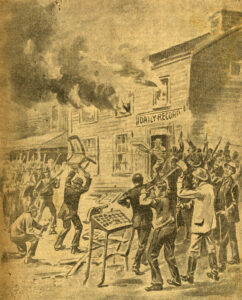
“City Limits,” my review-essay about a white supremacist coup that took place in Wilmington, North Carolina, in 1898, is published in the 27 April 2020 issue of The New Yorker. The online title is “What a White-Supremacist Coup Looks Like.”

What follows is a bibliographic supplement, crediting some of the sources I drew on. It probably won’t make much sense unless you read the review itself first!

As always, my first debt is to the book under review, David Zucchino’s Wilmington’s Lie: The Murderous Coup of 1898 and the Rise of White Supremacy, published by Atlantic Monthly Press. It’s the capstone to more than a century of attempts to bring the coup into America’s consciousness.

As I mention in my article, two of the earliest such attempts were novels by African Americans. Hanover; or, the Persecution of the Lowly was written by David Bryant Fulton, under the pen-name Jack Thorne, and was published in 1900. There’s an electronic text in the online archive Documenting the American South, though I found the scan in the Internet Archive easier to make sense of. (By the way, I’m mad at the Internet Archive right now for using the pandemic as a pretext for giving away the copyright of living authors, even though I appreciate their hosting of scans of 120-year-old books.) Hanover is a fascinating but unstable text. It opens by reprinting an Associated Press news story, and Fulton doesn’t seem to have been able to decide whether he wanted his book to be fiction or non-fiction. Sometimes a person appears in one chapter as himself, under his real name, and in another as a fictional character, under a pseudonym.

Intriguing side note #1: Fulton up-ends the late-19th-century literary conventions for dialect: uneducated black characters speak in dialect, as they often do in novels of the period, but so do some uneducated white ones. “Who ish mine frients?” asks a German grocer, for example, who, as it happens, sides with the blacks in Wilmington, since they’re his customers. The racist “poor white” Teck Pervis, who seems to be a fictionalized version of the real-life white supremacist Mike Dowling, is given a gerbilly, nasal way of speaking that reminded me of the satire of “white voice” in the recent movies Blackkklansman and Sorry to Bother You. Intriguing side note #2: Fulton hints that there’s something unorthodox about the gender identity of one of his characters, Uncle Guy, a dancer and clarinet soloist in a shoo-fly band that used to play during the black post-Christmas holiday known as Jonkonnu: “he was the embodiment of neatness, feminine in build—it seemed that nature intended to form a woman instead of a man,” Fulton writes.

Mounted albumen print of Alexander Manly, in the John Henry William Bonitz Papers #3865, Southern Historical Collection, The Wilson Library, University of North Carolina at Chapel Hill. The second novel about Wilmington in 1898, Charles W. Chesnutt’s novel about Wilmington, The Marrow of Tradition, published in 1901, is better known today. There’s a Library of America volume for Chesnutt, and the Norton edition of Marrow has a great historical supplement in back. Chesnutt’s book has a more conventional novelistic shape and heft. It may conform a little too well to convention; the creaking is audible as the machinery of the love-plot grinds forward, and a child in peril is introduced to force the reconciliation of people who in real life would probably have been irreconcilable. Like Fulton, Chesnutt is at pains to give an accurate representation about the outrage that enveloped the Daily Record, the African American newspaper in Wilmington, after its editor, Alex Manly, breached taboo by writing about white women’s sexuality. In fact, sexual purity wasn’t the point, Chesnutt writes: “A peg was needed upon which to hang a coup d’état.” Instead of attempting a full representation of the racial violence that broke out in the city, Chesnutt draws an em dash and makes an aposiopesis: after noting that on the day of the massacre, armed whites challenged and searched every black they met on the street, he writes, “If he resisted any demand of those who halted him—but the records of the day are historical.” There are too many scholarly articles about Chesnutt to list here! Richard Yarborough compares Fulton’s and Chesnutt’s fictionalizations (and provides keys that identify the real-life figures behind the characters) in a chapter titled “Violence, Manhood, and Black Heroism,” in David S. Cecelski and Timothy B. Tyson, eds., Democracy Betrayed: The Wilmington Race Riot of 1898 and Its Legacy (University of North Carolina, 1998).

As I note in my article, the third book-length fictionalization of the coup was a white supremacist one, Thomas Dixon Jr.’s The Leopard’s Spots, published in 1902. It’s best-seller garbage, not to put to fine a point on it—a pure indulgence of resentment and grandiosity. Here’s a solid if dated article about it: Maxwell Bloomfield, “The Leopard’s Spots: A Study in Popular Racism,” American Quarterly 16 (1964): 387–401.

'Destruction of the Record Office, in Wilmington Yesterday,' undated clipping from unknown newspaper, in a Manly Family Scrapbook at the Cape Fear Museum of History and ScienceI’m going to jump ahead now to the scholars and other writers who recovered the historical memory. In The Negro and Fusion Politics in North Carolina, 1894–1901, published by the University of North Carolina Press in 1951, Helen G. Edmonds comes across as a patient, commonsensical person with a sly sense of humor; a reader imagines her armed with a small pick, chipping away steadily at white supremacist gunk that has hardened over the facts. In We Have Taken a City: Wilmington Racial Massacre and Coup of 1898, published by Fairleigh Dickinson Press in 1984, H. Leon Prather Sr. painted the conflict in brighter colors and with a looser hand, perhaps because he was writing after the civil rights movement. (Prather’s book seems to be out of print, but you can find used copies pretty easily.) There are a number of useful essays in the Democracy Betrayed anthology mentioned just above, especially Glenda E. Gilmore’s “Murder, Memory, and the Flight of the Incubus” and Michael Honey’s “Class, Race, and Power in the New South.” I’ve come to believe that for every important historical subject, there’s an indispensable dissertation that should have become an acclaimed book but for some reason never did. In this case, that dissertation is Jerome A. McDuffie’s “Politics in Wilmington and New Hanover County, North Carolina, 1865–1900: The Genesis of a Race Riot,” written for his 1979 degree at Kent State University. The novelist Philip Gerard reimagined the coup and massacre in his 1994 novel Cape Fear Rising (John F. Blair). In an essay titled “Revising the Revisionists,” published on the website the Rumpus, Gerard was interviewed about the role that his novel played in Wilmington’s recovery of its historical memory. The interviewer was one of his students, the novelist Johannes Lichtman (disclosure: a friend, after I raved about his novel Such Good Work in a newsletter last year). Gerard himself wrote about his research process and the ethical questions he wrestled with in “The Novelist of History: Using the Techniques of Fiction to Illuminate the Past,” North Carolina Literary Review, 2015. The original 2006 report of North Carolina’s official investigation into the coup is available for download; LeRae Sikes Umfleet streamlined and revised this report into the 2009 book A Day of Blood: The 1898 Wilmington Race Riot, published by the North Carolina Office of Archives and History. It’s copiously illustrated with maps and photos. Don’t be thrown by the format, which makes it look like a high school social studies workbook; it’s perhaps the most thorough treatment of the coup, even if Zucchino’s has a bit more narrative zing. Not long after North Carolina’s report was released in 2006, the Raleigh News & Observer published a reckoning with its own legacy of participation in the ordeal, “The Ghosts of 1898,” by Timothy B. Tyson.

'Gentlemen, Day of Race Riot, 1898,' Dr. Robert M. Fales Collection 602, New Hanover County Public Library A number of the primary sources unearthed by these scholars are now available online, thanks to several web projects. In 2007, the curator Nicholas Graham published “The 1898 Election in North Carolina,” an online exhibition for the University of North Carolina libraries, where you can find, for example, the Democratic Handbook 1898, which put in writing the party’s white supremacist platform that year, and racist political cartoons by Norman E. Jennett, also known as Sampson Huckleberry, that Josephus Daniels published in the Raleigh News & Observer, including the one of a black vampire that I mention in my article. For more on the cartoons, see Andrea Meryl Kirshenbaum’s article “The Vampire That Hovers Over North Carolina: Gender, White Supremacy, and the Wilmington Race Riot of 1898,” Southern Cultures (1998), and 
Rachel Marie-Crane Williams’s ” A War in Black and White: The Cartoons of Norman Ethre Jennett & the North Carolina Election of 1898,” Southern Cultures (2013).

Also in 2007, Karin L. Zipf put together the website “Politics of a Massacre: Discovering Wilmington 1898,” hosted by East Carolina University, where you can find in the bibliography section a scan of “The Story of the Wilmington Rebellion,” the perhaps somewhat inadvertently revealing pamphlet that the volunteer white supremacist historian Harry Hayden self-published in 1936, as well as a 1954 typescript by Hayden titled “The Wilmington Light Infantry Memorial,” about the state guard troops involved in the massacre and coup (the site’s internal link to Hayden’s history of the W.L.I. is broken, so use my link here). Zipf’s site also links to “A Statement of Facts Concerning the Bloody Riot in Wilmington, N. C. Of Interest to Every Citizen of the United States,” the Baptist preacher J. Allen Kirk’s narrative of hiding his wife and niece in a cemetery after the massacre and dodging lynchers as he fled Wilmington by train (though the text is hosted by UNC’s Documenting the American South).

In 2012, the Cape Fear Museum of Science and History shared on Flickr a set of images related to the Wilmington coup, including a four-page letter that Caroline “Carrie” Sadgwar Manly, widow of the Daily Record newspaper editor Alexander Manly, wrote to her children in 1954, describing how her late husband escaped from Wilmington after white supremacists made one of his editorials the pretext for a massacre. The museum later shared on its own website a scrapbook of newspaper clippings given by the Manly family.

A couple of other primary sources: I quote a Democratic newspaperman who recalled in his memoirs that the whites in Wilmington had prepared for the coup six to twelve months prior to pulling it off. His name was Thomas Clawson, and the typescript of his memoir is available in the online finding aid to his papers at the University of North Carolina. I also quote a Populist who joked that everyone believed the rumors of a black uprising except those who invented it; his name was Benjamin F. Keith, and his memoirs, published in 1922, are online at the Internet Archive.

Between 2015 and 2019, the Third Person Project, founded by the writers and history buffs John Jeremiah Sullivan, Joel Finsel, and Trey Morehouse, recruited a group of eighth graders to track down as many surviving copies of Manly’s Daily Record as they could find. Thanks to their detective work, seven issues are now online at the website Digital NC, which is hosted by the Cape Fear Museum, UNC–Chapel Hill, and the North Carolina Department of Natural and Cultural Resources. The Third Person Project went on to hunt through other surviving 19th-century newspapers for articles and squibs that had been reprinted from Manly’s Daily, and then put together what they call a “Remnants Issue” of these shored-up fragments. Sullivan (disclosure: another friend, in this case of long standing) also wrote about the Wilmington coup in his recent New Yorker profile of the folk singer Rhiannon Giddens.

Last but not least, the story of the revival of awareness of the coup and massacre in Wilmington today is traced by Lichtman in the article linked above, and also in Melton Alonza McLaurin’s article “Commemorating Wilmington’s Racial Violence of 1898: From Individual to Collective Memory,” Southern Cultures (2000).

Would fiscal stimulus during a pandemic cause inflation?

I’ll start by noting that over the past couple of decades, it has proved far less necessary to worry about inflation than most economists have long thought. Economists used to believe in something called the Phillips curve, for example, which asserted that the odds of inflation rise as the rate of unemployment descends. They even used to believe that they could use the Phillips curve to make predictions. The last half decade of low, low unemployment and low, low inflation has trashed that faith. Median wages have only begun to inch up in real terms very recently, and these days many economists believe that the US economy could make profitable and noninflationary use of even more fiscal stimulus than it has received. There’s been a fair amount of fiscal stimulus under Trump; deficit spending has soared in a way that Republicans would never have permitted under a Democratic President, and yet all the indicators have toddled happily along nonetheless. The Fed is so far from worrying about inflation these days that its great fear of late seems to be that it has kept interest rates so low for so long that if it needs to add fiscal stimulus by monetary means, there’s not much lower it can go.

All of this is by way of saying, it’s a little perverse at the moment for me to even raise the specter of inflation, and I know it. Let me explain what made me think to ask the question.

In the 1970s, Keynesian economics failed to explain the combination of high unemployment and high inflation that became known as “stagflation.” This intellectual failure gave a policy opening to Friedman’s monetarism and, a decade later, to Thatcher and Reagan’s neoliberalism. Did Keynesianism fail because its premises were wrong, as Friedman and other advocates of shrinking the government asserted, or because the Keynesians were misreading the economic signals at the time? This is a big debate among economists. Among the most striking economic signal in the 1970s were the spikes in the real price of oil. Looking through the decade’s numbers, I’ve been impressed by the fact that real food prices seemed to spike in tandem with real oil prices, which makes sense, given that modern agriculture is driven by fossil fuel, via fertilizer and farm machinery. In other words, during the 1970s, two costs that an average working person could not forgo, food and fuel, both rose relative to the prices of other goods, leaving workers with less to spend on any other category, and as Keynes showed, the spending of people with less income is far more crucial to the strength of the economy than the spending of those at the top. This leads me to wonder, in my amateur, I’m-only-a-novelist-playing-at-economics way, if an economic crisis caused by a sudden rise in the cost of core goods might be different in kind from an economic crisis caused by a collapse in demand. Maybe the right remedy for one might not be beneficial for the other?

There’s a suggestion of this in an endnote to Binyamin Appelbaum’s new book, The Economists’ Hour. Appelbaum believes that Keynesianism can be reconciled with the conditions of the 1970s:

Stagflation can be explained in a Keynesian framework, but the explanation was not well understood at the time. The gist is that higher oil prices forced people to reduce consumption of oil, or of other goods, which increased unemployment. The United States responded with an economic stimulus, driving up inflation. Why was the stimulus ineffective? The original problem was a decline in the supply of oil, so pumping money into the system drove up prices. It was a demand-side response to a supply-side problem. Nations that refrained from stimulating their economies, including Germany and Switzerland, experienced an economic downturn but did not experience higher inflation.

My question is whether a COVID-19 pandemic, if it does break out in America (this coming fall if not this spring or summer), might be more like the 1970s oil crisis than like the 2009 financial crisis. In America, as in all industrialized economies, the bulk of the economy long ago shifted away from manufacturing to service. But during a pandemic, the supply of services is bound to contract, as people stay home from work because of either illness or fear of illness. And if services end up suffering a supply-side shock—if there are suddenly far fewer people offering services—will pouring money into the economy help? (Pouring in money is what a number of policy makers are now contemplating.) If far fewer people are healthy or brave enough to cut your hair, babysit your children, or deliver your groceries, because they’re all sheltering in place in their homes, won’t juicing the economy merely drive up the price of these services, without doing much to increase the number of people available to perform them?

I’m offering this only as speculation. I may have misunderstood some of the economic fundamentals here; for example, in the gig economy we have now, all those haircutters, babysitters, and grocery deliverers will probably be abruptly without income during a pandemic, and maybe the demand-side shock caused by their loss of income will cancel out any supply-side shock caused by their sudden withdrawal of services, and so they’ll need to get some new money in their wallets after all. Or it may be the case that the underlying capacity of the economy to absorb more stimulus is still simply greater than any compromise of that capacity that might be inflicted by the pandemic’s shock to the supply of services.

UPDATE, 6:20pm: I just discovered that Appelbaum himself raised more or less exactly this issue, more cogently, in an online op-ed at the New York Times a few days ago:

Cutting rates is not an effective antidote for the coronavirus. Lower interest rates increase economic growth by driving up demand, while the disruptions caused by the spread of the virus are reducing the supply of goods. Cutting rates won’t address that “supply shock.” It won’t hasten the return of Chinese workers to factories, or speed ships across the Pacific.