WWRWED?

A pen-and-ink drawing of a skinny man with a giant eyeball for a head. The handwritten caption is a quote from Emerson's Nature: "Standing on the bare ground, my head bathed by the blithe air, & uplifted into infinite space, all mean egotism vanishes. I become a transparent eyeball." Christopher Pearse Cranch, "Illustrations of the New Philosophy," drawings, [ca.1837-1839] (MS Am 1506). Houghton Library, Harvard University, Cambridge, Mass.

For at least half a century, if not since basically forever, it has been unfashionable to take R. Waldo Emerson too seriously as a philosopher. He does, however, have a theory of the world, and I’ve found it useful.

Emerson’s idea, to put it in my own untranscendent prose, is that the world consists of circles. You are one; I am another; the world is yet another. Some of these circles are nested; others intersect. The meaning or truth of each is a bit of a secret, because truth is in the center, and we only see surfaces. That doesn’t mean surfaces are without value. They are, in fact, the only possible access to the truth in another person. Truth radiates, or grows, from the center of each circle to its circumference; the surface is the only place it becomes legible. Along that radiative journey, however, truth is liable to get waylaid, to be interfered with. Unfortunately, one of the most pernicious kinds of interference comes from the truth radiating out from other people’s circles, which are always distracting and sometimes even compromising. Somewhat paradoxically, however, Emerson believes at the same time that the truth at the heart of every circle is the same, in essence. This leads to somewhat conflicting imperatives. Out of respect for truth, you must listen to everyone you meet as if they were as valid a source of truth as you—because they are—but you must only follow the guidance of the voice that emanates from inside you. Truth is incarnated in every individual, and unfolds in every individual in a distinctive way that will be her unique contribution to the world if, and only if, she can hold on to it—stay faithful to it—resist the temptation to soften or temper it in deference to the truth emanating from the other people she meets as she goes through life.

Thus the primacy of the eyeball in Emerson’s cosmology: an eyeball is a circle that lets the light of the world in, that focuses it. To reach the truth (“meaning” is as good a word as “truth” for what is being sought), you have a choice of two paths: listen to the still, small voice that speaks in your soul, or let in the light of the world in a capacious, almost self-annihilating spirit. Emerson believes that the two paths lead to the same place, that the whole, in the end, reveals the same truth as the center.

It’s better, in this worldview, to avoid becoming another person’s acolyte, because of the risk that by doing so, you’ll slight your own genius. But if you do happen to become an acolyte, don’t worry. It needn’t be a dead end, because if you follow another person in a spirit that is generous enough, you will eventually exhaust them, pass through them—and come back to yourself.

The only thing you absolutely mustn’t do, in Emerson’s philosophy—the one thing that blocks you from reaching the truth and meaning of your single, special life—is let your judgment be supplanted by a consensus or an average. You must never accept the received opinion instead of coming up with one of your own, because once you give up seeing for yourself, you are lost. The average is the dense gray medium that the light of truth is supposed to struggle to penetrate. It is the sum of all the compromises the light tries to get through. The dross of this world. If you’re willing to let what’s popular with others take the place of the truth, you might as well not have lived.

I have found this philosophy useful, and, I’m afraid, true. Have I always lived up to it? No! I try never to look at Goodreads, but I do look at Rotten Tomatoes, and I usually cook from recipes instead of inventing each dish from first principles. Still, I believe Emerson was right. And I believe that if he were alive today, he would condemn artificial intelligence.

If you believe every human being has a soul, in an Emersonian sense—that is, a unique portal inside their heart through which they can hear the voice of God, if they listen in the right way—the danger AI poses is clear. AI is the average. It is the digestion and recapitulation of what has already been said. As such, it is exactly what the scholar (Emerson’s term for a seeker of truth) must avoid: pure opacity. In the limit case, this is obvious: if everyone in the world gave up writing in their own voice, and all future prose were devised instead by artificial intelligence, no new truth would ever come into the world. But I think it’s true incrementally, as well. The more often people ask AI to write their emails, the less human soul is expressed into the world. Some intellectuals are prone to romanticize gambling, and to condescend to denunciations of it as schoolmarmish, but the Emersonian reason to abstain from gambling is the same, more or less, as the Emersonian reason to abstain from AI: when you gamble, you hand over to chance a portion of the head-to-head combat that your will would otherwise have to make with the world. You give up an opportunity for intentionality. You voluntarily increase the amount of your life that is subject to materiality, to the chaos you’re supposed to be trying to see through.

This is an awfully high-minded reason not to use AI, I am aware. But I am afraid I’m a little worried about it.

Fight Gone Bad 2025!

A shirtless middle-aged novelist in a bright red swimsuit, holding a bright red whistle, as he pretends it is not late October.

I’ve signed up again for my gym’s annual fundraiser, a grueling workout called Fight Gone Bad, to be held this coming Saturday. It’s for a good cause, Brooklyn Community Housing & Services, a group that provides support and safe, clean housing for people who are unhoused or at risk of becoming so.

This year my team chose the 1990s TV show “Baywatch” as its theme, I believe for aesthetic reasons. If you feel up to giving something for a good cause, and/or just want to encourage novelists to work out in skimpy beach outfits, please click the link below! Be sure to put my name on the line for “FGB participant” so our team gets credit for your donation.

https://bchands.org/cfsbk-fight-gone-bad-2025/

Thanks! And if you’d like to watch in person while we sweat in lifeguard-red swimwear, feel free to drop by Cross Fit South Brooklyn, 597 Degraw St., Brooklyn, on Saturday, November 1 (the morning after Halloween). The event starts at 8:30am and lasts all morning, and my team is scheduled to start competing at 10:35am. Hope to see you there!

Another cruise

A stereogram titled A Whaling Scene, by J. Freeman of Nantucket, showing two images of a diorama in which three whale boats have left their bark to pursue sperm whales, one of which is lolling upside-down with splinters of a whaleboat in its jaws

I was interviewed about Moby-Dick for a podcast the other day (keep an eye out for an episode of The World in Time, from Lapham’s Quarterly), which triggered a re-reading. I think this was my sixth time through? I am now the age of Ahab, who, in chapter 132, tells Starbuck that he started whaling as “a boy-harpooneer of eighteen” and has spent “forty years on the pitiless sea.” I, too, have reached my implacability-and-fixed-purpose era. (Or would like to have reached it. That third novel would be getting written faster, if I had.)

I think I was invited on the podcast because I’m a bit of an oddity, someone who managed in the end to turn himself into a general “writer” but started as a Melvillean. In an earlier life, I wrote for scholarly journals and university presses about such topics as Melville’s conflation of cannibalism and homosexuality, the trick sanctification of sacrificed gay desire in Billy Budd, and the Platonic erotics of mining for sperm at sea.

I happen to be re-reading Emerson’s journals, for no particular reason, and along the way I have been jotting down what amounts to a haphazard collection of entries that prefigure Melville. Some are pretty uncanny. For example, a dozen years before Melville’s debut novel Typee, which fictionalized his experience of jumping ship to live among islanders who might or might not have been thinking of dining on him, Emerson wrote in his journal: “In the Marquesas Islands on the way from Cape Horn to the Sandwich Islands, 9° S. of the Equator they eat men in 1833.”

A few days later, Emerson records a night in a hotel that foreshadows the meet-cute of Ishmael and Queequeg:

I fretted the other night at the Hotel at the stranger who broke into my chamber after midnight claiming to share it. But after his lamp had smoked the chamber full & I had turned round to the wall in despair, the man blew out his lamp, knelt down at his bedside & made in low whisper a long earnest prayer. Then was the relation entirely changed between us. I fretted no more but respected & liked him.

Prayer helps reconcile Ishmael and Queequeg, too; shortly after they get married, as you may recall, Ishmael joins Queequeg in worshipping his idol, Yojo.

Father Edward Taylor, the seamen’s minister, who was the real-life model for Melville’s character Father Mapple, was a friend and colleague of Emerson’s, and stayed over at his house at least once. In June 1835, while mulling over whether he should still call himself a Christian, Emerson declared, “But if I am the Devil’s child, I will live from the Devil,” a passage that reminds me of Ahab seizing a lit-up lightning rod in chapter 119 and avowing himself a child of the unholy electric fire.

Maybe the most remarkable prefiguration comes on 19 February 1834, when Emerson reports that

A seaman in the coach told the story of an old sperm whale which he called a white whale . . . who rushed upon the boats which attacked him.

Emerson was living in a Melvillean world.


What’s it like to read Moby-Dick when you’re Ahab’s age? There are probably a number of things I no longer see as acutely as when I had young eyes, but some elements are now in sharper focus. When young, I had only the vaguest sense, in any given chapter, where Ishmael was, geographically speaking. For me then, the important seas to be swimming through were of metaphor and feeling. Now I see that Melville is actually pretty careful to map the Pequod’s journey; in late middle age, my internal GPS module keeps better track of where I as a reader am supposed to be—so much better track that it’s a bit of a comedown to realize that the epic events of the novel happen in specific actual places, not just in elemental spheres.

At this point, I’ve read pretty much every word of Melville’s that has survived, so another thing I can’t help but notice is the way Melville prefigures himself in Moby-Dick. For example: In one of his prefatory chapters, Melville presents a series of quotes about whales and whaling. One of these is taken from an account of a mutiny aboard the whaleship Globe, and reads, “‘If you make the last damn bit of noise,’ replied Samuel, ‘I will send you to hell.'” Next to this extract, a younger me wrote in the margin, “& the relevance to whaling?” (in his defense, young me went on to speculate a not-implausible link to Hobbes’s Leviathan). I don’t have any trouble seeing the relevance today. It seems obvious to me now that mutiny is implicit everywhere in the novel, that Billy Budd is already present in Moby-Dick, as an undertext. (Mutiny and Billy Budd were also present in White-Jacket, the novel that came just before Moby-Dick.) In chapter 123, mutiny becomes explicit, when Starbuck raises a musket and then, weakly, lowers it. Starbuck is a good hero who can’t get angry enough to rebel, much as Billy Budd is the Handsome Sailor who can’t bring himself to say plumply no, until his fist flashes out. Starbuck’s fist never does. He’s the classic liberal, without quite enough thumós to take out the madman before it’s too late. Mutiny pretty much has to be an issue aboard the Pequod; the search for energy, after all, is classically the locus where force supervenes in politics and economics—where need and power override contracts and consent.

Other prefigurations: In their gams, the whaleships in Moby-Dick trade letters, sometimes addressed for sailors who have already perished, a foreshadowing of the Dead Letter Office that was Bartleby the scrivener’s previous place of employment. And in the contrasting plights of the sperm-filled whaleship Bachelor and the bone-dry Jungfrau, there seems to be a precursor to the “joke”/schema of Melville’s paired stories “The Paradise of Bachelors and the Tartarus of Maids”—a joke that now seems pretty ponderous to me, unfortunately, however laden it may be with homoerotic significance.

When you read Moby-Dick as an undergraduate, and you come across a reference to, say, a Bible verse you haven’t heard of—such as, in chapter 95, Melville’s reference to 1 Kings 15, which describes, Melville says, an idol “found in the secret groves of Queen Maachah in Judea; and for worshipping which, king Asa, her son, did depose her, and destroyed the idol, and burnt it for an abomination at the brook Kedron”—you think to yourself, Huh, well, we didn’t learn that verse in Sunday school, but I bet it’s the sort of thing a well-read person in the 19th century would have known about and recognized. Or, you read Melville’s comparison of the white whale to an anti-deity worshiped by “the ancient Ophites of the east,” or his comparison of the dark depths of Ahab’s soul to the undercellar of the Hotel de Cluny and to “the Roman halls of Thermes,” and you think, Everyone must have been so much more learnèd in Melville’s day! They must have had all these esoteric religious and archeological references at their fingertips. Well, maybe. But I’m as grown-up now as I’m likely to get, and have read an awful lot of 19th-century prose, and I think undergraduates can be forgiven for not getting all of Melville’s references. My sense is that some of Melville’s points of reference were pretty obscure, and would have been even to educated peers of his. Which isn’t that surprising. Melville was an autodidact. His picture of the cultural world is one he had to draw for himself, and what he came up with can be a little quirky, as is often the case with autodidacts. Especially quirky, with Melville, are the departments of theology and anthropology. Somewhat surprisingly, he actually seems pretty canonical where whaling is concerned; my sense is that most whaling nerds of his day would have agreed that the whaling books he mentions are the important ones.


The last thing that strikes me strongly on this re-reading: Moby-Dick is not built the way novels are supposed to be. It’s not surprising that most people who attempt the novel lose their oomph somewhere around page 100. Novels usually hold your attention with little loops and twists of plot. Clara and Guillaume have become engaged to marry, but after Soren returns from his apprenticeship in Rome, Clara remembers all that Soren used to mean to her, and for some reason becomes willing to believe Soren has reformed, as he claims, although Guillaume has by chance found out that Soren is not only still partial to gaming but also saddled with ignominious debt, and yet it would be ungentlemanly for Guillaume to betray Soren’s confidence to Clara; the only noble thing to do is wait out patiently the rekindling and eventual subsidence of her infatuation—there is nothing like any of this in Moby-Dick. Instead: sailors get on a doomed ship. They agree to hunt a white whale. Everyone knows it is going to end badly. Everyone knows this pretty much from the start. There is a romance plot, but no sooner is it sparked than it dives, far beneath narrative. Ishmael and Queequeg are married in chapter 10 (of 135), but once they board the Pequod, you pretty much never hear about their love, or any of its vicissitudes, ever again, unless you count the very late resurfacing (sorry, spoiler!) of Queequeg’s coffin, which becomes Ishmael’s life buoy. And there’s not really anything that takes the place of this submerged romance plot. There is no other novelistic “business.” Nothing ever seriously threatens to derail Ahab from his mission, for example; there’s not any back-and-forth of hope raised and then dashed. The novel’s plot is a straight line—interrupted, for a span of about 350 pages, by fairly allegorical episodes of whale-hunting, and fairly metaphysical essays about whales. I still think Moby-Dick is brilliant, don’t get me wrong, but it’s brilliant as a meditation on representation, and incarnation, and the problem of having a soul that’s inside a body, and necessarily dependent on, and sometimes antagonistic to, other bodies, which apparently have souls inside of them, too, and of living in a world that is said to have been created by a deity but doesn’t have all that much in it in the way of the grace and mercy that a benevolent deity could be counted on to supply. Moby-Dick is not brilliant in the way of, say, Middlemarch, which is the novel I’m re-reading now, where characters have different kinds of interiority and purpose, and project onto one another and frustrate one another and discover they have feelings for one another they weren’t at first aware of. Ishmael is almost too ironic about himself to have interiority, of the George Eliot sort. In Moby-Dick, only Ahab has rich interiority, and he’s insane. And the reader accesses his interiority through his soliloquies and through Melville’s complicated prose gestures towards him, not through the eavesdropping that free indirect discourse makes possible.

In Moby-Dick, a young, great, unruly, and untrained mind is wrestling. In chapter 42, for example, as Melville piles up associations and allusions that might help explain the meaning of the whiteness of the white whale, he notes that “the great principle of light . . . for ever remains white or colorless in itself, and if operating without medium upon matter, would touch all objects, even tulips and roses, with its own blank tinge.” Two chapters later, describing an episode that Ahab goes through of what sounds like depersonalization, maybe as a component of a panic attack, Melville tries to describe what it’s like to be conscious without a self, writing that “the tormented spirit that glared out of bodily eyes, when what seemed Ahab rushed from his room, was for the time but a vacated thing, a formless somnambulistic being, a ray of living light, to be sure, but without an object to color, and therefore a blankness in itself.” Did Melville realize he was echoing his earlier paragraph? The novel is full of what scholars call “unemendable discrepancies” and “unnecessary duplicates”—scribal errors that are impossible to yank out of the book’s semantic fabric. Maybe this echo, too, is an error, or maybe, to look at it more generously, Melville became aware, as he wrote, that he was repeating that idea that light, which bestows color, itself has no color—and doubled down. Maybe the “mistake” of repetition, as he made it, began to suggest a meaning he couldn’t bring himself to discard. I don’t think Melville is someone who ever killed his darlings. It’s hard to winkle out exactly what this particular “mistake” means, and it’s equally hard to imagine that Melville intended to make it before it, as it were, happened to him, in the heat of writing. Still, the suggestion made by the error is ingenious: that there is a parallel between the horror that the white whale inspires, through being the no-color of light itself, and the horror that not-Ahab experiences, when the self of Ahab is no longer coloring not-Ahab—that there is something terrifying about unqualified, unmediated existence, more real and more powerful than the appearances that we usually live as and among.

The motive for speaking out

I think the best books of history are those plucked when the matter is ripe—when archives have accumulated and have been opened, and witnesses survive, though enough time has passed to loosen their tongues. A historian with the energy and methodicalness to fossick through the archives and interview the witnesses at that point will strike gold, if, in addition, he has a writerly gift.

In To the Success of Our Hopeless Cause: The Many Lives of the Soviet Dissident Movement (Princeton, 2024), Benjamin Nathans has written such a book. It’s the tale of the dissident movement in the USSR, which was sparked, in the early 1960s, by a mathematician named Alexander Volpin, who, after four bouts of involuntary psychiatric hospitalization, read the Soviet Code of Criminal Procedure and realized that his government had not followed its own rules in its handling of him. A decade earlier, following Khrushchev’s exposure of Stalin’s wrongdoing, the Soviet criminal code had been revised to strengthen legal protections around defendants and witnesses. Volpin, who does, alas, seem to have been not altogether sane, and was very literal-minded, hit on the idea of insisting that the Soviet government follow these rules—a civil-disobedience strategy sometimes referred to as legalism and sometimes as “civil obedience.”

I happened to pick up Nathans’s book at a moment when I was ready, for a variety of reasons, for it to speak to me. Nathans makes clear that the Soviet Union’s dissident movement was able to sprout only because the country’s rulers had made a collective decision, following the mass deaths and bloody internecine feuds of the Lenin and Stalin eras, to move away from brutality. Khrushchev repudiated Stalin’s tyrannies, and Brezhnev brought about “stability of cadres,” an end to the cycles of purges and show trials. The new dispensation saved wear and tear on the rulers’ own skins but also propagated a general social peace—a “respite from history” [495]. Once the reign of the proletariat had been safely achieved, the Soviet state, Brezhnev and his successors felt, no longer needed violence as a political weapon. Also, and perhaps more crucially, rulers in later generations no longer had the same appetite for torture and terror as the founders. They just couldn’t stomach any more, which imparts to Nathans’s story a certain fairy-tale-like quality, at least for a reader in contemporary America, where the rulers have recently tasted blood and have become excited by the discovery that they relish its savor.

By the middle of the 20th century, the supremacy of Communism as an ideology had indeed been achieved in the Soviet Union—the country’s leaders weren’t mistaken about that. The Soviet nonconformists disliked the term dissident and preferred to call themselves inakomysliashchie (“other-thinkers”) [13], but few if any of them thought so otherly that they hoped to overturn the regime or aspired to call Communism into doubt. “They did not seek to capture the state,” Nathans writes; “theirs was a mission of containment by law” [197]. Yuli Daniel’s defense was typical, when he was interrogated nineteen times, in 1965, about a pessimistic novel he had written: he maintained that “I wrote my works not against the Soviet system, but against violations of the Soviet system” [61]. Having left the bloodshed of Stalin’s era behind, Nathans explains, the country declined into what he calls a “lip-service state,” a hypocritical truce between rulers and ruled. A famous piece of black humor captured the cynicism of this truce in economic matters: “They pretend to pay us, and we pretend to work” [18]. Dissidents were disturbers of this quiescent peace. They were people who believed the political fables they had been told a little too earnestly, and when they ran into an injustice, couldn’t keep their disillusionment to themselves. “Every orthodoxy houses the seeds of its own potential disruption,” Nathans observes [277]. In the case of the Soviet Union, the most dangerous seed was sincerity.

Nathans’s book also spoke to me for personal reasons. I’ve been reading about the dissident movement in the former Czechoslovakia ever since Disturbing the Peace, Karel Hvížďala’s book-length interview with Václav Havel, came out in English in 1990. After a visit to Czechoslovakia, I translated the first biography of Havel, by Eda Kriseová, published in English in 1993, and I’ve continued to read and write about the place. The Soviet movement looms large in histories of the dissident movement in Czechoslovakia, but it looms from off-stage, and I’ve long wished I knew more about it. The Soviet Union famously crushed Czechoslovakia’s experiment with “socialism with a human face” in 1968, by means of a military invasion, and I’ve often wondered, for example, whether the invasion, and the Czechoslovak experiment generally, figures as largely in Soviet as it does in Czechoslovak accounts. (Losing the thirteen colonies, after all, is not quite as big a deal in British historiography as it is in American.)

New York Times, 28 February 1990. Yelena G. Bonner laying a wreath yesterday at a cemetery near Moscow as she and President Václav Havel of Czechoslovakia, behind her, visited the grave of her husband, Andrei Sakharov.

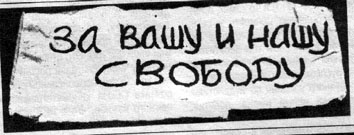
In fact, at least according to Nathans, the 1968 invasion of Czechoslovakia seems to have been a very big deal to Soviet dissidents. “Nobody took the Soviet side,” a Soviet physicist-turned-dissident later recalled [244], though the regime tried mightily, through the media and by means of staged demonstrations, to create the impression that popular support for the invasion was total. When Soviet dissidents decided to crack this facade by holding a public protest in Moscow’s Red Square, it “became the most celebrated fifteen minutes in the history of the Soviet dissident movement,” Nathans writes [253]. One participant, Larisa Bogoraz, tried to explain her motivations at her trial:

I found myself facing a choice: to protest or to keep silent. For me, keeping silent meant associating myself with the approval of actions of which I do not approve. To keep silent meant to lie. . . . It was precisely the demonstrations, the radio, the reports in the press about universal support [for the invasion] that aroused me to say: I am against this, I do not agree. [262]

Only eight people took part in the demonstration. For the most part, Nathans reports, “they barely knew each other” [252]. That’s very different from the Czechoslovak milieu, where personal connections, often established in the cultural sphere, linked many dissidents together before they became dissidents. As time passed, the Soviet and the Czechoslovak social maps seem to have grown more similar; Nathans reports that in Sacred Paths to Willful Freedom, a 1972 satiric novel about the Soviet dissident community, which circulated in samizdat, “Almost everyone is sleeping with someone other than their spouse” [533]—an endemic state of affairs (as it were) in Czechoslovakia. The other major difference between the two countries’ movements is that a plurality of Czech and Slovak dissidents came from the humanities and the arts—they were playwrights, actors, novelists, musicians, philosophers, and essayists—and a plurality of Soviet ones were scientists or mathematicians. The two movements had, as a result, distinctive flavors. The Soviet movement, even in its late, everybody-is-in-bed-with-one-another phase, seems to have had a certain abstract character, which caused it to keep being reinvented after repeated quashings, as if it were a crystal that couldn’t help but be re-precipitated from the general solution of Soviet political culture. In its early days, its main engine was what Nathans refers to as a “chain reaction”: dissidents would insist on making transparent the processes of the Soviet judiciary, which would get them arrested, which would lead to more trials, and more opportunities for difficult transparency. Via samizdat—texts that were retyped by hand, with as many carbon copies as feasible, and personally distributed—the trial transcripts reached a wide audience, and scientists, even though they were often sheltered and even pampered by the Soviet government, seem to have been more likely to be activated by reading them, perhaps because they were predisposed by their training to feel the need to set right inconsistencies between received opinion and the actual state of the world.

Here, too, there was convergence; eventually the Czechs and Slovaks also adopted the Soviet strategy of civil obedience. Czechoslovakia’s famous Charter 77 movement borrowed its central concept from Moscow’s Public Group to Assist in Implementing the Helsinki Accords: hold Communist leaders accountable for respecting human rights, as the leaders had sworn to do when they signed the 1975 Helsinki Accords, in exchange for which promise they had been granted formal international recognition of their nations’ borders for the first time since World War II. Kissinger and the diplomatic community pooh-poohed the human-rights language in the treaty as mere boilerplate; George F. Kennan, Nathans reports, dismissed it as “high-minded but innocuous” [599]. The dissidents took the promises seriously. (Even during this campaign of pretending to believe the government meant what it said, however, the predominant style in Czechoslovakia was ironic. “I know you’ll put all this into one of your articles,” an interrogator told the Moravian dissident Ludvík Vaculík during an interrogation, soon after Charter 77 was announced. “It was no use—they know everything,” Vaculík concluded, jestingly, in an essay about deciding not to share with his interrogator any of the nice apples he’d recently picked in the countryside.)

Another major difference between the movements is that in Czechoslovakia, as in other Soviet satellites, dissidence was buttressed by at least a tinge of nationalism, which in those countries had never been fully dissolved in the international fraternity of socialism. I think it made a difference, too, that Communism took hold in Russia at the end of World War I, and in Czechoslovakia not until a few years after the end of World War II. Russia never had all that much of a bourgeoisie in need of crushing in the first place, and by mid 20th century, it was more or less extinct. Socialism had brought millions out of poverty, but the country’s intelligentsia was a thin, artificially created layer of the population, less a “middle” class than a “between” class, for the most part gray and anemic because “we all have the psychology of government workers,” the dissident Andrei Amalrik wrote in Will the Soviet Union Survive until 1984? (1969), a samizdat analysis of the social composition of his movement and of the USSR more generally [304–10]. Key to the “chain reaction” of difficult transparency in the Soviet Union were open letters, to which dissidents often added their professions beneath their signatures. Analyzing this dataset, Amalrik found that among dissidents “the single largest contingent,” Nathans writes, “worked at institutions of higher education” [305]. For a class of thinkers sustained by a single universal employer to oppose the power of that single universal employer is a tricky balancing act. Officially, by the mid 1960s, there was no middle class in Czechoslovakia, either, but the Havel family, to take a crucial example, had been among the grandest of the great bourgeois families of the First Republic, the democratic and capitalist interregnum in Czechoslovakia between the two world wars. The Havels were real estate developers who pioneered the country’s nascent film industry. All but two rooms of their six-story Prague townhouse had been nationalized by the time Havel started writing plays, but it would have taken at least one more generation of class struggle to prevent any social and intellectual capital from being passed on to him. Dissidents in Czechoslovakia may have stood on economic ground no sturdier than what dissidents in the Soviet Union stood on, but the displaced social order was still a living memory for them, and they were able to speak with a cultural authority that hadn’t quite dissipated.

By relaying Nathans’s insight that Soviet leaders in the late 20th century were trying to move past violence, I hope I’m not giving the impression that the country’s dissidents had it easy. The Soviet authorities remained relentless, even if they were no longer quite as ruthless. Nathans devotes chapters to the “dissident repertoire” and to the repertoire of the secret police assigned to crush them, and the disparity is extreme. In a psychological rebound from the formality of Soviet life, dissidents seem to have been allergic to formally organizing themselves, and to have preferred for each person involved to be acting on the promptings of his individual conscience. Their weapon of choice was the open letter, circulated in samizdat. Even their dissident newspaper, the Chronicle of Current Events, was decentralized and intermittent. At first the authorities arrested and tried dissidents, hoping to repeat the pedagogical effects of the show trials of the early Soviet Union, in which bludgeoned defendants publicly confessed to everything and more, but the authorities soon learned that absent the bludgeonings, trials accelerated the dissidents’ “chain reaction,” because even though the judgments went as foreordained, defendants got a chance to speak for themselves. Authorities came to rely instead on extrajudicial means of suppression: involuntary psychiatric hospitalizations, “prophylactic” conversations (intimidating visits from KGB officers), and internal and external exile.

These were efficacious. By the early 1980s, the free-ranging Soviet dissident was an endangered species. Andrei Sakharov was banished in 1980, and after the Chronicle of Current Events ceased publication in 1982, the dissident movement all but shut down [609]. And then, a decade later, the Soviet leader Mikhail Gorbachev started echoing dissident catchwords like transparency and reform, and shortly after Gorbachev loosened the stays, the straitjacket unraveled. Whether the dissident movement had anything to do with the end of the Soviet Union remains a debated question. Nathans argues, hopefully, that “the dissident movement sparked by Volpin helped drain the Soviet system of legitimacy inside them,” [614] and maybe that is how the spirit of history did its work, in this case. Unfortunately, the current state of politics in Russia does not grace the story with a happy ending. In his 1969 samizdat essay, Amalrik had guessed that if the Communist regime collapsed, dissidents, and the middle class they came from, would be too weak to lead Russia, and the likely result would be “the rise of virulent Russian nationalism ‘with its characteristic cult of strength and expansionist ambitions'” [309]. In a 1967 essay, Sakharov had predicted that the Soviets and the West would someday converge, combining the best of both worlds [285], but his fellow dissident Leonid Plyushch thought the convergence more likely to be a dark one, with the USSR descending into “state capitalism in its most inhuman form” while the West became “less democratic, [with] greater concentrations of capital, and merging monopolies with the state” [292]. Ah well. Being right about the future doesn’t necessarily mean it turns out any better.

And maybe one doesn’t become a dissident because one thinks it likely one will prevail. Discussing the source of Larisa Bogoraz’s radical drive for transparency, Nathans quotes an essay by Hannah Arendt, “Moral Responsibility under Totalitarian Dictatorships,” about what motivated resistance to Nazi rule. Protesters, Arendt maintained, acted

not because the world would be better (not because of political responsibility) and not because they were worried about the salvation of their soul, but because they wanted to go on living with themselves. [292]