Heavy Rotation, the debut and the parties

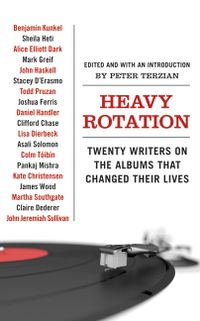
Peter Terzian, Heavy RotationMy boyfriend, Peter Terzian, has edited an anthology that Harper Perennial is going to publish on June 23: Heavy Rotation: Twenty Writers on the Albums that Changed Their Lives. It features the following pair-ups:

  • Stacey D'Erasmo on Kate Bush,
  • Pankaj Mishra on ABBA,
  • Colm Tóibín on Joni Mitchell,
  • Mark Greif on Fugazi,
  • Sheila Heti on the Annie soundtrack,
  • Ben Kunkel on the Smiths,
  • James Wood on the Who,
  • John Jeremiah Sullivan on early blues,
  • Clifford Chase on the B-52s,

and quite a few more. In my opinion, it is the book of the year. Kirkus, perhaps a more neutral judge, calls it "Music writing with a personal twist by an assortment of modern writers. . . . A satisfying, fun read that may prompt rifling through old CDs and LPs to reclaim one's own transformative musical memories." You can order your copy now on Amazon, on Barnes & Noble, or through Powells.

And if you're in New York City this summer, you're invited to some parties in its honor, which promise to be pretty amazing, especially if you have a taste for lounge-singing book editors and bongo-drumming literary critics. Here's the schedule, courtesy of Peter:

  • Tuesday, June 23rd, 7:00 pm
    Heavy Rotation launch party
    Come have a drink, meet the contributors, and celebrate the book's publication day.
    At Book Court, 163 Court Street between Dean and Pacific Streets, Brooklyn

  • Wednesday, July 1st, 12:10 pm
    A lunch-hour event in Bryant Park, behind the New York Public Library. Editor Peter Terzian will be discussing music and writing with contributors Clifford Chase, Stacey D'Erasmo, Joshua Ferris, and Asali Solomon. Plus, the New York debut of contributor John Jeremiah Sullivan's band Fayaway, with special guest percussionist James Wood.
    Note: Fayaway will play two sets—one at 12:10, before the discussion, and another at 1:30, after the discussion. The discussion will begin at 12:30.
    At
    Bryant Park Reading Room, New York (near 42nd Street, between the back of the library and 6th Avenue—look for the burgundy and white umbrellas)

  • Tuesday, July 14th, 7:00 pm
    Contributors Lisa Dierbeck, John Haskell, Todd Pruzan, and Martha Southgate will join me in a reading and panel discussion. With musical accompaniment by cabaret singer (and the book's Harper Perennial editor) Rakesh Satyal.
    At McNally Jackson, 52 Prince Street between Lafayette and Mulberry Streets, New York

No RSVP required. See you there!

Discord

In the London Review of Books, Paul Mitchinson investigates the damage that Leoš Janáček did to his career by his lack of tact (subscription required).

He persisted for years in misspelling (in multiple ways) Arnold Schoenberg’s name, and filled his copy of Schoenberg’s Harmonielehre with critical commentary. (‘Ass!’ he wrote in the margin next to a discussion of chord-construction on fourths.)

There seems to have been a little of this laying waste to normal human decorum even in Janáček's "most famous contribution to music: the 'speech melody.'"

In the summer of 1897, perhaps under Dvořák’s influence, Janáček began notating the tempo and pitch of the conversation he heard around him: the cries of children, the comments of neighbours, even the sounds of farm animals. In 1903, as his daughter lay dying of rheumatic heart disease, Janáček notated her strangled cries.

Unrequited love and zucchini curry soup

Martha Wainwright (2008), photo by Peter Terzian

[Today’s post is a departure from this blog’s usual preoccupations and usual author: Peter Terzian interviews singer-songwriter Martha Wainwright.]

Martha Wainwright made her recording debut in 1998 on The McGarrigle Hour, a collaborative family album featuring her brother, Rufus; her father, Loudon Wainwright III; and her mother and aunt, the Canadian folk duo Kate and Anna McGarrigle. Set among straight-arrow American standards—“Gentle Annie,” “Johnny’s Gone to Hilo,” and such—Martha’s “Year of the Dragon” was sexy and shape-shifting. A full-length debut, however, was years in the making; Martha Wainwright didn’t appear until 2005. Wainwright’s songs traffic in big, messy emotions. Her now-famous “Bloody Mother Fucking Asshole” is addressed to her dad; “When the Day is Short” is a dreamy paean to one-night stands.

“My heart was made for bleeding all over you,” she sings on her new album, I Know You’re Married But I Have Feelings Too. Wainwright’s voice is breathtakingly elastic—sometimes soaring and theatrical; other times kittenish; occasionally goofy.

I interviewed her a few weeks ago, on a sweltering Tuesday at Monkeyboy Studios, the Williamsburg recording studio of her husband, producer Brad Albetta.

PETER TERZIAN: How long have you lived in Brooklyn?

MARTHA WAINWRIGHT: Almost ten years, I think. I lived in Williamsburg early on. I lived in the East Village for a while and then moved back to Williamsburg.

Continue reading Unrequited love and zucchini curry soup

Ol rait

So, it’s the 1970s, and Elvis Presley is Italian, and he can play the harmonica like Bob Dylan, and he’s in a music video directed by Leni Riefenstahl, singing in Esperanto. Except it isn’t Esperanto; that isn’t good enough. No, he’s singing in a language that he made up himself. And he says that Prisencolinensinainciusol means “universal love,” and the Italian Debbie Harry is singing backup, along with about a hundred others. You can watch Adriano Celentano here, and read along to the lyrics here. (Hat tip to Acknowledged Classic.) According to a Russian fansite, Celentano is also an actor, who has appeared in over forty films, including Fellini’s La Dolce Vita, and according to his Wikipedia page, his daughter played Satan in Mel Gibson’s Passion of the Christ.