Madame Merle, not waving but drowning?

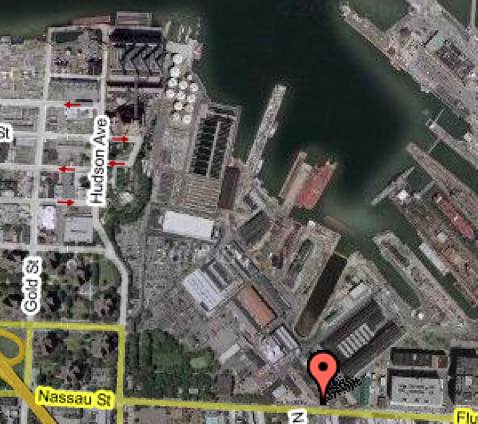
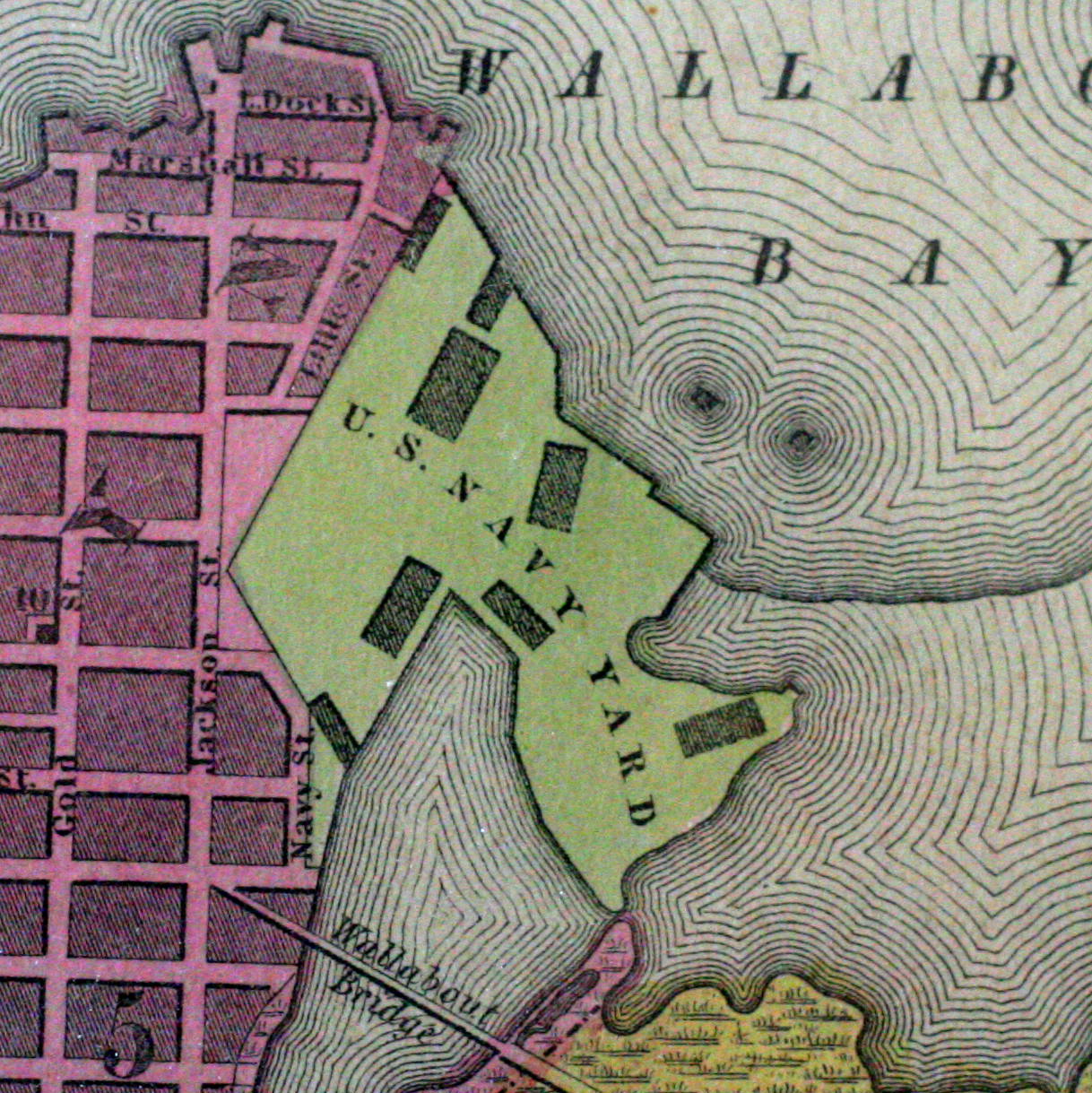
Here’s a current-day Google hybrid map of the same area of the Brooklyn Navy Yard pictured below in an 1850 map. The big thing to notice is that in 1850 much of today’s navy yard was still under water; there must have been a big landfill project sometime afterward. Corie Trancho was kind enough to send me an email of her assessment of the 1850 map:

I don’t think that any of those shaded images were the Officer’s Row houses. The configuration of the yard is a little strange in that map, but the houses would probably have sat somewhere to the right of the triangular area.

Kaboom

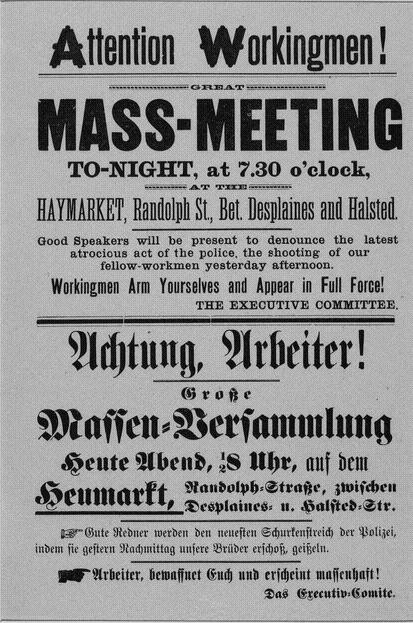
“The Terror Last Time,” my article about the 1886 trial of Chicago’s Haymarket anarchists, which is in part a review of James Green’s new book Death in the Haymarket, is published in the 13 March 2006 New Yorker. As it happens, there are many Haymarket resources on the web, so I thought I’d link to a few of them. What follows will seem a little scattered unless you read my article first (ahem), but if you’ve done that, then . . .

If you want to read the witnesses’ testimony yourself, the Chicago Historical Society has published the trial transcript in the Haymarket Affair Digital Collection. The collection has all sorts of neat tidbits. If you thought my description of Louis Lingg’s beauty was a bit too breathless, for example, you can judge for yourself here. If you want to see exactly how nut and bolt screwed together to make a bomb, look here, for a bomb allegedly Lingg’s. The historical society also collaborated with Northwestern University to create Dramas of the Haymarket, a sort of online guided tour of the archival holdings.

The 2003 re-analysis of the Haymarket bomb fragments and evidence was described in this article by Timothy Messer-Kruse, James O. Eckert Jr., Pannee Burckel, and Jeffrey Dunn in a 2005 issue of the journal Labor: Studies in Working-Class History of the Americas.

The night before Parsons, Spies, Engel, and Fischer were hanged, Parsons sang the Scotch ballad “Annie Laurie.” There’s no recording of Parsons himself singing it, but there’s a period recording of the song by the Edison Male Quartette in the UC Santa Barbara Cylinder Preservation and Digitization Project. As I mention in the article, the next morning, just a few hours before they were hanged, the men sang the “Workers’ Marseillaise” together. The three German speakers may well have sung in German, and I strongly suspect that that’s what’s being sung in this period recording. I’m not sure, though, because my German comprehension is extremely poor; it’s the right tune, certainly, and someone has catalogued it under the title Arbeiter, i.e., “workers.”

Brooklyn Navy Yard, 1850

In the interest of trying to determine whether Madame Merle could possibly be telling the truth about her birth (see previous blog entry for details), here’s a detail from an 1850 map titled “City of New-York,” credited to Thomas, Cowperthwait. More expert eyes than mine will have to say whether any of these gray-shaded blocks correspond to the Officers’ Row at issue today.

Discretion

The documentarians Corie Trancho and Alexis Robie have been photographing and writing about Officers’ Row, a group of condemned buildings at the Brooklyn Navy Yard, sometimes called Admirals’ Row. Their online archive is haunting, and I recommend a tour of it. There are movements afoot to try to save the houses, though the documentarians are staying neutral.

To the best of Trancho and Robie’s knowledge, the houses weren’t built until 1860 at the earliest. No doubt they’re right, but Henry James seems to have thought they were older. While re-reading Portrait of a Lady recently, two things jumped out at me. First, James introduces Madame Merle the same way Melville does Queequeg— by a sequence of misconceptions. Ishmael first thinks Queequeg is an injured white man, then a tattooed white man, then the devil, then a savage, then a cannibal, and finally a suitable bedmate. Isabel thinks Madame Merle is an artist, then a Frenchwoman, then an American, then a “very attractive person,” then “a person of tolerably distinct identity,” and finally a suitable confidante.

Second, and more relevantly, it leaped out at me that Madame Merle was born in Officers’ Row:

Madame Merle glanced at Isabel with a fine, frank smile.

“I was born under the shadow of the national banner.”

“She is too fond of mystery,” said Mrs. Touchett; “that is her great fault.”

“Ah,” exclaimed Madame Merle, “I have great faults, but I don’t think that is one of them; it certainly is not the greatest. I came into the world in the Brooklyn navy-yard. My father was a high officer in the United States navy, and had a post— a post of responsibility— in that establishment at the time. I suppose I ought to love the sea, but I hate it. That’s why I don’t return to America. I love the land; the great thing is to love something.” (chapter 18)

At least, that’s where Madame Merle says she was born. Whether you believe what she says is at your option. She’s about forty at the time of the novel, which seems set in a moment contemporary to its publication, in 1880-1881; in James’s imagination, then, the row, or a predecessor to it, was standing in the 1840s.