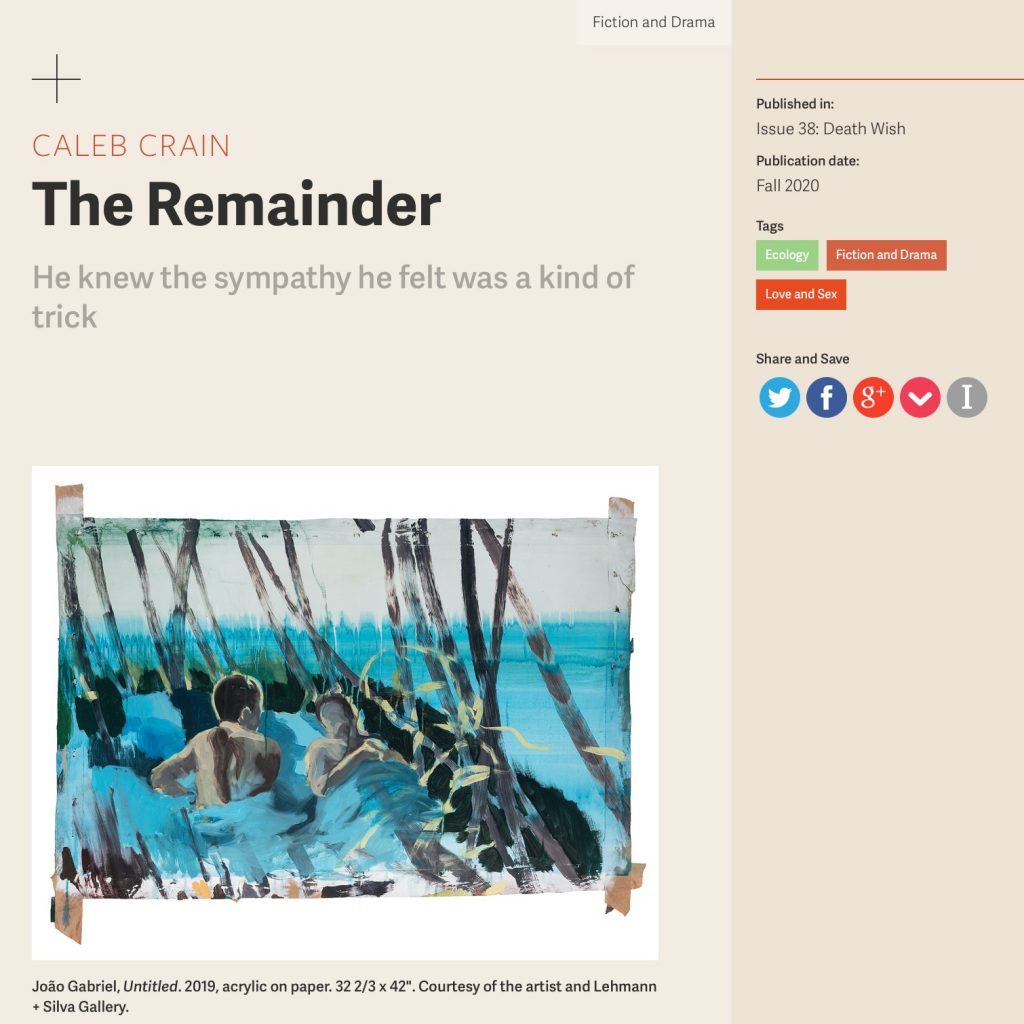
Polling can’t be fixed because only the very nice still answer the phone

I only did two sessions of phone-banking in this election cycle, but even in that very small sample, I came away impressed by how few people still answer their own phones and how elaborate the technology has become for avoiding calls from strangers. I was phone-banking with a group that had pretty sophisticated software, which did the dialing for us, in the background, but even so, mostly I was just leaving voicemail messages. Now and then I got through to an app called Google Assistant, which is basically just a way to hang up on people in realtime without the awkwardness of having let them hear your voice. Years of scam callers also seem to have disinhibited people from just hanging up the old-fashioned way.

I don’t blame people for not wanting to talk to strangers. I hate it myself, and only undertook to call strangers because I believed democracy was in peril. But if no one has to answer their phone any more, the people who do still answer their own phones must be different from you and me. They must not mind somehow. Maybe they enjoy human connection just for its own sake? (I’m reminded of the New York Times profile last year of a woman with a genetic mutation that has made her immune to any feelings of pain or anxiety.) Maybe the people who still answer their phones are . . . nicer? More open to experience? More available to human interaction? Is “sociotropic” the right word? Something like that.

Statisticians probably aren’t ever going to be able to correct for this difference by adjusting for race, gender, income, age, or any other trait. After the widespread pollster failure of 2016, many pollsters decided that their error in 2016 was failing to realize that the non-college-educated were different from the college-educated, and in 2020, almost every pollster did adjust for that. It didn’t help. One rough estimate I saw on Twitter is that in 2016, state polls were off by about 5 percent, and in 2020, they seem to have been off by about 7 percent.

If I’m right, polls from now on are always going to suggest a more humane outcome than will really happen. There will be no way to compensate, because you can’t add extra weight to the opinions of people who don’t answer their phone. They don’t answer their phones! Multiply zero by as large a factor as you want, it’s still zero. In the future, my advice is that whenever you read a poll result, figure out which candidate a mean person would be more likely to vote for, and silently add to that candidate’s numbers an extra 5 to 10 percent. Or more, if you think people are getting meaner.

UPDATE, 1pm: On Twitter, @15c3PO points out to me that David Shor, the political consultant famous for having been unjustly fired, has made a similar suggestion: because distrustful people didn’t answer their phones, the Hillary Clinton campaign failed to realize in 2016 that socially liberal messaging wouldn’t play well with non-college-educated voters. Says Shor:

The actual mechanical reason was that the Clinton campaign hired pollsters to test a bunch of different messages, and for boring mechanical reasons, working-class people with low levels of social trust were much less likely to answer those phone polls than college-educated professionals. And as a result, all of this cosmopolitan, socially liberal messaging did really well in their phone polls, even though it ultimately cost her a lot of votes.

And, @15c3PO adds, reporter Matthew Zeitlin also had the same idea as me, but sooner. The day before the election, Zeitlin wrote on Twitter: “Just putting this out there but isn’t it possible that the low social trust non-response problem has gotten worse and thus the swing toward Biden in the Trumpy demos and the states that swung big toward Trump is something of a mirage…(we’ll find out!).”

Chicago Instagram residency, day 2: Luddite writing tools

View this post on Instagram

My name is Caleb Crain, and I'm a Luddite. Today I'm displaying my tools for writing. (My novel "Overthrow" comes out next week from @VikingBooks, and I'm doing a residency here at the Chicago Review of Books' Instagram account.) I write fiction longhand, and I tend to start scribbling in pencil, preferably with the Staedtler Mars Lumograph HB, though I have tried to be unfaithful to it with the Uni Mitsubishi Hi-Uni HB and the Uni Mitsubishi 9000 HB, and they and I have had some nice flings. I have no ambivalence about pens: the best is the Uni-ball Signo UM-151 Gel Pen (0.38 mm). The pencil sharpener pictured here is a Boston Vacuum Mount, inherited from my late father-in-law. I keep in supply four kinds of notebooks: the Staples Sustainable Earth composition notebook (for writing fiction); the Midori MD notebook, A5, lined (for keeping a journal); the Apica CD 11, A5, 7mm rule (for taking notes about books in); and the Muji Passport Notebook (for taking notes about everyday life in). My only phone is the ugly dumb burner phone here. Next to it is an Ipod Touch, which in my writing space has no internet access, because there's no Wi-fi, and which I use for the Oxford Shorter English Dictionary, Logeion, the Chambers Thesaurus, Lingea's Handy Lex English-Czech Large Dictionary, and a few foreign language dictionaries. The little white rope-like thing on the left is the tail of a librarian's snake; it has bullets inside, to make it heavy enough to hold open the pages of books. Pictured is a fine Staedtler eraser but I like the Uni Boxy eraser marginally more.

A post shared by Chicago Review of Books (@chicagorevbooks) on

“Overthrow,” as thing & as tour

I just got sent a copy of Overthrow as a finished book.

Overthrow by Caleb Crain

Plus, here’s the schedule for bookstore events in August and September. Please come, if you’re in Brooklyn, Manhattan, San Francisco, or Los Angeles! And please consider supporting these bookstores by buying your copy from one of them. Thanks!

A Longitudinal study of self-presentation on the interwebs

Listen, whippersnappers. I was online back when one searched with Archie instead of Google. I remember when a text-based menu system called gopher was hailed as a startling breakthrough, which it was, since at the time they hadn’t invented the worldwide web yet.

Sadly, I never had a gopher. I did have an early webpage, however. It launched no later than March 1995, to judge by mentions of it that I find in old emails. I wrote it myself. All of it. That is, I wrote not only the words but the html. In those days the internet was very do-it-yourself. Because the site was hosted by Columbia, where I was in grad school, the URL was http://www.columbia.edu/~wcc6. It was a fairly nerdy thing; I don’t remember that any of my fellow grad students in English and American literature had one.

The earliest record that I have of what it looked like is dated 1999, four years after its birth, when I downloaded a copy before Columbia shut it down (I was, finally, graduating). By then it was looking a bit plain, compared to other websites on the internet, and I had begun to get emails from strangers asking why I didn’t update it more often. It was a point of pride with me, however, that a reader who browsed my website in Lynx, which only downloaded text, wouldn’t miss much. (Lynx was handy for bandwidth-poor people like me who connected via dial-up modem.) In other words, my public online self in 1999 probably wasn’t markedly different from my public online self in 1995. Here it is:
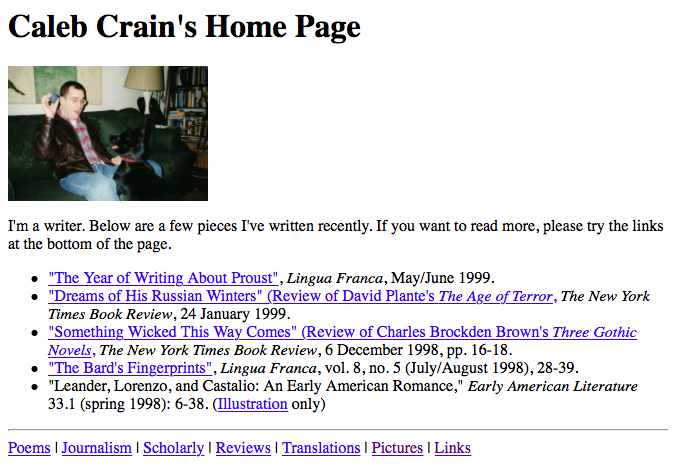
Caleb Crain's website 1999

That was my dog. Yes, there were poems. No, I will not be re-posting the poems today. This isn’t quite what the website looked like, of course, because in those days the font of a website was chosen by its reader not its writer. My webpage would have appeared to you in whatever font you had told your browser you preferred.

After Columbia kicked me out of the nest, I vanished from the internet until March 2003, when I learned that as a Harvard alum, I qualified for a free blog, courtesy of the Berkman Center (now known as the Berkman Klein Center). The idea seemed to be that blogs were going to bring the Habermasian public sphere to the internet, and a nonprofit could reputably be in the business of inducing them to proliferate. The software platform was something called Manila. There were colors! There were templates! My URL was http://blogs.law.harvard.edu/calebcrain/, which gave a number of people the wrong idea that I was a law professor. Here’s a screenshot from December 2003, preserved thanks to the Wayback Machine.
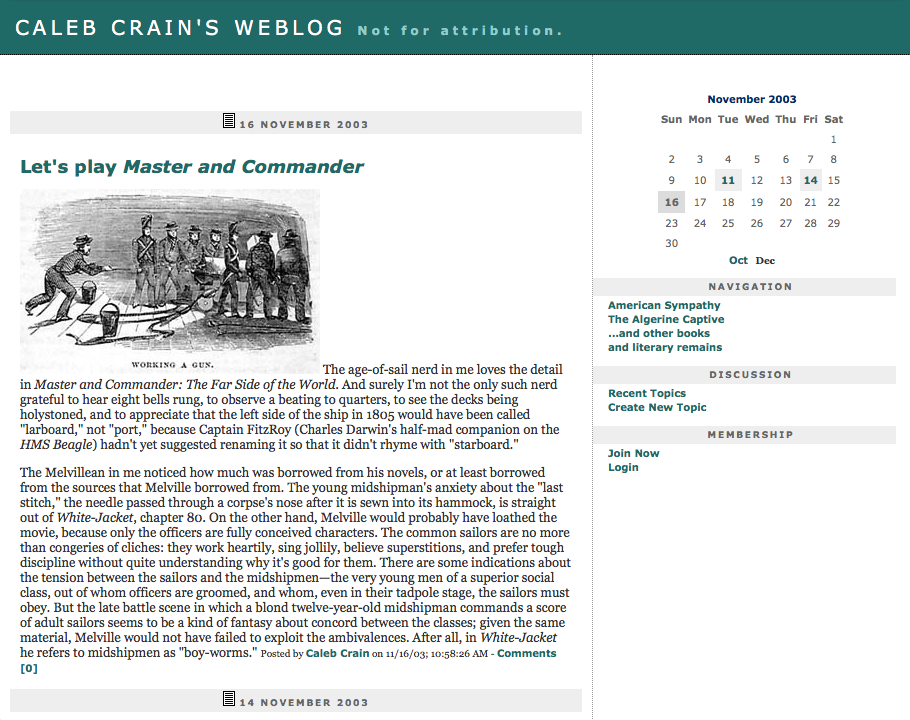
Steamboats are ruining everything, December 2003

My blog wasn’t named “Steamboats Are Ruining Everything” at first. That title was in place at least by October 2004, however, and in April 2006, I hooked it up to the URL https://steamthing.com, a portmanteau of the first and last syllables.

As you can see below, I switched to a red palette by April 2006, I think because I read somewhere that although people are soothed by tones of blue and green, they are more likely to find a brash color like red memorable. (Even back then we on the internet were trying to manipulate you.) Note the long, name-droppy blogroll in the right-hand column. Before Facebook (born February 2004) and Twitter (born March 2006), such links were how one found cool things to read on the internet (things you didn’t know you wanted to read, as opposed to things you knew you wanted to read, which you could search for).

Steamboats are ruining everything, April 2006

The snapshot above is saved on my hard drive because I was then about to move to a blogging platform called Type Pad, and fearful of disaster, I made one of my rare backups. My probably erroneous memory is that Type Pad had struck some kind of deal with the Berkman Center to take bloggers off their hands; at that point no one any longer thought bloggers needed foundations or anyone else to encourage them.

In this era, on many blogs, one found at the end of a post little pellets of html frass, which offered to automate a connection, should the reader be generous enough to want to make one, to sites such as Reddit, Stumble Upon, and dozens of others. Let us clutter your website, these services proposed, and in exchange we will send you “traffic.” I briefly experimented and found that I hated the clutter, as well as the sense of having compromised myself, and thenceforward abstained. (I never tried ads or a tip jar.)

The Type Pad platform allowed for something called banners at the top of the page. Armed with a scanner, an old book of engravings of steamboat disasters, and a copy of Photoshop that I had purloined from Lingua Franca back in 2000, here’s what I came up with:

Steamboats are ruining everything, July 2009

As you can see, by July 2009 I had backed off from all red. That color was now reserved for unclicked links. I developed a whole psychology of link colors, to mess with readers. Unclicked links were red, as if they were forbidden and butch, in order to dare you to approach. When you hovered your mouse over the link, however, it subsided to pink—friendly and nonthreatening and maybe even a wee bit submissive. If you fell for this, you would find, upon returning to the page, that the link had turned orange, as if you had created some kind of hazard. More manipulation on my part. I have kept these psychoerotic link colors to the present day. My background color in 2009 was a sort of sepia because the overall idea being conveyed was that I was a 19th-century guy; cf. the long list of 19th-century archival resources in the right-hand sidebar and the general look of intense textiness.

Here’s a slight improvement of the banner, captured in April 2010.
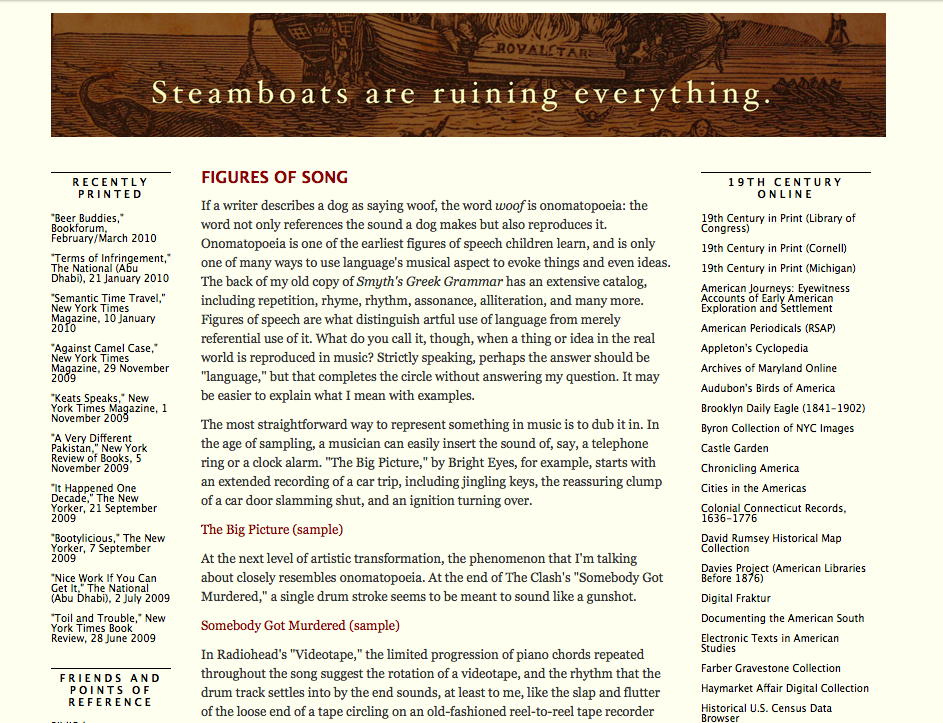
Steamboats are ruining everything, April 2010

After a while, the pseudo-Victorian look began to seem a little somber to me. To lighten it up, I had the idea of making the title appear as if it were being uttered by one of the drowning steamboat passengers. As preserved by Archive.is, here’s a screenshot of February 2013:
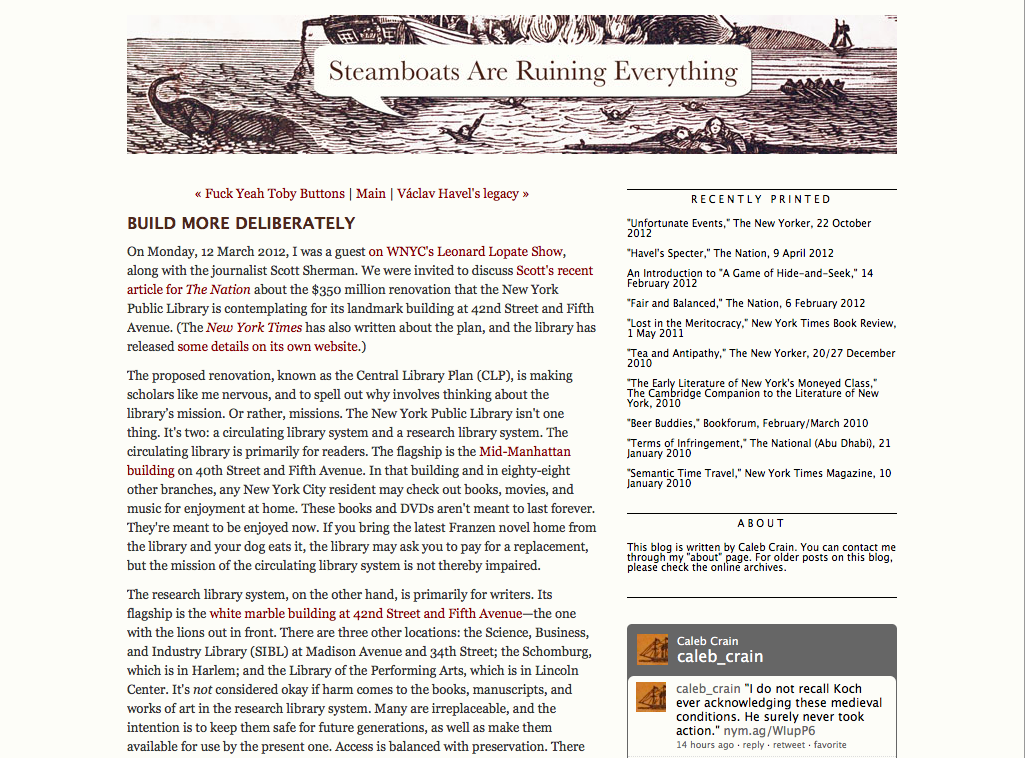
Steamboats are ruining everything, February 2013

In some ways I think this was the most echt Steamboats look, though I now regret having allowed the intrusion of a whole box of Twitter in the right-hand sidebar—a false compromise with a power that was then beginning to exterminate blogs right and left. Note that my lists of friends and 19th-century sources had by now been demoted. They were still on the page, but you had to scroll fairly far down to see them.

By 2013, I wasn’t really a 19th-century guy any more, except at heart, and my first novel was scheduled to come out in August. I needed a whole new look, fresh and modern. Type Pad, meanwhile, had become a little creaky in the joints, so I made a ridiculously kludgy switch to Word Press. I looked around and discovered that nobody but me still had a blogroll (and that most of my friends had shuttered their blogs), so the blogroll and the list of 19th-century resources were moved to subsidiary pages. The focus, I decided, would be on a single, readably narrow column of text, with recessive decoration on one side and a few unobtrusive utilities on the other. The advice about keeping the column of text narrow came from a website written by Kibo, ages ago. (Oh, you don’t know who Kibo is? How recently did you say you were born?) The idea of reducing distractions on the page to a minimum came from Mandy Brown’s blog, A Working Library. Here’s the end result of this redesign, as it appeared in August 2013, on the eve of the publication of Necessary Errors:

Steamboats are ruining everything, August 2013

Elegant, no? Alas, it was hacked, in 2016, by people who seemed to be interested in porn and Indonesian song lyrics. While rebuilding and “hardening” the site, I took the opportunity to make it “responsive,” which is the word for a site that changes shape depending on whether you’re looking at it on a desktop computer or a mobile phone. (If you’re reading this on a laptop, you can see how this site now “responds” if you drag the lower righthand corner of your web browser to the left, to make it smaller; sometimes I do this myself just for the pleasure of watching the sidebars pop away into the ether, one by one.) I think the overall site lost a bit of its panache in the process, but utility is all and I like that the page is still relatively simple.
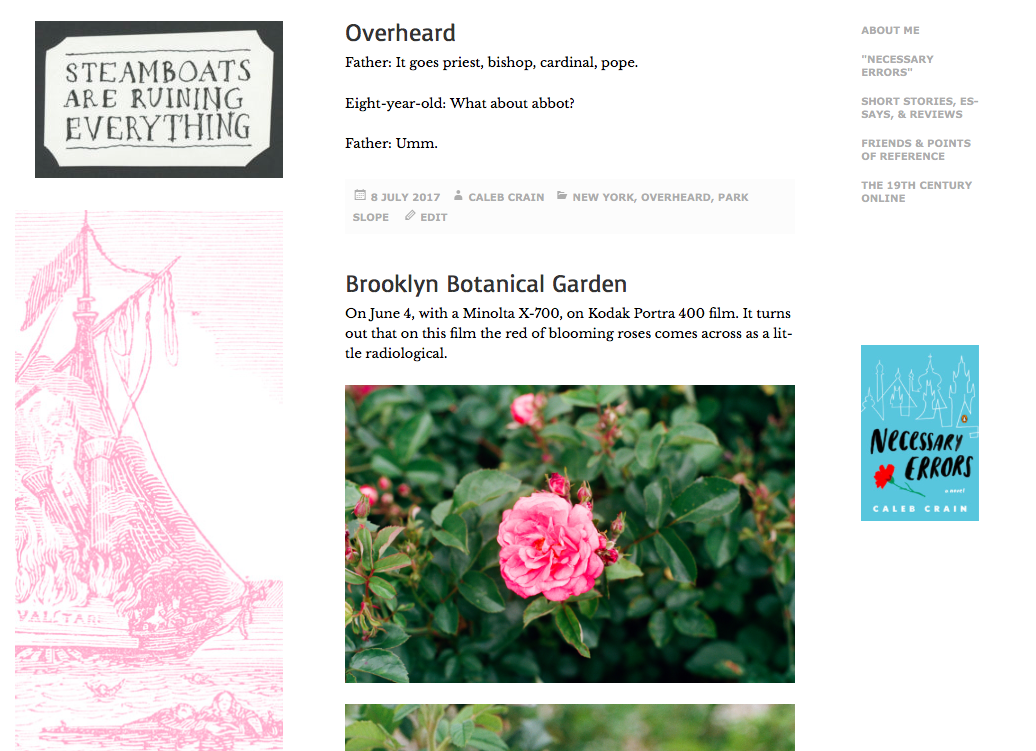
Steamboats are ruining everything, July 2017

I seem to have left out of this post a history of comments, and also an explanation of why blogging is dead, but maybe those go without saying.

Those people were a kind of solution: the future of books and copyright, part 2

François Bonvin, 'A Woman Reading, after Pieter Janssens Elinga,' 1846-47, Metropolitan Museum of Art

It’s bracing to spend time with people who know in their hearts that your way of life is going the way of the horse and buggy.

In an earlier post, I described a few legal concepts in vogue at In Re Books, a conference about law and the future of the book that I attended on 26 and 27 October, and I characterized the conference as haunted by the ghost of the late Google Books settlement. In this post, I’d like to relay what the conferencegoers had to say about the future of publishing, including the problem of how to price e-books.

Most of the conferencegoers seemed to be lawyers, law professors, or librarians. One of the exceptions, the author James Gleick, noted that everyone present was united by the love of books—and then added that the love sometimes took the form of a wish to have the books for free. But the lawyers themselves didn’t seem to think of their doomsaying as in any way volitional. Some of them even seemed to look upon the publishing industry with pity; they hoped it would soon be out of its misery.

Consider, for example, the battle being waged between Amazon and traditional publishers over the price of e-books. Most people in publishing see their side as waging a crusade in the name of literature. Their version of the story goes like this: A few years ago, Amazon had managed to establish a near-monopoly on e-books by offering low prices. Amazon in many cases sold e-books to customers for even less than the wholesale price that publishers demanded, losing money for the sake of market share. Publishers were alarmed. If customers came to expect such low prices habitually, and if Amazon’s monopoly remained unbroken, publishers would be forced in time to lower their wholesale prices radically. Editors, designers, publicists, and sales representatives would lose their jobs, and books would no longer be made with the same level of care—if publishers managed to remain in business at all. When Apple debuted the Ipad in 2010, publishers saw a chance to rebel. They agreed with Apple to sell e-books on what was called the “agency model”: publishers were to set the retail price, and Apple was to take a percentage, the way it did with the apps sold through its Itunes store. With many titles, the publishers were agreeing to sell e-books to Apple for a wholesale price lower than the one they had been getting from Amazon, but the power to control retail price seemed worth the sacrifice. The publishers gave Amazon a choice: accept the agency model or lose access to books. Amazon complained that the publishers were abusing their “monopoly” over books under copyright, and the retailer briefly tried to coerce publishers by erasing the “buy” buttons from the Amazon pages of the publishers’ print titles. In the end, though, Amazon gave in, and over the next couple of years, Amazon’s market share in e-books fell. Today the Nook and the I-Pad offer the Kindle stiff competition. In April 2012, however, the Department of Justice accused the publishers and Apple of antitrust violations. A few publishers settled, for terms that required them to allow Amazon to discount their e-books as before. Others are still fighting the charges. Amazon, meanwhile, has become a publisher itself—of serious books, as well as vanity titles. How, most people in publishing want to know, can the Department of Justice fail to see that Amazon is trying to drive traditional publishers out of business?

The lawyers at the In Re Books conference were able to see that, as it happens. They just didn’t see it the way people in publishing do. They saw, rather, a historical process of Hegelian implacability, and they saw the publishers as desperate characters who had resorted to possibly illegal maneuvers in a futile attempt to prevent it. “You know, the agency model,” said Christopher Sagers, a law professor at Cleveland State University who specializes in antitrust, “we used to just call it price-fixing.” Sagers allowed that a recent Supreme Court ruling, the Leegin case of 2007, was somewhat indulgent toward so-called “vertical” price-fixing, which consists of a series of contracts between a manufacturer and its distributors and retailers, along the vertical axis of the supply chain, that allows a manufacturer to determine retail prices of its goods. (Apple famously prohibits its retailers from discounting its products without permission, for example.) But “horizontal” price-fixing remains illegal, as do certain strains of “vertical” price-fixing, Sagers said, and the Department of Justice thought that the publishers and Apple were guilty along both axes. It was no defense, Sagers pointed out, to say that the publishers were choosing to lose money. The law didn’t care about that. Nor was it a defense to say that publishing is special. Throughout history, Sagers said, companies have responded to antitrust accusations by claiming to be special, and Sagers didn’t think publishing was any more special than, say, the horse-and-buggy-making industry had been. In Sagers’s opinion, publishing is suffering through the advent of a technological change that is going to make distribution cheaper and, through price competition, bring savings to consumers. Creative destruction is in the house, and there is no choice but to trust the market. “Someone will figure it out,” said Sagers, “it” being a new economic engine for literature, and he apologized for sounding like Robert Bork by saying so. As for the charge that Amazon was headed for a monopoly, Sagers’s reply was, in essence, Well, maybe, but the answer isn’t to let a cartel set prices.

The legal question at issue is somewhat muddied by the fact that publishers are allowed to set the retail prices of books and even e-books in a number of other countries, where publishing is heralded as special. Germany, France, the Netherlands, Italy, and Spain allow the vertical price-fixing of books, as Nico van Eijk, of the University of Amsterdam, explained at the conference. The United Kingdom, Ireland, Sweden, and Finland, on the other hand, do not. Van Eijk thought he saw a pattern: The warm and emotional countries indulge their literary sector, while the cold and as it were remorseless ones subject it to the free market. The nations that allow for “resale price maintenance,” as it’s called, in publishing justify the legal exception for three reasons. They believe that it brings a bookstore to every village, that it makes possible a wide selection of books in those bookstores, and that it enables less-popular books to be subsidized by more-popular ones. In other words, the argument for resale price maintenance rests largely on the contribution that local, independent bookstores make to cultural life. And bookstores do thrive in countries where publishers may set retail prices. The trouble is that the same arguments don’t work as well with e-books, as Van Eijk pointed out. E-bookstores are virtually ubiquitous, thanks to widespread internet access, and every e-book available for sale is available in almost every e-bookstore. As for cross-subsidization, van Eijk dismissed it as already doubtful even as a justification for printed books. (In fact, though several people I spoke to at the conference seemed either unaware of it or not to believe in it, the current publishing system does allow for cross-subsidization. Most books of trade nonfiction wouldn’t get written without it. Publishers advance substantial sums to writers who propose books that sound promising, and publishers can afford the bets because they’re buying a diversified portfolio: if the biography of Henry VIII doesn’t make it big, maybe the cultural history of the Mona Lisa will. If publishers are driven out of business, only heirs and academics are likely to be able to put in the years of research necessary to write a book of history, unless the market comes up with a new funding mechanism.) Most European countries seem skeptical of allowing resale price maintenance for e-books, but “we’ll always have Paris,” van Eijk joked. French law, he explained, not only allows but requires fixed pricing for e-books. Moreover, France insists on extraterritoriality: even non-French booksellers must comply if they want to sell to French customers.

Niva Elkin-Koren, of the University of Haifa, predicted a “world of user-generated content,” where the tasks of editing and manufacturing books will be “unbundled,” and “gatekeeping,” which now occurs when Manhattan editors turn down manuscripts, will take place through online reviews after the fact. She seemed to see the “declining role of publishers,” as she put it, as a liberation, but I’m afraid I found her vision bleak. In the future, will we all be reading the slushpile? Jessica Litman, of the University of Michigan, also thought little of publishers, accusing them of angering libraries and gouging authors. As a bellwether, Litman pointed to the example of a genre author whom she likes who now sells her books online. I found myself wondering if Litman was extrapolating from an experience with academic and textbook publishers, some of whom do bully authors and have resorted to extorting the captive markets of university libraries and text-book-buying students. In my experience, trade publishers go to great pains to keep prices low and authors happy.

In the last panel session, a masterful analysis of the economics of publishing in America and Britain was presented by John Thompson, of the University of Cambridge, author of Merchants of Culture. Thompson began by surveying the forces of change in the last couple of decades. In the 1990s, the rise of bookstore chains killed off independent bookstores. The introduction of computerized stocking systems brought greater control over when and where books appeared in stores. Once upon a time, paperbacks were publishing’s bread and butter, but mass-marketing strategies originally devised for paperbacks were applied to hardcovers, and in time hardcovers became the moneymakers. Literary agents grew more powerful. A handful of corporate owners consolidated control.

Thanks to these changes, said Thompson, today there are large publishers and many tiny ones, but very few that are middling in size. That’s because a midsize publisher misses out on the economies of scale available to a large one, and misses out on the barter-circle of favors that indie presses are willing to exchange with one another. Large publishers are preoccupied with “big books,” which Thompson defined as “hoped-for best-sellers,” because their corporate owners demand annual growth of 8 to 10 percent, even though the overall market for books is stagnant. At a large publisher, the only way to keep your job is to pursue big books, however mathematically doomed the pursuit may be in the larger scheme of things. Big-book status depends, in Thompson’s formulation, not so much on fact as on “a web of collective belief”; big books are identified by the “expressed enthusiasm of trusted others.” Certain people—often, literary agents—become brokers in this economy of belief, enabling them to extract higher prices. Thompson called the result “extreme publishing.” Every year, the reasonable sales predictions aren’t good enough, and editors are forced to try to “close the gap,” that is, to come closer to the sales figures that their corporate overlords are demanding—a task for which only big books are big enough even to be plausible. Meanwhile, as bookstores are shuttered, it’s becoming harder and harder to bring new titles to customers’ attention. In hopes of making a big book, publishers pay to feature their books in store windows, where a new book has about six weeks to prove itself. If it shows signs of doing well, publishers have become adept at “pouring fuel on a flame,” as Thompson put it. But they’ve also become ruthless at killing off the weak. About 30 percent of books are returned from bookstores to publishers, and most are pulped.

In the United States, said Thompson, publishers face agents who are able to demand higher advances for their authors. In the United Kingdom, where the Net Book Agreement, which allowed publishers to set retail prices, collapsed in the 1990s, publishers face powerful retailers like Tesco who not only sell at a discount but demand cuts on wholesale prices.

As for e-books, Thompson stressed that the market is changing fast enough to make a fool out of anyone claiming to know what it will do next. He noted that when e-books were introduced, most analysts expected business titles to be the pioneers, but instead genre fiction led the way. Forty to fifty percent of romances, science fiction novels, and thrillers are now sold in digital form. (I thought I saw a hint of an explanation for the divergence in a talk given by Stuart M. Shieber, a professor of computational linguistics at Harvard. After analyzing the pros and cons of print books and e-books—including such factors as resolution, weight per reading unit, capacity for random access, and pride of ownership—Shieber predicted that when display technology has been perfected, “E-book readers will be preferable to books” but “Books will still be preferable to e-books.” If Shieber is right, then perhaps what differentiates is where a reader’s attachment lies. If your attachment is to the experience of reading rather than to a particular set of titles, you’re more likely to prefer an e-reader. But if your attachment is to particular books, you’ll prefer to read them in print. After all, at the extreme, if all you want to do is re-read a single text, you probably won’t bother with an electronic device.) But even literary fiction is shifting, Thompson noted. Twenty-five percent of the sales of Jonathan Franzen’s Freedom were e-books, and fifty percent of Jeffrey Eugenides’s The Marriage Plot.

Though he stressed the hazards of guessing, Thompson concluded by making a number of short-term predictions. He thought Amazon would continue to grow and bookstore chains to wither. He foresaw more consolidation, as weak publishers fold and impatient corporate owners decide to get out of the publishing business. As bookstores vanish, they will be taking their windows and display tables with them, and it will become harder and harder to introduce new books to readers, a battle that will have to fought online. Thompson expected that different kinds of books will continue to shift from print to digital formats at different speeds. Price deflation for e-books will be perhaps publishers’ greatest challenge, and publishers will very likely be forced to reduce costs in order to remain profitable—shedding staff and limiting themselves even more rigidly to big books than they do now. Nipping at their heels, all the while, will be an army of small presses and start-ups, many of whom will be trying to come up with new kinds of “disintermediation”—new ways to abridge a book’s journey from writer to reader.

What does it all mean? In looking over these notes, I find myself wondering if copyright is meaningful in the digital world without some power to set retail prices. The rigorous application of free-market logic to issues of copyright sounds slightly off-key to me. It is nowhere written that the law has to defer to macroeconomics, which copyright, by its very nature, defies. No market left to its own devices would come up with copyright. The whole point of it is that society has decided that the written word is special, and has recognized that perfect competition in the literary sphere quickly leads to prices so low that no writer can make a living. (An important subsidiary point is that society demands, in exchange for granting this exceptional economic protection, a temporal limit to a copyright’s term, but we’re not litigating that aspect of the case today.) Amazon’s publicists had a point when they lamented that copyright is a monopoly. In the market for a particular work of literature, it is one, a legal one. It is authorization to sell a work of literature at a higher per-unit price than the market would support if everyone were free to print it. Authorization alone would be meaningless, however. The government also has to prevent a publisher’s competitors from selling the same work at a lower price. In her remarks at the conference, Elkin-Koren predicted that as books turn into e-books, they will move from being commodities to being services, and publishing will merge with retailing. “There is no difference between a bookseller, a publisher, and a library,” she said. But if she’s right, then if copyright is to have any force, shouldn’t the power to set a book’s price at its “first sale” be extended to the price of the license sold to the reader-consumer? The extension might be necessary to preserve the spirit of copyright. And given the ease with which digital copies can be made and shared, it might also be necessary to retain beyond the “first sale” of an e-book the copyright controls that are exhausted upon the first sale of a printed book. That may sound inelegant, but there’s no reason to think that the best way for law to foster literature is going to be natural-looking. Copyright never has been natural, and it never will be. The challenge is to find the least amount of legal protection adequate to retaining publishing as a viable business.