Did David Lynch Watch the Czech New Wave?

Just came home from Václav Vorlíček’s Kdo chce zabít Jessii? (1966), or “Who’s Trying to Kill Jessie?” (not “Who Killed Jessie?” as it’s mistranslated in some of the program notes). It’s bouncy and lightly absurdist, like Zazie dans le métro, and has an allegorical condemnation of totalitarian socialism so flagrant that it’s hard to imagine how it got past even the wilting censors of late 1960s Czechoslovakia: a lady scientist has devised a serum that will improve workers’ productivity by removing unruly elements from their dreams. The unintended side-effect, however, is that these unruly elements then materialize in the waking world, where they are provokingly curvaceous, steal the milk bottles of infants, and bite the plumbing.

But before she injects her husband, who to her dismay does not dream of her, the lady scientist first injects a cow. The cow’s dreams are visible on a large cathode ray tube (prefigurations of Minority Report). Before: the cow in a nightmare is stung by gadflies and dances herky-jerkily across a pasture. After: the same cow is rocked in a hammock, munching on flowers, while a string ensemble plays Handel. Among the scientists invited to witness the experiment is a supposed Brazilian, but in fact, when the Brazilian speaks, his voice is recorded Czech, played backward. It’s just one of the movie’s silly, throwaway jokes, but it felt a little uncanny, because the “Brazilian’s” gibberish is translated by one of his colleagues as a question about the integrity of dreams, and the whole sequence—a dream, recorded speech played backward, speculation about the fragile border between reality and dreams—reminded me of the “Red Room” scene in the first season of Twin Peaks. It would be a rather esoteric source, but I wonder if Lynch ever saw it.

In Babylon

More photos from my friend in Iraq, T. R. Klysa, USMC, who has also provided the information in the captions. He’s now stationed in Al Hillah, better known as Babylon, where he is advising the local government on schools and food distribution.


Khawawla Bint El Azawer School for Girls and Western School for Boys, Al Hillah (Babylon), Iraq. April 27, 2003. “Boys and girls go to the school separately in shifts, as is common for schools in Iraq. Elementary school, grades 1-6, student population of about 600. About 25 rooms. 50 windows, 37 broken according to my count. ‘Western school’ because it was originally built by the British in 1921.”


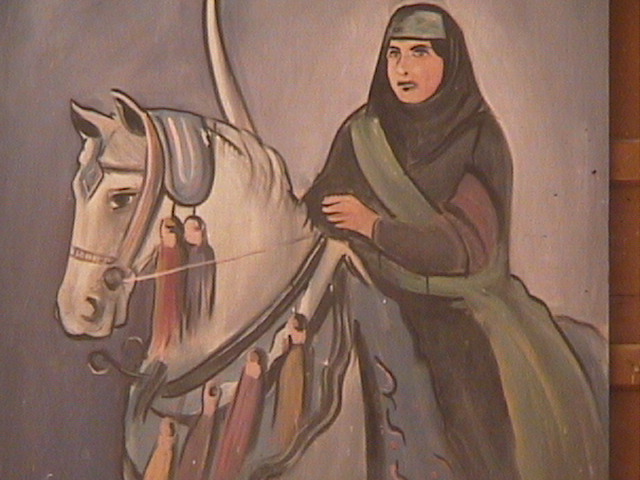
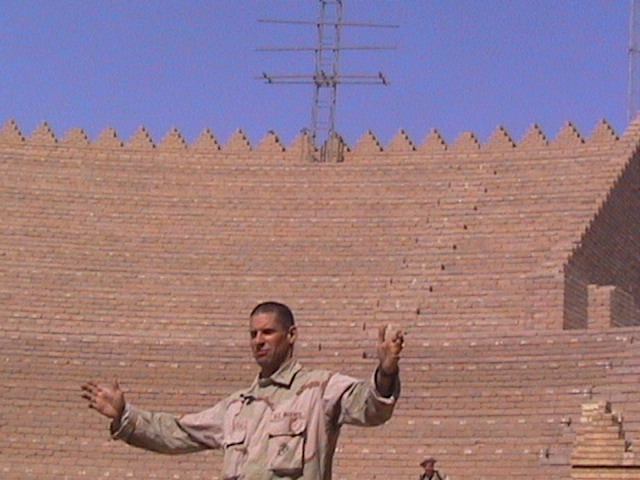
Left: Portrait of Khawawla Bint El Azawer, at the Khawawla Bint El Azawer School for Girls. “An Iraqi hero, a horsewoman—sort of a Joan of Arc type—according to legend stood up to Roman invaders.” Right: Greek Theater, Babylon ruins complex. April 24, 2003. Update: There was an article about this theater in the New York Times by Alan Riding on May 2, 2003.

Mungo

En route to the subway this morning, I passed a storefront under renovation, where a crew was installing one of those metal security grilles that scroll up like a window blind. About a dozen stuffed animal toys were attached to the radiator of their truck: a few Warner Brothers characters, but for the most part anonymous and sweet-looking. I’ve always been curious about these stuffed animals on trucks. A friend once told me that they were called “mungo,” but I’ve never spoken to anyone who could confirm that. They look playful, but what kind of play? Are they meant as mascots? Trophies? Victims? Pets?

An attractive Latina with dyed-blonde hair in a brown-and-white-print summery dress crossed the street, and one of the men wolf-whistled at her. His co-workers joined in, but she paid no attention. The man who started the whistle seemed to be at loose ends with the lack of response, and he turned to the stuffed animals and fiddled with them. They must have been attached to the radiator only loosely, because he swiveled several of them, straightening them so that they stood upright and face forward.

Photos from Iraq, taken today

Actually, only the first two of the photos below were taken today. But the immediacy is disconcerting. It’s a little unreal to think that someone I’ve known for years took these photographs in Iraq this morning, and I’m looking at them after lunch in the safe haven of Brooklyn. I know that this collapse of distance happens daily in newsrooms, but it takes some getting used to. All of these photos have been taken by T. R. Klysa, USMC, who also provided the information in the captions. (Note of caution: Some viewers may find the image at the bottom left to be difficult.)

105-0532:
105-0544:

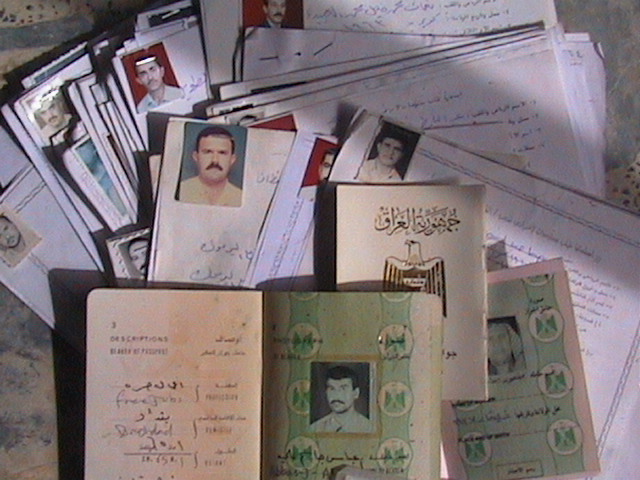
Former Iraqi Directorate of Special Security, Baghdad, April 19, 2003. Left: “Can see pretty clearly where the cruise missile drove right through the front entrance of this building.” Right: “Literally, tons and tons of paperwork. Dossiers. Files. Binders. The paperwork here is a mix of political prisoners and Baath party leaders—all mixed up. It is very unlikely any of this will ever get sorted out. This was
taken from a pile marked ‘burn.’ “

104-0415:
104-0420:
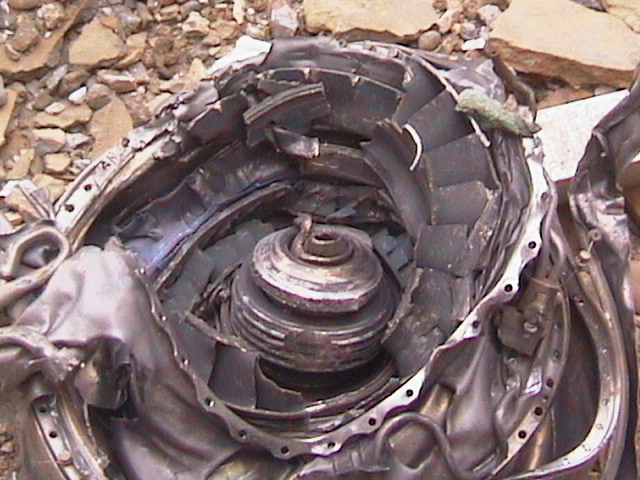
Fragments of U.S. cruise missiles.

102-0239: Regional Baath Party Headquarters, Al Azziyah, April 6, 2003. “Emblem of the former Iraqi regime.”

From a friend in Baghdad

A friend of mine, T. R. Klysa, USMC, recently sent me a few photos that he's been taking with his digital camera.

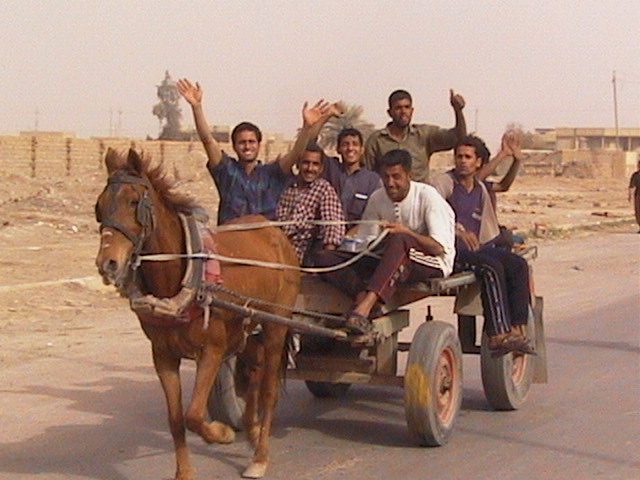
Baghdad, traffic circle. April 9, 2003
Saddam City, Baghdad. April 9, 2003

Above left: Baghdad, traffic circle. April 9, 2003. "These people are on the way to loot the Iraqi Tobacco warehouse just around the corner, that's why they are so happy."
Above right: Saddam City, Baghdad. April 9, 2003.
Below: At the Al Quds power plant, North Baghdad, in front of an untoppled statue of Saddam Hussein. April 15, 2003.

At the Al Quds power plant, North Baghdad, in front of an untoppled statue of Saddam Hussein. April 15, 2003