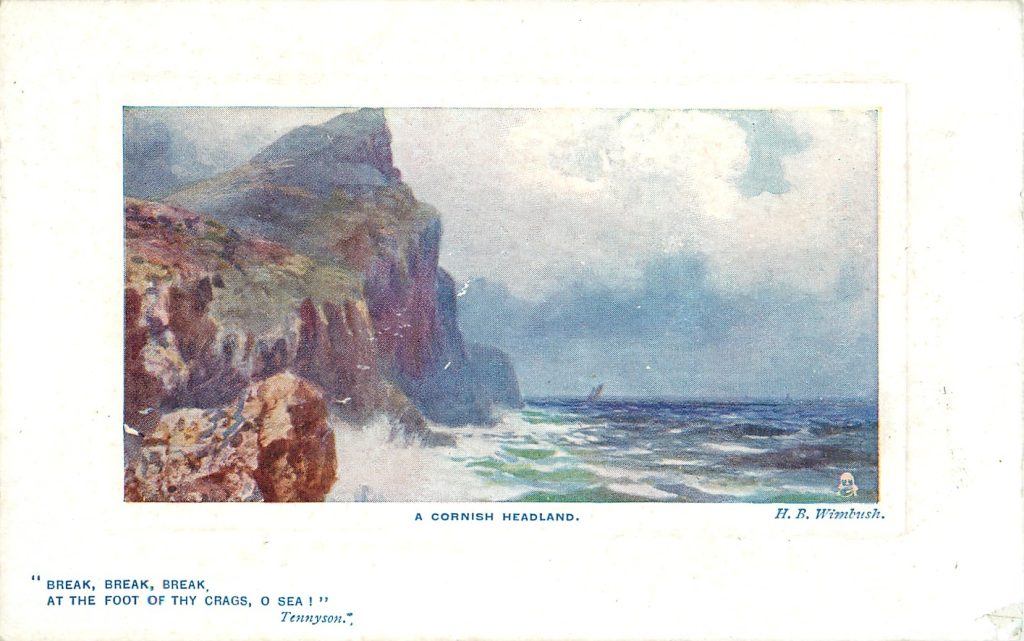
The nether sky

A 1908 postcard of a painting by H. B. Wimbush of "A Cornish Headland," with a quote from Tennyson's poem "Break, Break, Break"

Peter and I are trying to revive an old practice, reading a poem together when we get up in the morning. The first one in the anthology we’ve chosen is “Beeny Cliff,” by Thomas Hardy, about a seaside rock face in Cornwall that Hardy visited with his first wife, Emma Lavinia Gifford, soon after they met. The poem starts by invoking the colors they saw in the ocean:

O the opal and the sapphire of that wandering western sea,

The poem’s subtitle is “March 1870—March 1913,” which are the month Hardy met Gifford and the month he revisited the site, forty-three years later, after her death. The first stanza has no tense, however; it merely apostrophizes the colors and then Gifford in a voice that belongs to neither the present nor the past, a voice that floats between.

And the woman riding high above with bright hair flapping free—
The woman whom I loved so, and who loyally loved me.

In a memoir that Gifford wrote not long before she died, and which Hardy didn’t discover until after, she recalls that when she rode her pony, which was named Fanny, “Fanny and I were one creature, and very happy,” and that she rode him in a brown dress whose color matched his coat, so long that she had to carry the end of it in order not to trip. She met Hardy because he was the architect hired to remodel the church where her brother-in-law was rector, a structure so dilapidated that “birds and bats had a good time” in the roof timbers. She remembered that when the architect visited, “I rode my pretty mare Fanny and he walked by my side, and I showed him some of the neighbourhood—the cliffs, along the roads, and through the scattered hamlets, sometimes gazing down at the solemn small shores below, where the seals lived, coming out of great deep caverns very occasionally.” In her biography of Hardy, Claire Tomalin reports that Gifford and Hardy sketched each other, the Victorian equivalent of taking joint selfies.

Unlike the poem’s first stanza, the second commits itself to the past, and describes one of the couple’s outings.

The pale mews plained below us, and the waves seemed far away
In a nether sky, engrossed in saying their ceaseless babbling say,
As we laughed light-heartedly aloft on that clear-sunned March day.

Peter and I both stumbled over “mews,” which are gulls, it turns out, not stables. I thought at first that “plained” had something to do with the flatness of the horizon, but Hardy means “cried” (as in the related words “complained” and “plaintive”). Gulls are crying below, in other words, but “mews plained” comes a little closer to the sound gulls make when they’re doing so. Hardy doesn’t mind using a word that’s a step removed from common diction if he can gain a poetic effect by it. His calling the sea below “a nether sky” is a nifty metaphor, because sea and sky are alike in both stretching away into the distance, where they meet and mirror each other along the horizon, and the metaphor accomplishes a neat trick of perspective: looking down somehow feels like looking up. There’s a suggestion, too, that the sea, or the reversed sky, covers an underworld, a suggestion at the moment easy to dismiss, given that the sea is distant and the murmuring of its waves sounds trivial, easily interrupted by the laughter he and Gifford are sharing.

A little cloud then cloaked us, and there flew an irised rain,
And the Atlantic dyed its levels with a dull misfeatured stain,
And then the sun burst out again, and purples prinked the main.

Colors are always subtle in Hardy. “Irised” means “iridescent,” the shimmer of rainbow that sometimes appears in rain, especially when seen from above. The Atlantic Ocean, lying behind this prismatic rain, appears to color it, to darken it, in horizontal strata. Hardy’s language here is as precise and general as an experiment in optics. At one moment he sounds like he’s talking to you in a conversational tone—“A little cloud then cloaked us”—and in the next line, he compresses his thought to the density of a mathematical formula. “Irised” isn’t a common word, but its meaning is clear, and its compactness keeps the poem in its trotting rhythm. There’s a kind of grammatical insistence, too, I think, in the accumulation of past participles—“engrossed,” “sunned,” “irised,” “misfeatured.” There’s even one at the core of “light-heartedly.” Act is being consolidated into completed action. In the “dull misfeatured stain” the malevolence of the “nether sky” is again visible, still in the background for now but beginning to leach through. Happily the sun returns—the action of this stanza is taking place in the past, when rebirths were still possible—and transfigures the staining ocean, whose tints now become decoration.

—Still in all its chasmal beauty bulks old Beeny to the sky,
And shall she and I not go there once again now March is nigh,
And the sweet things said in that March say anew there by and by?

With the em-dash, Hardy jump-cuts to the present. Beeny has become “old Beeny,” fond in memory, and Hardy asks, as if challenging a limit he knows he can’t pass, whether he and Gifford will ever visit it again together. The small love talk he exchanged with her on the cliff summit years ago now seems as distant as the babbling of the waves did when he stood next to her there.

What if still in chasmal beauty looms that wild weird western shore,
The woman now is—elsewhere—whom the ambling pony bore,
And nor knows nor cares for Beeny, and will laugh there nevermore.

The phrase “chasmal beauty” and the name “Beeny” are repeated, as if to stress that the cliff still exists, as the “woman” (a word repeated with a similar stress in the first stanza) does not. In any sublime geographic feature, there’s a hint of eternity, which is part of the attraction for human visitors, a hint that plays on the visitors a very slow joke, in that while rocks and sea may be lasting, any admirers, though they may feel like they have been placed above nature by virtue of their powers of perception, are not.

In his two-volume autobiography, written and then posthumously published under the not very convincing pretense that his second wife was the author of it, Hardy reprinted some of the notes he made in his journal when he first visited Beeny Cliff in March 1870 with Gifford.

March 10. Went with E. L. G. to Beeny Cliff. She on horseback. . . . On the cliff. . . . ‘The tender grace of a day,’ etc. The run down to the edge. The coming home.

The ellipses are Hardy’s. What a little shocked me, when an annotation to “Beeny Cliff” sent me to Hardy’s autobiography for a look at this journal entry, is the quoted fragment of poetry: “The tender grace of a day.” It comes from the conclusion of Tennyson’s poem “Break, break, break,” which is also about looking out over the sea while in mourning. The last two lines of that poem read as follows:

But the tender grace of a day that is dead
Will never come back to me.

Tennyson wrote the poem while grieving for his young friend Arthur Hallam, who had died while abroad, and whose death became the subject of his later masterpiece, In Memoriam, which imaginatively follows the homeward progress by sea of Hallam’s sealed coffin. What’s puzzling is that while it makes a great deal of sense for “Break, break, break” to have been in Hardy’s mind in 1913, when he was composing “Beeny Cliff” as an elegy for Gifford, the poem seems to have been in his mind already in 1870, back when he was courting her. The stenographic style of the journal entry implies that when he was writing about the day, he was confident he would always remember its texture. “The run down to the edge. The coming home.” These were lyrical moments that he knew a brief prompt would always return him to, the way a short quoted phrase can call to mind the poem it has dropped out of. Did he and Gifford kiss when they came to the edge of the cliff? Did the sight of the waves crashing below bring the same Tennyson poem into both of their minds (“Break, break, break / On thy cold gray stones, O Sea!”), and did one of them quote it to the other? Those details are not recoverable by us now, but the surprise is that the nether sky that Hardy saw in the sea that day, with Gifford by his side, was not a later invention, projected onto the past by a grieving husband. He saw it then, and so, probably, did she. “The tender grace of a day that is dead”: the young lovers wouldn’t have quoted that Tennyson line to each other unless they were already aware that they were living through a moment that was not going to return, aware that the beauty of their happiness together was not going to last as long as Beeny Cliff.

Click on the poem to unpack it: a proof of concept

Giovanni Battista Palumba, Diana bathing with her attendants transforming Actaeon into a stag, c. 1500, © Trustees of the British Museum, 1845,0825.627

[On my old blog host, I had figured out a way to make my interlinear gloss appear and disappear when you clicked on the lines of the poem below. It was pretty clever! Alas, I’m now on WordPress, and I haven’t yet been able to figure out how to run a javascript applet. For the moment, then, here’s Wyatt’s poem and my gloss without any clickability. —CC, 10 July 2013]

[Fixed it! Using the WordPress plug-in Collapse-pro-matic, I managed to restore the clickability. Click on the lines of poetry to see. The gloss for each verse expands and collapses separately. —CC, 22 September 2016]

They Flee from Me

by Thomas Wyatt

Remembering lost lovers is a bittersweet pleasure.
They flee from me that sometime did me seek
Thomas Wyatt seems to be looking back at his lovers from middle age, though he can’t have been too old when he wrote it; he didn’t live to be forty. When this poem was first published, in an anthology that appeared in 1557, a decade and a half after his death, the editor gave the following explanation of what happens in it: “The lover showeth how he is forsaken of such as he sometime enjoyed.” By tradition, men hunt, and women are hunted, but love didn’t always quite work that way even in the sixteenth century, and no sooner does Wyatt introduce the metaphor of hunting than he messes with it. In the very first line, the poet is hunting creatures that once hunted him.
With naked foot stalking in my chamber.
Are they deer? “To stalk,” wrote one of Wyatt’s 19th-century commentators, “means to steal softly with noiseless step.” But a hunter also stalks. Naked feet, stalking—I imagine that in the darkness, the poet’s bedroom chamber has become overgrown with verdure, and maybe even forested, like Max’s in Where the Wild Things Are. Or perhaps the creatures are ghosts. Infidelity and death are two ways of losing a lover to time.
I have seen them gentle tame and meek
As the poet remembers how the creatures came to him, his memories of them also seem to approach, advancing from the simple past to the present perfect tense. They’re so docile that the reader may wonder whether hunting really is the metaphor in play. The creatures seem to have offered themselves to the poet freely, like the animals who submitted themselves to Adam for naming in the Garden of Eden.
That now are wild and do not remember
Tame in one line, wild in the next. However accustomed to his touch the creatures once were, they don’t know his hand any more; they no longer come when called. I’m reminded of Lewis Carroll’s Fawn, who lets Alice clasp his neck as the two of them walk together through the wood where things have no name, only to shy away from her once he discovers, upon emerging from the wood, that he’s prey and she’s a predator.
That sometime they put themselves in danger
The note of danger returns the reader to his first guess: The poet does seem to be describing an episode of hunting, after all. Hunters lay lures; they hope their victims don’t perceive the threat until too late. But the word danger is rhymed with remember and chamber, raising the complicating possibility that, whatever direction the vector of hazard may have pointed in the past, it’s the poet who’s at risk now, in peril for having ventured so far into memory.
To take bread at my hand; and now they range
Maybe it’s hard to distinguish hunting from domestication because the fate of a cow or pig isn’t all that different from that of a hunted deer. Domestication is an act of hunting that takes place in slow motion—over the course of the animal’s lifetime—in a confined space.
Busily seeking with a continual change.
Suddenly the creatures have escaped the confined space; abruptly the metaphor of hunter and deer has dropped away. By betraying an interest in change for its own sake, the fugitives reveal that they have the moral complexity and disreputableness of human beings. I suppose you could describe the “seeking” of the creatures as foraging, if you insisted on finding a way to continue the venatorial metaphor, but I suspect that the important discovery here is that metaphor isn’t able to hold them.


The poet’s tone of voice shifts. Perhaps because he made himself vulnerable in the first stanza, he starts the second one with a touch of bluster.
Thanked be fortune, it hath been otherwise
It would hardly be courtly, let alone gentlemanly, for a poet to boast of his conquests. But after a confession of general romantic failure, in what sounds like middle age, a little boasting about his youth seems licensed. “I graunte I do not professe chastite,” Wyatt once admitted.
Twenty times better; but once in special
Let me tell you about this one time when I totally scored.
In thin array after a pleasant guise
When her loose gown from her shoulders did fall,
The poet is undressing the woman, or rather, recalling how her clothes fell from her.
And she me caught in her arms long and small;
Notice that it’s she who caught him. Rather gallantly, he resists describing her naked body, even while describing how it was revealed, until he comes to her arms. It isn’t indiscreet to describe a woman’s arms, and somehow the inherent modesty of arms makes it all the more poignant that he lingers over them.
Therewithal sweetly did me kiss,
And softly said, Dear heart, how like you this?
This is an immortal line. Wyatt’s 19th-century commentator is at pains to insist on “the propriety of this image,” maintaining that it represents a convention of chivalry: “whenever a lady accepted the service of a knight, . . . she gave him a kiss, and this was considered to be an inviolable bond of obligation.” No doubt the kiss that Wyatt received did play on a chivalric convention, but the bond in question turned out not to be inviolable, and it’s the erotic intensity of the image that brings tears to my eyes. I know that the phrasing of the woman’s question doesn’t sound colloquial today, but I feel confident that the rhythm of it was natural in Wyatt’s day. In fact I feel confident that a woman once existed who said these exact words to Wyatt while he was in love with her—I feel as if I’ve heard her say them to him—and I’m sorry, but I imagine that she was doing more than kissing him while she spoke. “Dere hert,” is how the words are spelled in the surviving manuscript and in the first publication of the poem. The poet has himself become the deer and the hart, not clearly distinguished from dear and heart in 16th-century orthography. He was and still is willing to be taken. It’s for this moment, and for the concentration of pleasure into this moment, that she once came into his room, that he is revisiting the memory now, and that we are reading the poem.


In the third stanza, the poet’s tone of voice shifts again, turning conversational, even plain. He acknowledges that he has asked us to believe in the reality of a moment that even he has trouble still believing in.
It was no dream: I lay broad waking.
Today we would say wide awake rather than broad waking, but the meaning is the same. He experienced the woman’s love with the channels of his senses completely open.
But all is turned through my gentleness
He has been too kind to her. By gentleness he means not just the mildness of his manners but also the gentility of them. His highmindedness. His willingness to play the role of Lancelot to Guinevere—to let her go back to King Arthur if she wants to (Wyatt was long thought to have been a lover of Anne Boleyn’s before she became the wife of Henry VIII, though the Oxford Dictionary of National Biography doubts the liaison), or to let her take up with another knight altogether. Or maybe there’s a note of self-reproach in the poet’s description of himself as gentle. Maybe he means that he didn’t hold on to her hard enough.
Into a strange fashion of forsaking;
Already in the 16th century, seeing other people was a bold thing that lovers tried, in order to prove they weren’t hamstrung by conventional morals. Fitzgerald, on the Jazz Age: “I remember a perfectly mated, contented young mother asking my wife’s advice about ‘having an affair right away,’ though she had no one especially in mind.”
And I have leave to go of her goodness,
Leave means “permission,” and of her goodness, “thanks to her graciousness.” But puns multiply in the poem’s closing lines, and her goodness also means “her goodness,” which the poet would rather not leave. Note that this line, like the two preceding it, is in the present tense. It turns out that the affair must not have happened in the poet’s long-ago youth, as the first two stanzas suggested; the loss of it is happening now. The poet and the woman have just recently had the conversation where they decided on their new terms, and they’re still repeating the terms to themselves, in an effort to convince themselves of the rightness of them. From the first stanza to the third, there has also been a shift from plural to singular, from they to her. It’s a poem crafted by means of what people in Hollywood call “cheating”: the artful dovetailing of unmatched parts to create an impression of unity.
And she also to use newfangleness.
It’s strange that newfangled still sounds like a novelty word, when it happens to be quite an old one. One of Wyatt’s 20th-century commentators observes that “the word is often used by Chaucer.” In Wyatt’s day it could refer to both an item that is “objectionably modern,” as the OED puts it, and to an immoderate inclination to try such items. In the ballad “The Boy and the Mantle,” for example, Queen Guinevere is attracted to a cloak, despite being told that it has the power to expose unfaithful wives, because “the Ladye shee was new fangle.” Wyatt and his lover have given each other permission to try a new and trendy way of being in a romance, which may amount to a propensity for new and trendy lovers.
But since that I so kindly am served,
Kindly here means both “with kindness” and “in kind”: since Wyatt is being treated with such kindness, . . . since Wyatt is being given the kind of treatment he gave his lover, . . . Both meanings are ironic. The implication is that Wyatt has no right to complain of his lover’s so-called goodness and so-called gentleness, because he started it. She’s only repaying him in his own coin. According to one of Wyatt’s 20th-century commentators, the word served in this line may suggest a reversal: the courtly lover is being served by his mistress instead of serving her. But what kind of cavalier serves his mistress by loving others?
I would fain to know what she hath deserved.
If Wyatt is getting what he deserved, namely, a taste of his own medicine, what does his lover deserve? On a first reading the question sounds almost rhetorical, as if the poet were making a half-hearted attempt to be cynical at the expense of his old lover, so as to prove to himself that he doesn’t miss her. But it might be a real question. Perhaps the answer is “Wyatt,” since his lover doesn’t seem to have behaved any better (or worse) than he did. Or maybe the most that she deserves is this poem—a memory of the happiness they briefly made with each other, set somewhat ironically in verse—their real love recalled and lost all over again in a courtly form.