Strike three

Three moments in Wednesday night’s debate struck me as crucial.

#1. Obama described McCain’s pettiness:

OBAMA: . . . And, now, I think the American people are less interested in our hurt feelings during the course of the campaign than addressing the issues that matter to them so deeply.

But McCain seemed unable to leave his narcissistic injuries behind.

#2. Obama stood up for women’s right to equal pay for equal work:

OBAMA: . . . Senator McCain and I disagreed recently when the Supreme Court made it more difficult for a woman named Lilly Ledbetter to press her claim for pay discrimination.

For years, she had been getting paid less than a man had been paid for doing the exact same job. And when she brought a suit, saying equal pay for equal work, the judges said, well, you know, it’s taken you too long to bring this lawsuit, even though she didn’t know about it until fairly recently.

We tried to overturn it in the Senate. I supported that effort to provide better guidance to the courts; John McCain opposed it.

I think that it’s important for judges to understand that if a woman is out there trying to raise a family, trying to support her family, and is being treated unfairly, then the court has to stand up, if nobody else will. And that’s the kind of judge that I want.

SCHIEFFER: Time’s up.

MCCAIN: Obviously, that law waved the statute of limitations, which you could have gone back 20 or 30 years. It was a trial lawyer’s dream.

This seemed a massive failure of political acumen on McCain’s part. I don’t think many women voters will be pleased to learn that for McCain, the principle of equal pay for equal work runs a very distant second to the integrity of the statute of limitations.

#3. Obama stood up for unions:

McCAIN: . . . But let me give you another example of a free trade agreement that Senator Obama opposes. Right now, because of previous agreements, some made by President Clinton, the goods and products that we send to Colombia, which is our largest agricultural importer of our products, is — there’s a billion dollars that we — our businesses have paid so far in order to get our goods in there.

Because of previous agreements, their goods and products come into our country for free. So Senator Obama, who has never traveled south of our border, opposes the Colombia Free Trade Agreement. The same country that’s helping us try to stop the flow of drugs into our country that’s killing young Americans.

And also the country that just freed three Americans that will help us create jobs in America because they will be a market for our goods and products without having to pay — without us having to pay the billions of dollars — the billion dollars and more that we’ve already paid.

Free trade with Colombia is something that’s a no-brainer. But maybe you ought to travel down there and visit them and maybe you could understand it a lot better.

OBAMA: Let me respond. Actually, I understand it pretty well. The history in Colombia right now is that labor leaders have been targeted for assassination on a fairly consistent basis and there have not been prosecutions.

And what I have said, because the free trade — the trade agreement itself does have labor and environmental protections, but we have to stand for human rights and we have to make sure that violence isn’t being perpetrated against workers who are just trying to organize for their rights, which is why, for example, I supported the Peruvian Free Trade Agreement which was a well-structured agreement.

But I think that the important point is we’ve got to have a president who understands the benefits of free trade but also is going to enforce unfair trade agreements and is going to stand up to other countries.

McCain’s complaint here is so incoherent as to be nearly incomprehensible, but he seems to be saying that America had nothing to lose from a free trade agreement with Colombia, as far as tariffs are concerned, and owed Colombia such an agreement because it’s an ally of ours. Obama, however, points out that America would lose something: a principled stand on human rights. According to Human Rights Watch, over four hundred labor leaders have been assassinated in Colombia during the six years of Alvaro Uribe’s administration, and almost none of the murderers have been brought to justice. And by pointing this out, and by standing up for labor leaders in Colombia, Obama showed his solidarity with union members in America. I suspect this may have been the moment he won their votes. Protectionism is ultimately self-defeating, but it is not specious to object to a free-trade agreement for shifting jobs from countries where workers have civil rights to ones where they don’t. Obama demonstrated that he knows when the unions have a point and that he’s willing to recognize it publicly. The white working class is said to be the last remaining demographic that Obama needs but is not yet sure of (cf. this great article by George Packer), but if union members were listening, at this moment Obama showed them where he stands.

Kundera and forgetting

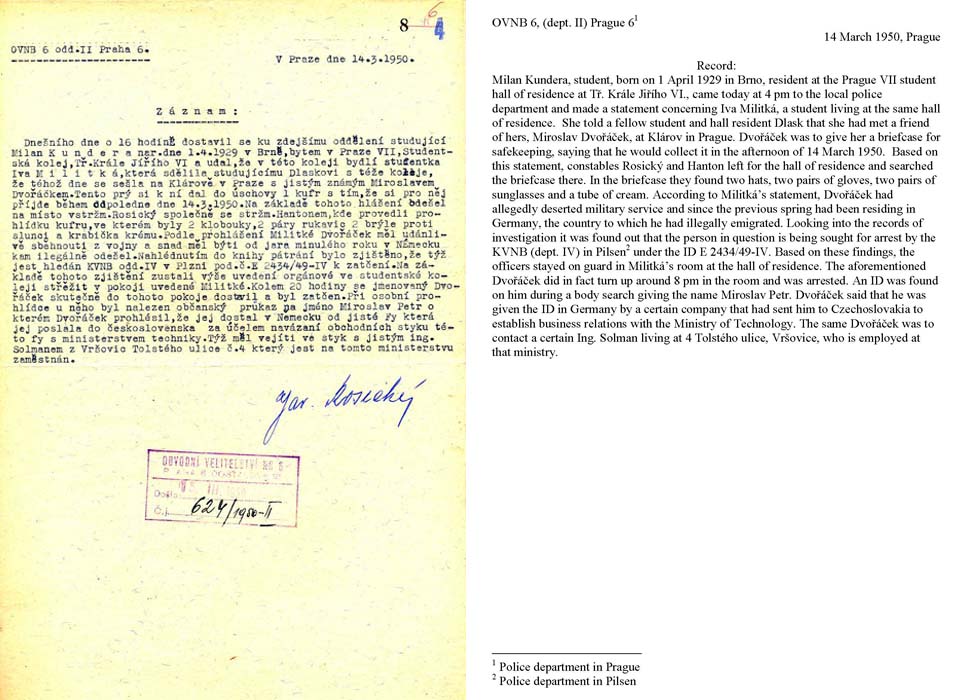
“The author is transformed into a figure in a novel,” writes Martin M. Šimečka, commenting on the revelation that in 1950 Milan Kundera—then a film student, later a world-famous novelist—visited his local police station and informed on Miroslav Dvořáček, a young Czech pilot working undercover in Prague for a Western intelligence agency. After Kundera tipped off the police, Dvořáček was arrested and eventually served fourteen years laboring as a prisoner in a uranium mine, according to a report by Adam Hradilek of the Institute for the Study of Totalitarian Regimes published in the Czech journal Respekt. Rachel Donadio has a concise account in today’s New York Times. Kundera has denied the charge outright, calling it “a total lie” and suggesting that it’s an attempt at an “author assassination” timed to coincide with the Frankfurt Book Fair. The headline of the lead story in today’s Lidové noviny: “Is Kundera Lying about his Past?” The newspaper writes that “Milan Kundera affirms that he did not betray the spy Miroslav Dvořáček to the police, but it’s difficult to explain the existence of the police record any other way.” An online follow-up article in Respekt by Petr Třešňák considers the possibilities for reconciling the typescript that incriminates Kundera with his protestations of innocence. Might a friend of Kundera’s have stolen his citizen’s identity card and impersonated Kundera while denouncing the spy? Given that Czechoslovakia at the time was a morbidly hysterical police state, running show trials and torturing prisoners, it’s unlikely anyone would have taken such a pointless risk.

The Institute for the Study of Totalitarian Regimes has posted an English-language biography of Dvořáček, along with links to documents relating to him in security archives, including the police memo that names Kundera as the informer.

To some American readers it may come as a surprise that Kundera was once a true believer in Communism. In the West, he’s been able to suppress that epoch in his biography, as I explained in “Kundera Is Elsewhere,” one of two articles that I wrote about Kundera for Lingua Franca in October 1999:

In the mid-1980s, the dissident Milan Jungmann accused Kundera of having misled Westerners about the extent of his Communist past—of having “turned his biography into kitsch for uninitiated foreign readers.” “Half of my life I spent as a relatively unknown Czech intellectual,” Kundera had told Philip Roth in 1984. Nonsense, Jungmann countered. In fact, Kundera’s name was “a household word” in the 1950s and 1960s. “He was the best-known spokesman of a wave undermining the borders between socialist and world culture,” Jungmann wrote. Kundera’s poetry, articles, speeches, and plays were eagerly anticipated and widely acclaimed. He won the Klement Gottwald State Prize in 1963 and taught for years in the tony Prague film school that launched the Czech New Wave. In The Joke, Kundera would mock the propaganda surrounding the Stalinist culture hero Julius Fučík, a communist journalist executed by the Nazis. But as Derek Sayer notes in his indispensable history The Coasts of Bohemia (Princeton, 1998), in 1955 Kundera was still so much a part of that culture that one of his own poems portrayed Fučík as a sort of Marxist Christ.

In Kundera’s defense, the literary critic Jan Trefulka pointed out last summer in Lidové noviny that “The political loosening of the 1960s did not happen of its own accord.” A longtime friend of Václav Havel’s, Trefulka, too, was a communist before the Russian invasion turned him into an impeccably credentialed dissident. The Prague Spring owed much to intellectuals of Kundera’s and Trefulka’s ilk, who laid the groundwork for liberalization inside the Party.

These fierce disputes about Kundera’s artistic and political past have been little reported in the West, and here, too, one senses the power of translation’s almost invisible hand. The Russian invasion forcibly changed Kundera from a Czech writer into an international writer, whose books were read mainly in foreign languages. Thanks to circumstance and copyright law, Kundera was given an opportunity that most mature artists can only dream about: He was able to decide which of his works he wanted the world to judge him by. Defensibly enough, he has quarantined his early socialism-tinged work. Hard as it is for Czechs to read Kundera’s late, capitalist novels, it is much harder for Westerners to read his early, communist poetry and essays. The Czechs, as a result, know a Kundera even more muddied, human, and self-contradictory than the rest of the world knows.

Paradigm shift

In 1928, when Lytton Strachey wrote Elizabeth and Essex, the English-speaking world agreed that torture was an atrocity. When, therefore, Strachey narrated the complicity of Robert Devereux, earl of Essex, in the judicial torture of Queen Elizabeth’s personal physician, Ruy Lopez, a Portuguese Jew, Strachey had some explaining to do. Essex was the hero of Strachey’s book, and so Strachey had to persuade his readers at least to understand Essex’s complicity, even if he could not hope to persuade them to forgive it. In Strachey’s telling, Essex is a man of feeling. “One can understand, perhaps, the intellectuals and the politicians,” Strachey wrote, “but Essex! Generous, strong, in the flush of manhood, is it possible that he failed to realise that what he was doing was, to say the least of it, unfair?”

Today, of course, a mind accustomed to the idea of torture no longer seems archaic. It’s instead the need to explain such a mind that has become historical. As a curiosity, then, here’s Strachey’s attempt to explain the Renaissance mind to readers whose sensibility had been shaped by the Enlightenment:

The true principles of criminal jurisprudence have only come to be recognised, with gradually increasing completeness, during the last two centuries. . . . No human creature can ever hope to be truly just; but there are degrees in mortal fallibility, and for countless ages the justice of mankind was the sport of fear, folly, and superstition. In the England of Elizabeth there was a particular influence at work which, in certain crucial cases, turned the administration of justice into a mockery. It was virtually impossible for anyone accused of High Treason—the gravest offence known to the law—to be acquitted. The reason for this was plain; but it was a reason not of justice but expediency. Upon the life of Elizabeth hung the whole structure of the State. . . . Her own personal fearlessness added to the peril. She refused, she said, to mistrust the love of her subjects; she was singularly free of access; and she appeared in public with a totally inadequate guard. In such a situation, only one course of action seemed to be possible: every other consideration must be subordinated to the supreme necessity of preserving the Queen’s life. . . . It was futile to talk of justice; for justice involves, by its very nature, uncertainty; and the Government could take no risks. The old saw was reversed; it was better that ten innocent men should suffer than that one guilty man should escape. To arouse suspicion became in itself a crime.

Having explained why torture seemed plausible to Elizabethans, Strachey then explained why it was nonetheless dysfunctional and corrupting.

It was in the collection of evidence that the mingled atrocity and absurdity of the system became most obvious. Not only was the fabric of a case often built up on the allegations of the hired creatures of the Government, but the existence of the rack gave a preposterous twist to the words of every witness. Torture was constantly used; but whether, in any particular instance, it was used or not, the consequences were identical. The threat of it, the hint of it, the mere knowledge in the mind of a witness that it might at any moment be applied to him—those were differences merely of degree; always, the fatal compulsion was there, inextricably confusing truth and falsehood. What shred of credibility could adhere to testimony obtained in such circumstances—from a man, in prison, alone, suddenly confronted by a group of hostile and skilful examiners, plied with leading questions, and terrified by the imminent possibility of extreme physical pain? Who could disentangle among his statements the parts of veracity and fear, the desire to placate his questioners, the instinct to incriminate others, the impulse to avoid, by some random affirmation, the dislocation of an arm or a leg? Only one thing was plain about such evidence: it would always be possible to give to it whatever interpretation the prosecutors might desire. The Government could prove anything.

Strachey’s final insight concerned torture’s effect on the political judgment of its users.

It was, of course, an essential feature of the system that those who worked it should not have realised its implications. Torture was regarded as an unpleasant necessity; evidence obtained under it might possibly, in certain cases, be considered of dubious value; but no one dreamt that the judicial procedure of which it formed a part was necessarily without any value at all. . . . Judges, as well as prisoners, were victims of the rack.

It would take a lot of explaining, in other words, before our great-grandparents would be able to recognize the America we live in.

Mule deaths of late

The Onion this week reprints its issue of 6 October 1783, including such articles as “Thousands More Teeth Lost,” “Rural Quaker Scandalized by Intricate Furniture Pattern,” “Citizens Now Free to Practise Any Form of Protestantism They Want,” and “Mule-Deaths of Late.” If, like me, you are the sort who laughs at such things as the Donald Barthelme story “An Hesitation on the Bank of the Delaware,” in which a soldier warns George Washington, “But, General, unless we launch the boats pretty shortly, the attack will lose the element of furprife,” you will probably appreciate the humor.

The overhead projector strikes back

The Adler Planetarium's Zeiss Mark VI projector, first installed in 1970, as featured in the planetarium's 2006 Report to Donors

Last night, during the second presidential debate, John McCain accused Barack Obama of voting for a $3 million earmark for an “overhead projector” for a planetarium in Chicago. “My friends,” said McCain, “do we need to spend that kind of money?”

Today the planetarium has defended itself. In a statement on its website, the Adler Planetarium explains that the equipment they wanted to replace is a Zeiss Mark VI projector, not an overhead projector, and the planetarium didn’t receive a new one, because the funding effort failed. The existing projector is forty years old, “is only the Adler’s second in seventy-eight years of operation,” and the manfacturer no longer makes parts for it. Moreover, “the Adler has never received an earmark as a result of Senator Obama’s efforts,” though they have received some federal support thanks to others, and they aren’t bashful about it, because they think science education is a worthwhile cause.