
![Marion S. Trikosko, Negro voting in Cardoza [i.e., Cardozo] High School in [Washington,] D.C., November 1964](/images/6a00d83452422969e2010535d7168d970c-500wi.jpg "Marion S. Trikosko, Negro voting in Cardoza [i.e., Cardozo] High School in [Washington,] D.C., November 1964")
Please remember to vote today!
Photo: Marion S. Trikosko, “Negro voting in Cardoza [i.e., Cardozo] High School in [Washington,] D.C.,” November 1964, U.S. News and World Report Photograph Collection, Library of Congress.
Please remember to vote today!
Photo: Marion S. Trikosko, “Negro voting in Cardoza [i.e., Cardozo] High School in [Washington,] D.C.,” November 1964, U.S. News and World Report Photograph Collection, Library of Congress.
Woolf found it difficult to keep her distance from servants, to give orders in a way that established her authority over them (she hated the "measured sweetness" with which servants were supposed to be addressed). [Nellie] Boxall, who worked for Woolf for eighteen years, was an excellent but temperamental cook, and they fought regularly, their rows leaving Woolf surprisingly unsettled and vulnerable. "She doesn't care for me, or for anything," Woolf once complained in her diary, as if talking about a school friend or a lover. She schemed for years to let Boxall go, rehearsing the scene in her mind but losing courage at the last minute, or being won over by Boxall's attempts at peacemaking. Boxall gave and retracted notice dozens of times. She was high-strung and insecure: the parallels with Woolf's disposition are hard to miss.
My parents' friends were amateur bee-keepers, gardeners, cabinetmakers, guitarists, and our more immediate neighbours likewise seemed to be making things up as they went along. One had a field full of junk cars, many children and a drinking problem; he was always driving off the road. Another ran the local airfield and kept a mountain lion for a pet; when he and his wife divorced later on, she married an arms dealer and moved to Istanbul.
There was nothing else I knew—we didn't have a TV—but even so I could tell our life was new and rare and unsponsored by tradition. . . . Everything was improvisation, with the thrill and risk the word implies. . . . And life up Salt Creek acquired a real enough frontier air on at least those occasions when a pack rat ventured out from the wall in the living room and my father picked up his .22 rifle to shoot it, a practice that could be unsettling to guests but which mostly impressed me as a display of good aim.
There is simply no way to write about [history-making events] in real time without revealing a huge amount about yourself. And the intimate bond this creates with readers is unlike the bond that the The Times, say, develops with its readers through the same events. Alone in front of a computer, at any moment, are two people: a blogger and a reader. The proximity is palpable, the moment human—whatever authority a blogger has is derived not from the institution he works for but from the humanness he conveys. This is writing with emotion not just under but always breaking through the surface. It renders a writer and a reader not just connected but linked in a visceral, personal way. The only term that really describes this is friendship. And it is a relatively new thing to write for thousands and thousands of friends.
"Lonely Together," my review of Loneliness: Human Nature and the Need for Social Connection by John T. Cacioppo and William Patrick (W. W. Norton) and Loneliness as a Way of Life by Thomas Dumm (Harvard University Press), appears in the 31 October 2008 books section of The National (Abu Dhabi, U.A.E.).
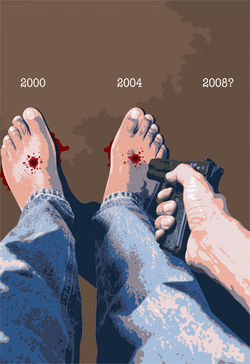
Having missed by about an hour a chance to buy Shepard Fairey's newest Obama poster, I fell down the Google rabbit hole and stumbled into an entire unsuspected world of Obama poster art. The definitive blog seems to be the Obama Art Report, with daily news of auctions, donations, and free downloads. If, however, you'd prefer a Continental synopsis of the scene, a French-writing blogger named Jeremie has culled what he considers the fifty best Obama posters at Visual Evasion, complete with click-through links to the designers, who, in the case of, say, The Match Factory, are still selling the posters and sending the proceeds to the Obama campaign (in their case, to the Nebraska Obama campaign). It was by clicking on one of Visual Evasion's links that I discovered that from now until the election, you can download a poster a day at 30 Reasons, whose number one reason was the very funny poster at left by Chaz Maviyane-Davies.

If you'd prefer to make your own poster, using specially designed pro-Obama letters, try visiting Spelling Change, where you can also make T-shirts and bumper stickers.
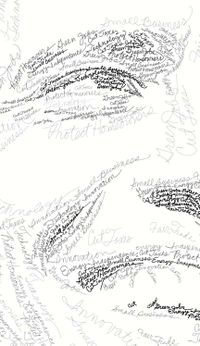
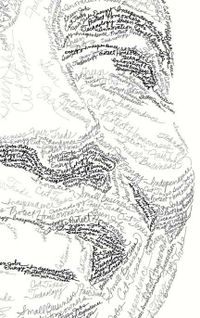
Alternately, you can make a poster by downloading and printing out someone else's. If you download all the pieces of Larry Roibal's poster, which at the molecular level consists of his ballpoint-pen cursive transcription of phrases from Obama's policy proposals, assemble them, and photograph yourself next to them, he'll post the picture on his blog.
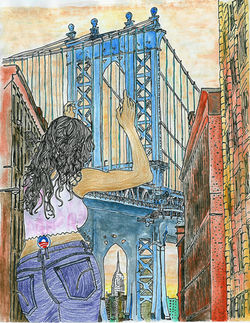
Some charming posters were commissioned by the Obama campaign for their voter-registration and voter-protection project, Vote for Change. Artist Cody Hudson has posted a few, and you can find a couple of others scattered in the open-to-all-comers site Design for Obama, which has the good, the bad, and the unofficial, all of which can be voted on. I was kind of taken with the Newyorkiness (Loisadaness?) of art teacher Robt Seda-Schreiber's Baby Got Hope, below. And last but not least, there are still a few all-typography posters for sale on the Obama-Biden campaign's own website, in the purchase of which you kill two birds with one click.
Asked whether his painting and his criticism had things in common, he answered, "The brutal fact is that they're exactly the same thing." He did not accept the idea there was a difference between artists and critics. ("I get a laugh from artists who ridicule critics as parasites or artists manqués—such a horrible joke.") In fact, his prose equals the subjects he wrote about and often surpasses them. While this may be true of some film critics writing today, saying their prose equals the subjects they write about is not a compliment.
Tonight, he puts on "Ain't Too Proud To Beg" and starts singing along, and before long is thinking about the ridiculousness of the idea that begging Liz would do any good at all. As if life was anything like a Motown song. And at the part where Ruffin sings about a crying man being "half a man, with no sense of pride," Bill can't sing along anymore. Ruffin is hitting way too many high notes to be nearly as upset as he claims, and Bill begins to get furious at the record. It feels like some kind of cruel facsimile of pain. The way the other four Temptations buoy Ruffin at every turn, he's not alone, not by a long shot; his buddies have his back, and he's still dancing. Bill thinks that maybe The Big Chill had it right, and that "Ain't Too Proud To Beg" is simply a way to make doing the dishes more enjoyable. He tries not to think about how he is now older than the Kevin Kline and Glenn Close characters.
Beneath the Now We Know Better is a whiff of Doesn’t That Look Good. The drinking, the cigarettes, the opportunity to slap your children! The actresses are beautiful, the Brilliantine in the men’s hair catches the light, and everyone and everything is photographed as if in stills for a fashion spread. The show’s ‘1950s’ is a strange period that seems to stretch from the end of World War Two to 1960, the year the action begins. The less you think about the plot the more you are free to luxuriate in the low sofas and Eames chairs, the gunmetal desks and geometric ceiling tiles and shiny IBM typewriters. Not to mention the lush costuming: party dresses, skinny brown ties, angora cardigans, vivid blue suits and ruffled peignoirs, captured in the pure dark hues and wide lighting ranges that Technicolor never committed to film.
Sooner or later, though, unless you watch the whole series with the sound off, you will have to face up to the story.
A front-desk attendant agreed to put a call through to Fahey's room. From subsequent reading, I gather that at this time Fahey was making the weekly rent by scavenging and reselling rare classical-music LPs, for which he must have developed an extraordinary eye, the profit margins being almost imperceptible. I pictured him prone on the bed, gray-bearded and possibly naked, his overabundant corpus spread out like something that only got up to eat: that’s how interviewers discovered him, in the few profiles I’d read. He was hampered at this point by decades of addiction and the bad heart that would kill him two years later, but even before all that he’d been famously cranky, so it was strange to find him ramblingly familiar from the moment he picked up the phone. A friend of his to whom I later described this conversation said, "Of course he was nice—you didn’t want to talk about him."
Fahey asked for fifteen minutes to get his "beatbox" hooked up and locate the tape with the song on it. I called him back at the appointed time.
"Man," he said, "I can't tell what she’s saying there. It's definitely not 'boutonniere.'"
"No guesses?"
"Nah."
We switched to another mystery word, a couple of verses on: Wiley sings, "My mother told me, just before she died/Lord, [precious?] daughter, don’t you be so wild."
"Shit, I don’t have any fucking idea," Fahey said. "It doesn't really matter, anyway. They always just said any old shit.