
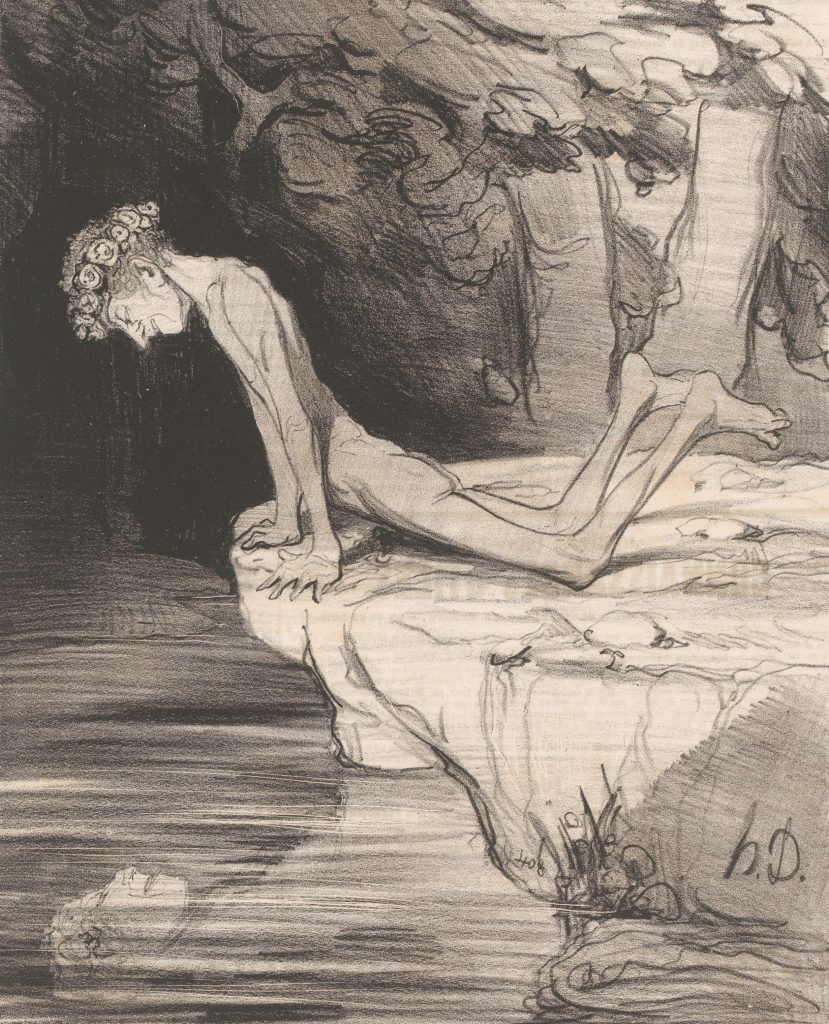
About a month ago, I went viral. It was the first day of a three-day heat wave in New York, and I had just completed a Cross Fit hero workout—a twenty-one-minute partner AMRAP of rowing, lateral burpees, and power cleans. I had my pump on, as the gym bros say, and was nice and sweaty. Last year I posted half a dozen shirtless selfies on Instagram, but I hadn’t yet posted any this summer, and it seemed time. Not least because I was going to be turning fifty-nine in a couple of weeks, and one likes to flex a little, in such a circumstance, as a matter of compensation. In the plate glass entrance next-door to the gym, I took a pic of my reflection. For a caption, I wrote, “Why work out when it’s 102 if you’re not going to post a thirst trap afterwards?”
“He’s not wrong,” the curators of my gym’s Instagram account commented, in sharing my post. I chuckled and biked home. By the time I got there, the post was doing numbers that may not have been enormous by influencer standards but were enormous for me. Within four days, the post had 1,760 likes (normally a post of mine gets about 50). “I am now probably more famous as a hot gay than as a writer or even than as a bird photographer,” I wrote in my journal. As of this writing, the number of likes is 5,019.
I can’t figure out what makes this photo different from the ones I posted last year. I don’t think I’m that much more swole, and I’ve posed as shamelessly before. I was scowling a little this time, and under the reigning canons of masculinity, maybe a glower is more potent than a smile? Maybe the reflecting glass, and the Iphone’s unacknowledged image processing, scumbled away more of the lines of age this time? More likely, the cause is Instagram changing something under the hood of its algorithm.
Not gonna lie, it was exhilarating, at least at first. Who doesn’t like to be liked? And here was a string of emojis and compliments and invitations to get in touch next time I visited Bangladesh or Qatar. I didn’t know who any of the people were, though, which limited the meaningfulness.
My Instagram account is public (I’m a writer—I’m supposed to be trying to attract attention), but in the spring, nervous about potential backlash to a review-essay of mine about Lewis and Clark that was about to be published, in which I was pretty down on the American project, I changed the settings so that comments can only be left on my posts by people who follow me, or whom I follow. Of course it turned out nobody cared what I wrote about the American project, but now I was grateful for the restriction anyway, because it meant most of the feedback was arriving privately, which felt a little less out of control. In the past, when friends sent me fire emojis in response to my shirtless pics, it was understood by them and by me that these emojis were surrounded by invisible scare quotes, and I blithely “hearted” them. But hearting the emojis of strangers proved perilous, because a very small percentage responded with more-than-usually-candid photographs of themselves. I wasn’t expecting that, which is probably because I’ve been with my husband for almost three decades and don’t really know what it’s like to be gay on the internet. I’m not squeamish or delicate, so I didn’t mind these photographs as a genre, but I felt bad about having possibly sent the wrong signals, and the photos left me in a socially awkward position. Not responding to such revelations felt a little abrupt, but responding would probably have amplified the wrong signal. I stopped hearting the emojis of strangers.
Instagram for some time now has been two different things: a way for individuals to share photos with friends and family, on the one hand, and a way for entertainers to broadcast content, on the other. I had crossed over from the first to the second, at least temporarily. The two spheres are not comparable in size, and the second easily eclipses the first, while it’s happening. It used to be that after I posted a photo, I checked back half a dozen times later in the day to see which friends had liked it. This was now impossible. In my notifications, my friends’ likes were buried under those of strangers. (There is a “people you follow” tab in the Notifications window, but it doesn’t work.) A number of the new people started following my husband, too, muddying his feed as well. “You’ve brought a curse upon our house,” he told me, and made his account private.
I must have been enjoying the experiment, though: I kept posting. When I posted a video of myself doing four 235-pound back squats, a fellow novelist and literary critic commented, “Bravo,” which tickled me more than the likes of several thousand strangers. But the post didn’t do any numbers, probably because I was wearing a shirt. I did manage to break a thousand likes again with a running selfie. A shirtless running selfie, to be clear. The internet wants what it wants.
Sadly, there has been no boost in book sales. Several of the new people have written to me in Portuguese and a couple in Arabic, so it’s not clear that very many of them are even in the market for English-language novels. (The Instagram app tells me that fewer than half the people who engaged with my viral post live in the United States.) I don’t know that this new state of affairs will last—I am, after all, fully fifty-nine now—and I probably won’t match the high of that one post ever again, but it has been interesting to peek briefly behind the curtain.